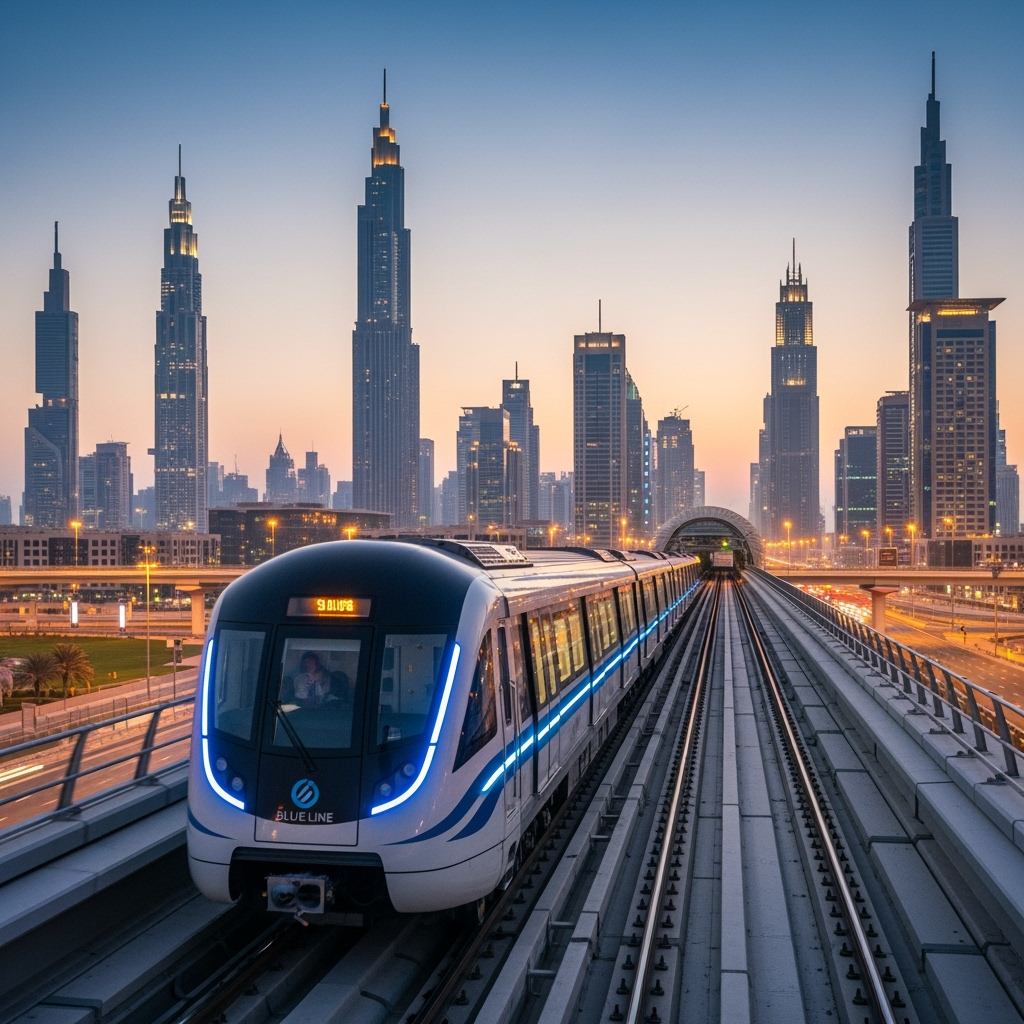
The Dubai Metro is rapidly advancing towards the completion of its Blue Line, with exciting new details unveiled on Monday. Featuring a futuristic design, the world’s tallest metro station, and the first Metro line crossing Dubai Creek, anticipation for the project is building.
Slated to open in just four years, the Blue Line will connect the Green and Red Lines, linking residential areas to Dubai International Airport in a swift 20 minutes. It aims to reduce traffic congestion by 20% on the roads it serves and will also connect to Dubai Silicon Oasis, a key urban hub.
Today, the Dubai Ruler laid the foundation stone, signifying a new era for the emirate’s transportation sector. From routes to design, parking to key features; here’s everything you need to know.
Stations and Route
The Blue Line will connect to the Red Line at Centrepoint Station and the Green Line at Creek Station. Comprising 14 stations, it splits into two routes.
Stay updated with the latest news. Follow KT on WhatsApp Channels.
The first route, featuring 10 stations, begins at the Green Line’s Creek Station, passing through Dubai Festival City, Dubai Creek Harbour, and Ras Al Khor, before reaching International City 1, which includes an underground interchange station. It then extends to International City 2 and 3, Dubai Silicon Oasis, and Academic City.
The second route, with four stations, starts at the Red Line’s Centrepoint Station, goes through Mirdif and Al Warqa, and ends at International City 1 Interchange Station.
Alleviating Congestion and Connecting Communities
The Blue Line is strategically designed to serve residents where they need it most.
By reducing travel time, alleviating congestion, and connecting vital areas, the network aims to simplify daily commutes — benefitting students significantly.
The Blue Line links to Dubai Academic City, which is projected to host over 50,000 university students by 2029, and Dubai Silicon Oasis, a major urban center.
The new line will cut traffic congestion by 20% on its routes. Offering direct connections between Dubai International Airport and nine key areas, travel times will range from 10 to 25 minutes.
The project aligns with the Dubai 2040 Urban Master Plan, which envisions a ’20-minute city’ where over 80% of essential services are within a 20-minute reach for residents.
Size and Passenger Capacity
The Blue Line spans 30 km, with 21 km in the first route and 9 km in the second. Upon completion, Dubai’s rail network will expand to 131 km, featuring 78 stations and 168 trains.
The system is expected to accommodate over 850,000 passengers daily. By 2030, ridership is anticipated to reach 200,000 daily, increasing to 320,000 by 2040.
Naming Rights and First Station
Businesses have the opportunity to name a station on the Blue Line. During the groundbreaking ceremony, it was announced that Emaar secured the naming rights for the first station, Emaar Properties, for ten years starting from its official opening in 2029.
Future announcements will reveal naming rights for other Blue Line stations.
The first station is also the world’s highest metro station, designed by Skidmore, Owings & Merrill (SOM), the architects behind Burj Khalifa.
With glass ceilings, earthy tones, and a blend of stone and metal, the design embodies Dubai’s vision as a ‘gateway to the future.’
Community-Oriented Features
The stations offer parking, electric scooter racks, taxi stands, and areas for private car drop-offs and pick-ups, along with accessible parking for People of Determination. Charging points for electric vehicles are also available, ensuring seamless integration with other transport modes.
The Blue Line includes nine elevated stations and five underground stations. The exterior design of elevated stations draws inspiration from seashells, while the interior design reflects seven themes: Heritage, Earth, Air, Fire, and Water.
Economic Benefits
By 2040, the project is expected to achieve a benefit-cost ratio of 2.60 (Dh2.60 in benefits for every Dh1 spent), with total anticipated benefits exceeding Dh56.5 billion. These benefits include time and fuel savings, reduced accident-related fatalities, and lower carbon emissions.
The Blue Line is also expected to enhance property values near stations by up to 25%. It is Dubai’s first transport project to fully comply with green building standards, achieving Platinum Category certification.