The detailed evaluation for launching Dubai’s innovative self-driving, trackless tram system is set to be completed by mid-next year or as early as the first quarter of 2026. This update was exclusively shared by a senior official from Dubai’s Roads and Transport Authority (RTA) at Gitex Global 2025, according to Khaleej Times.
These advanced trackless trams are crucial for alleviating traffic congestion and accommodating Dubai’s expanding population. Integrated with the Dubai Metro, these eco-friendly, driverless electric trams will help achieve the ambitious goal of making 25% of Dubai’s transportation smart and autonomous by 2030, said Dawood Alrais, Director of Rail Maintenance Department at RTA’s Rail Agency.
Stay informed with the latest updates. Follow KT on WhatsApp Channels.
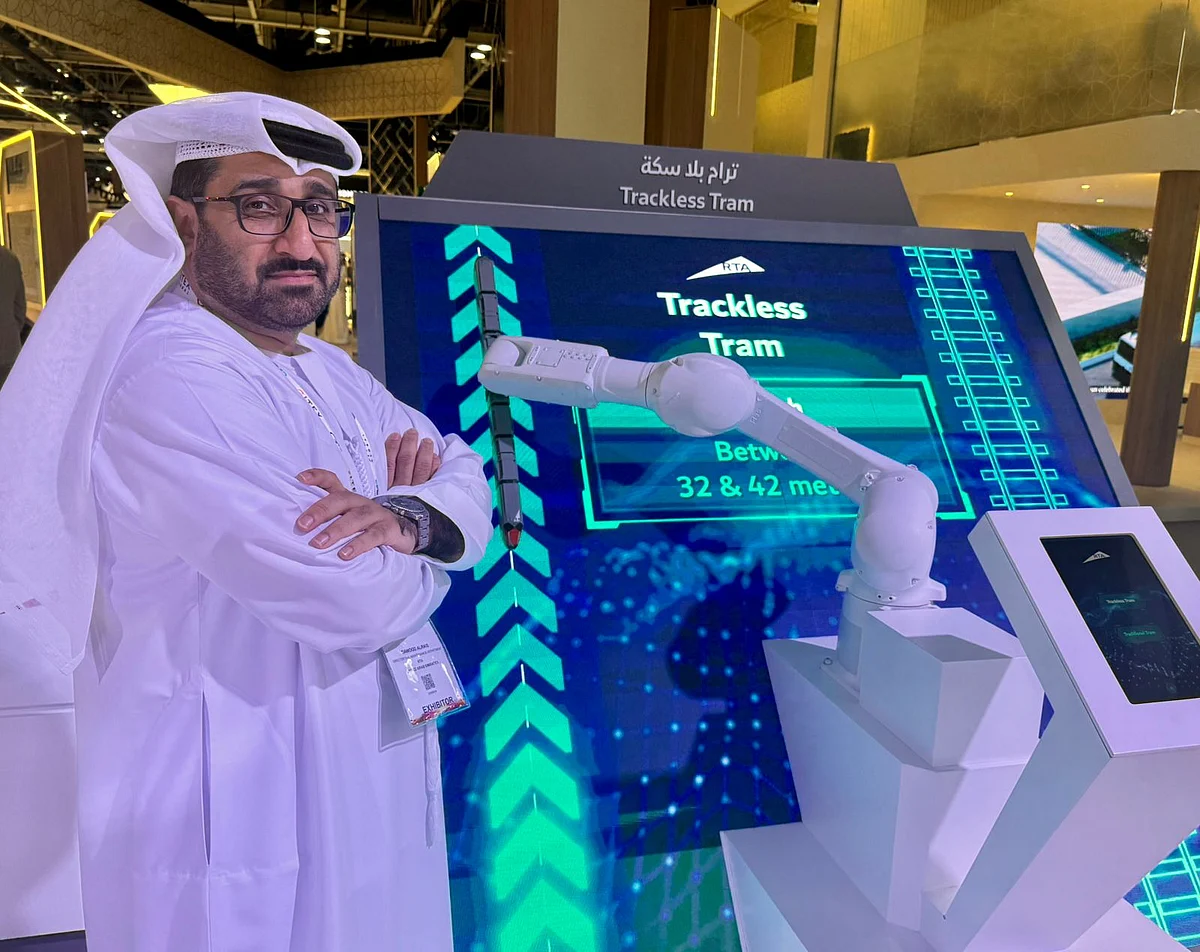
Photo: Angel Tesorero
Unlike traditional trams, including the existing Dubai Tram, trackless trams don’t require fixed rails. This flexibility allows them to navigate city streets using smart technologies like optical sensors, GPS, and LiDAR to follow a “virtual track” on highways or major roads.
The absence of fixed tracks means “virtual tracks” have a smaller environmental impact and lower maintenance costs compared to standard trams.
First revealed last November to mark the 10th anniversary of Dubai Tram, these trackless vehicles will operate alongside regular traffic. To ensure safety, Alrais mentioned that trackless trams will have dedicated lanes, similar to those for buses in certain Dubai areas.
Fixed routes, faster travel
Trackless trams will follow fixed routes with designated pick-up and drop-off stations, much like buses, but will carry over three times the capacity. Each tram will have three carriages accommodating 300 passengers.
With a width similar to regular buses (2.55 to 2.65 meters), these trams will range from 32 to 42 meters in length and are battery-powered, enabling travel up to 100 km on a single charge, almost enough to cover the distance between Dubai and Abu Dhabi.
Compared to the Dubai Tram, trackless trams will be faster, with a maximum speed of 70 km/h and an operating speed between 25 and 60 km/h. The Dubai Tram averages just over 20 km/h due to frequent stops and necessary slowing at junctions for safety.
Alrais highlighted that trackless trams are more adaptable, requiring only a 12-meter radius for turns, compared to 18 meters for traditional trams.
Initially, the trackless tram project was planned for eight locations across Dubai. However, Alrais hinted at the possibility of more, without specifying additional areas, confirming that the project aligns with the increasing demand for efficient public transit in Dubai.