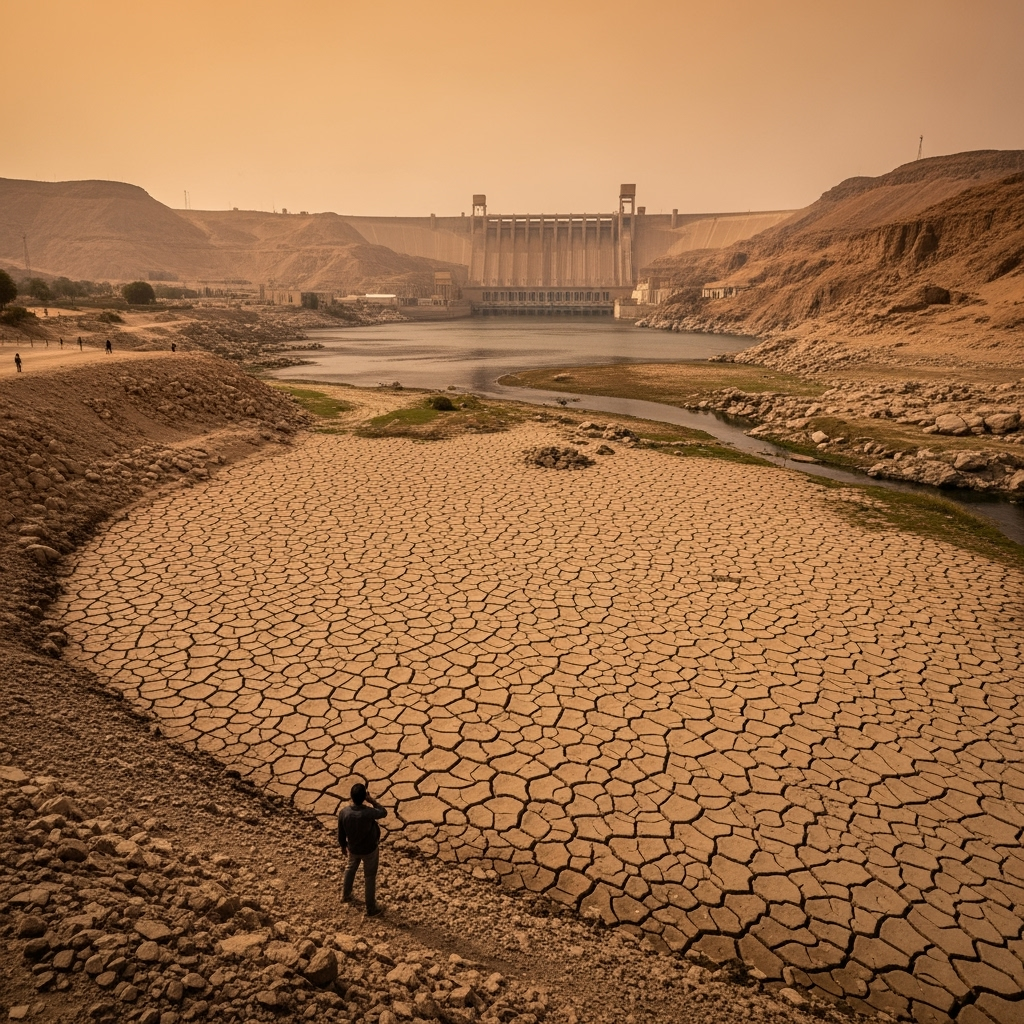
In a press conference today, Tuesday, he stated: “We deal with the issue of the Renaissance Dam as a source of existential threat,” affirming that “Egypt is for dialogue.” Abdel Aty emphasized enhancing water cooperation with the southern basin countries on the White Nile.
The Egyptian president earlier confirmed today, Tuesday, that “the water issue is part of the pressure campaign on Egypt to achieve other goals.” During a press conference with his Ugandan counterpart Yoweri Museveni, Sisi said, “The awareness and resilience of Egyptians are the main pillars to face any potential challenge or threat,” asserting that “Egypt rejects unilateral actions in the Eastern Nile Basin.”
The Egyptian president confirmed that “the volume of water in the White and Blue Nile Basin reaches 1,600 billion cubic meters annually,” noting that “a large part of the water is lost in forests, swamps, and groundwater, and only a small part reaches the Nile.”
Sisi explained that “Egypt speaks only about approximately 85 billion cubic meters, which is Egypt and Sudan’s share from Nile waters, representing only 4% of the total,” pointing out that “Egypt does not have other water resources and does not receive large amounts of rainfall. If we give up this part, it means giving up our lives.”
Addis Ababa is preparing for an official ceremony next September to celebrate the inauguration after Ethiopian Prime Minister Abiy Ahmed announced last July the completion of the dam’s construction by the end of this summer. Meanwhile, Egypt renewed its rejection of what it described as the “unilateral approach” adopted by Ethiopia in managing the dam project, considering that “the continued filling and operation of the dam without a legally binding agreement with the downstream countries is a blatant violation of international law.”
Egyptian Minister of Water Resources and Irrigation Hani Sewilam stated in previous comments that “the Ethiopian behavior poses a direct threat to the water interests of Egypt and Sudan and ignores the basic principles related to the fair and equitable use of shared water resources.”