The room is primarily occupied by men in immaculate white kanduras, with only a few foreign photographers dressed in black, their cameras clicking in rhythmic bursts as they lean against the wall. The atmosphere is quiet, with all eyes glued to the stage of the circular chamber. In one corner, a small group of women sits silently.
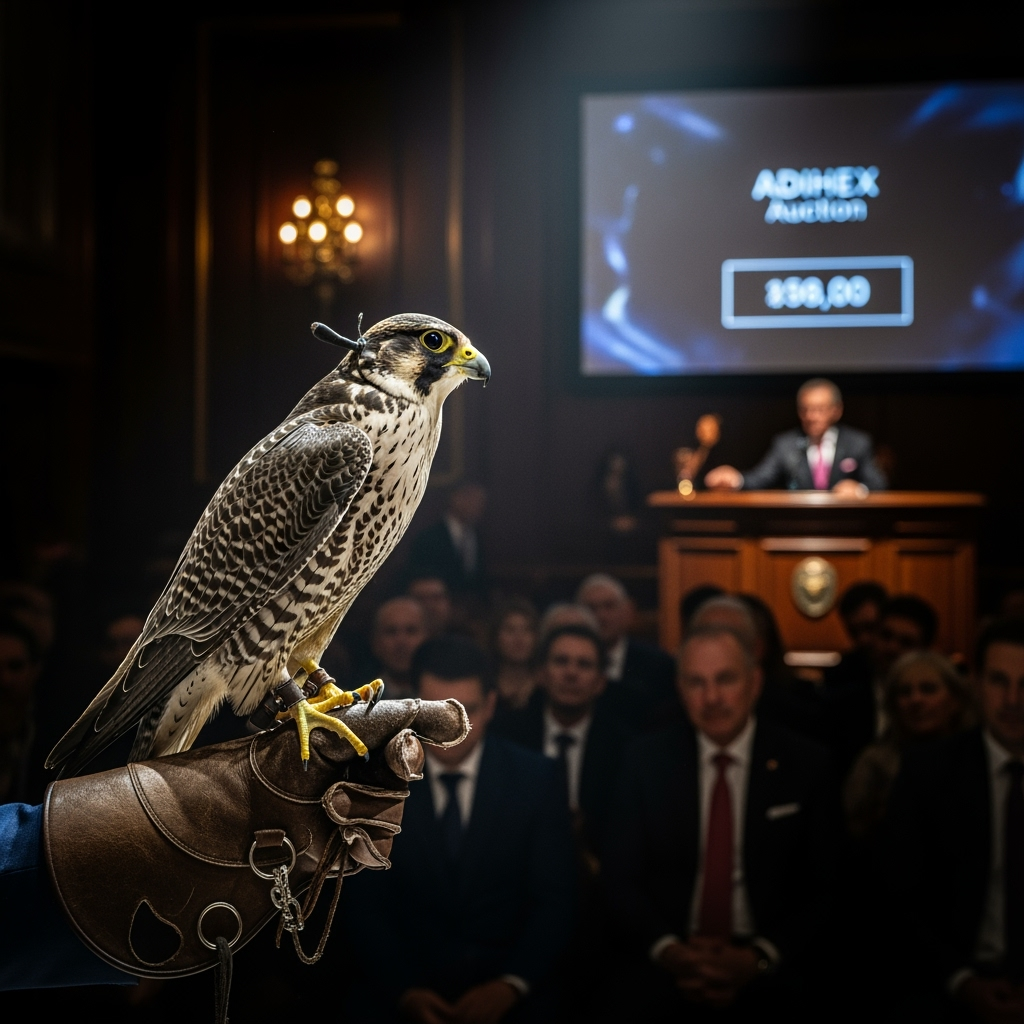
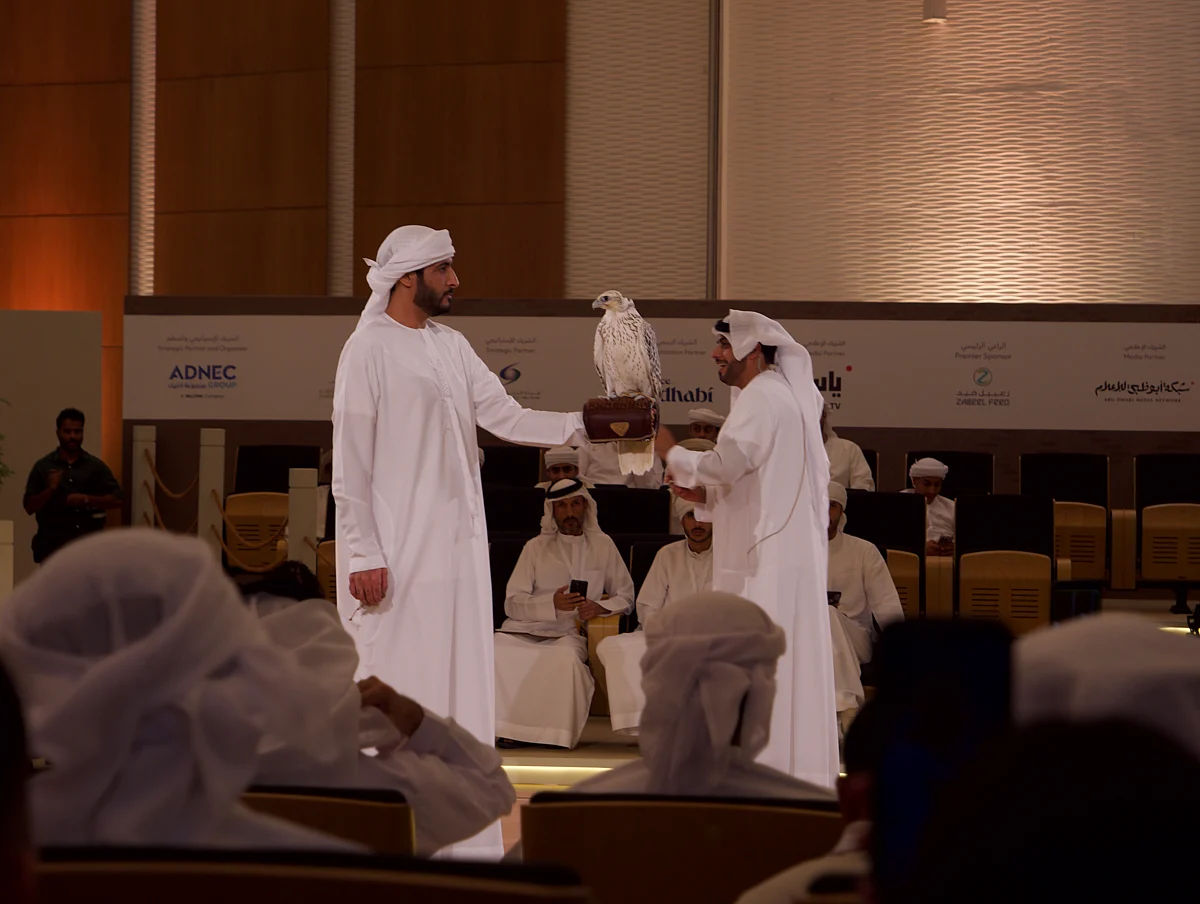
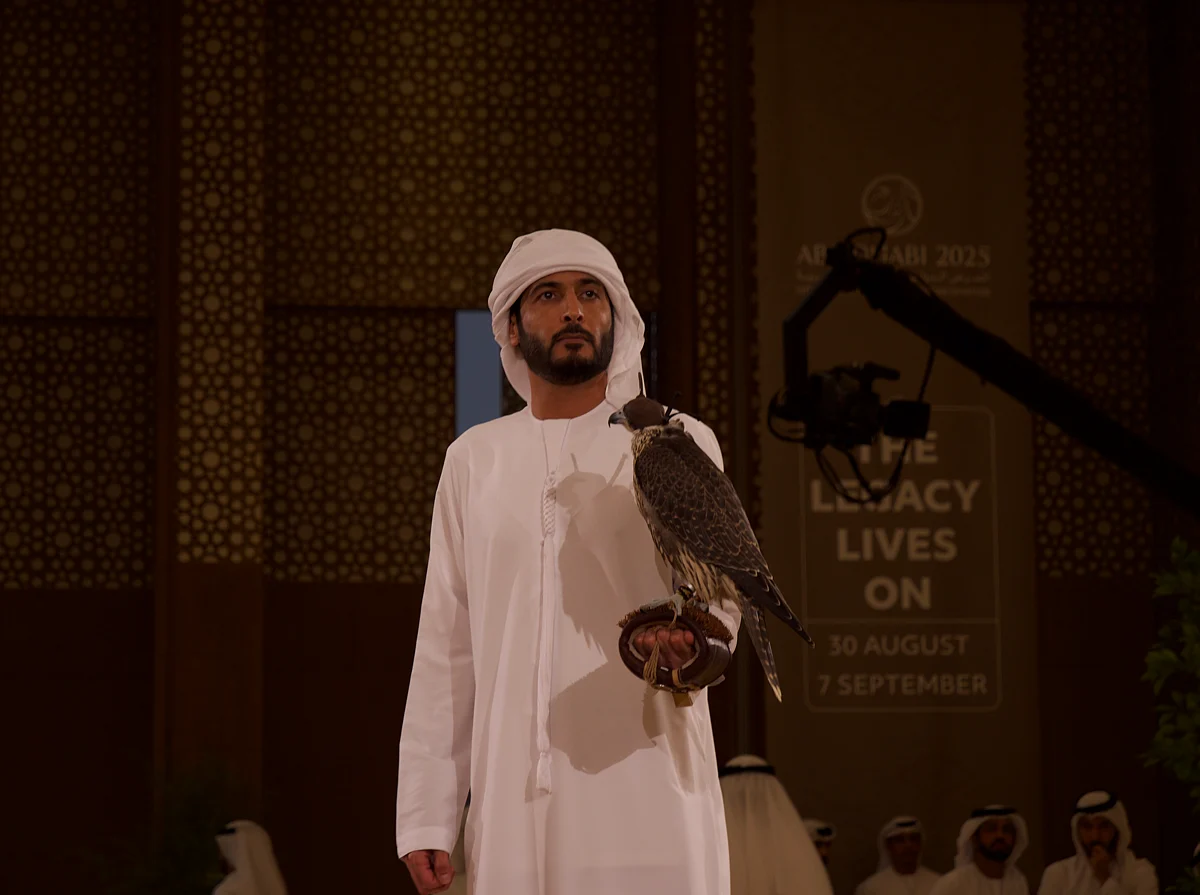
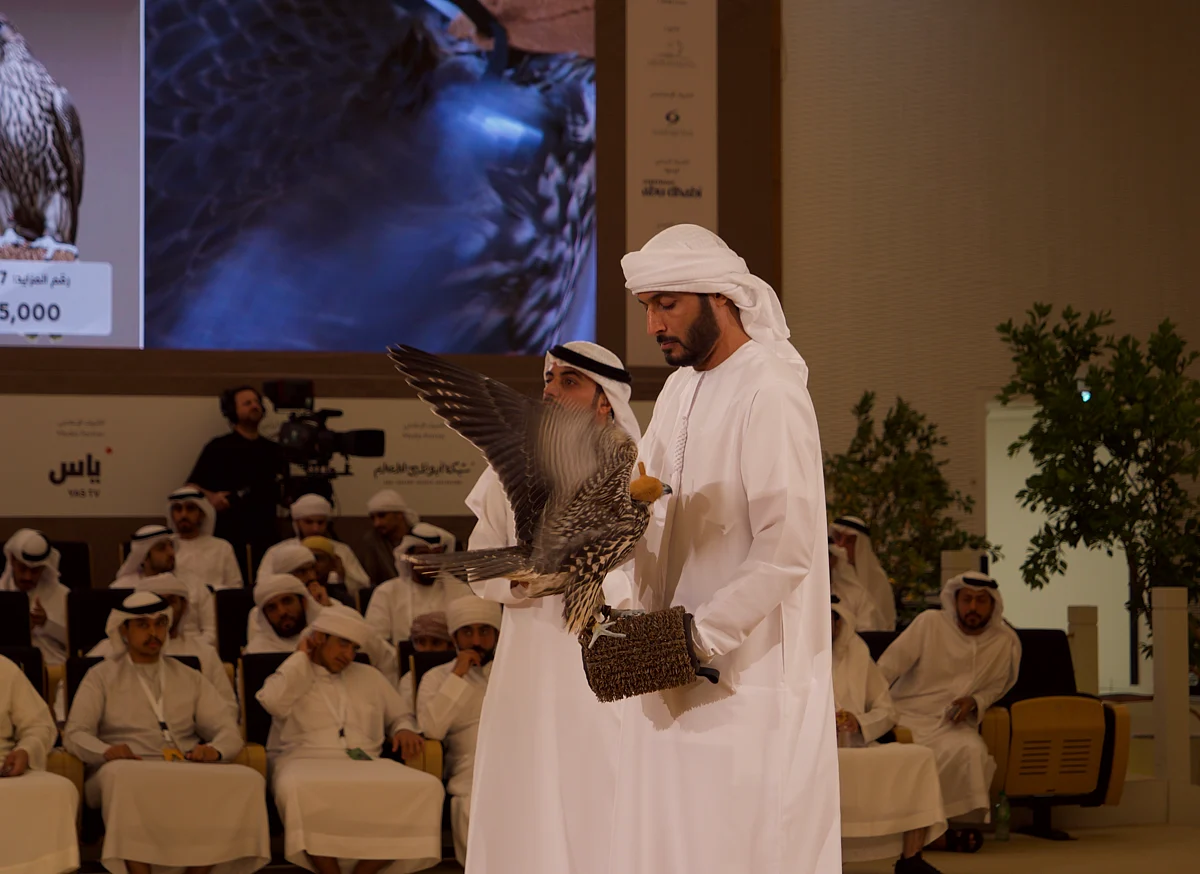
A handler steps into the center of the room with a young pure white Gyr falcon perched on his gloved arm. The auctioneer leans into the microphone, admiring the bird’s beauty as the room watches. It’s the seventh falcon of the evening. With a small white head and wings with brown patterns trailing into a darker tail, the falcon is a sight to behold. On either side of the small auditorium, two large screens display a live video of the falcon, allowing online bidders to follow along.
“Ah ya shabab,” the presenter starts, his voice deep and commanding — urging the young men. He announces the number repeatedly, sharp and insistent, waiting for the first paddle to rise. Bidding begins at Dh50,000 — already higher than the previous fledglings sold earlier for Dh20,000 or Dh30,000. The auctioneer repeats the number, projecting it into the room. A hand quickly raises, followed by another. The auctioneer double and triple checks the guests, asking who else. He repeats the last bid. The price climbs rapidly with each paddle raised. A few minutes pass before the gavel falls at Dh70,000.
This is just a moment in the annual ADIHEX falcon auction — the highlight of Abu Dhabi’s hunting and equestrian exhibition. This year’s exhibition, the 22nd edition, runs from today until September 7 at the ADNEC Centre. Over eight auction days, a select group of seven to eight birds competes for bids under bright lights. Virtual buyers must pay a refundable security deposit of Dh5,000 to participate, while those attending in person in Abu Dhabi must pay Dh50,000 to get an up-close view of the fledglings. Before bidding, all birds are displayed as a centerpiece in the foyer of the ADNEC centre, where guests must check in before the auction begins in a smaller room.
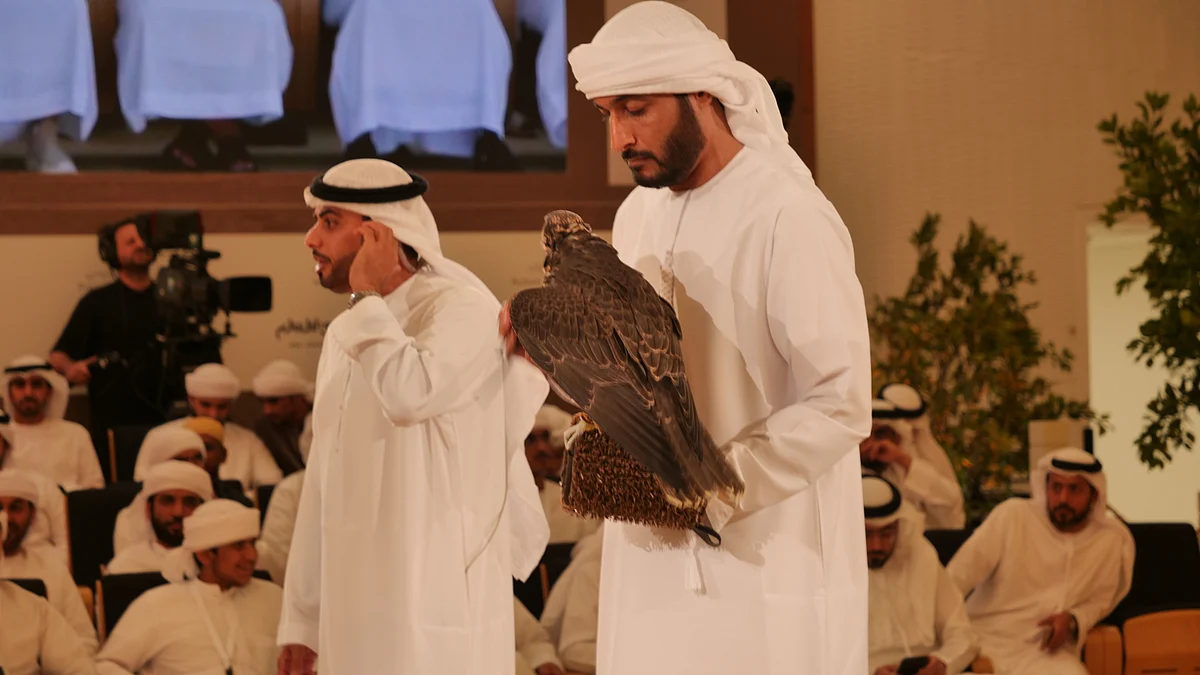
Saad Al Hasani, director of ADIHEX and head coordinator for the falcon sale, told KT LUXE that by the end of the night on August 23, when I attended, 40 falcons had been sold. “They have sold 40 falcons so far, totaling more than Dh1 million,” Al Hasani said, with only five more auctions to go.
The turnover is remarkable, with half a dozen birds sold in one evening and thousands of dirhams exchanging hands in a single night, distinguishing ADIHEX. This is the UAE’s only formal “elite” falcon auction, operated in partnership with the Emirates Falconers’ Club, held annually in Abu Dhabi. Around a thousand falcons are evaluated, but only a fraction make it to the floor. “All falcons are examined by a specialized committee that reviews the bird’s color and specifications, determining its suitability for the platform,” Al Hasani explained. The committee evaluates the health and integrity of each bird’s feathers, among other aspects. Notably, the rarity and uniqueness of the bird’s breed play a crucial role in its valuation.
“They wait for these birds from year to year for them to reach the market,” Al Hasani said about the saggars, or falcon trainers. It’s the exclusivity of the birds of prey, combined with the enthusiastic buyers, that gives the auction its significance.
In the spotlight, falcons, once hunters for Bedouin families, are now sold like rare art pieces. Buyers deposit funds just to raise a paddle, and prices rise relentlessly. In 2022, a rare Pure Gyr ultra-white from the US famously surpassed the Dh1 million mark, signaling a shift in the UAE’s falcon trade.
The auction offers a rare glimpse into how falcons are celebrated in Emirati culture, linked to lineage and identity, and how far they’ve come from the desert. This raises the question: is it still heritage, or has falconry fully transitioned into luxury and status?
For Anne-Lise Tropato, a researcher at NYU Abu Dhabi who has spent a decade studying the cultural and historical significance of falconry, the auction can never be simply about commerce.
“ADIHEX is, of course, a market, but it’s never only that,” Tropato said. “It has also become a gathering place for experts, practitioners, researchers, and professionals… It’s a diplomatic event as much as a commercial one.” While she acknowledges the strong luxury trade dimension in modern falconry, she emphasizes that institutions like ADIHEX help keep falconry visible and vibrant in the rapidly changing UAE society. “Good falcons have always been expensive,” Tropato noted. “In many parts of the world, falconry was the sport of kings,” she explained, highlighting its presence in Europe, at the Abbasid court in Baghdad, and in imperial China. However, for Bedouins in the Gulf, and in nomadic tribes before the UAE’s formation, it wasn’t closely tied to nobility and wasn’t based on trade.
ADIHEX
“Falconry for the Bedouins was primarily about survival. I recall a falconer in Abu Dhabi once told me something unforgettable. Speaking about the past, he said, ‘We humans owe our falcons our lives.’ And it’s true, in the desert, where conditions were harsh, falcons helped people secure food. That bond was absolutely vital,” Tropato said.
But she also clarifies that today’s falconry is not a straightforward continuation of tradition. “Buying and selling falcons at very high prices is not something rooted in Bedouin practice; it’s an imported model, more familiar from other parts of the world,” Tropato said. The spectacle of modern auctions brings a different logic.
“What worries me now is the risk of homogenization, of flattening falconry into one globalized image of luxury birds, instead of recognizing the diversity of traditions and meanings it has carried across cultures,” Tropato said, noting that auctions like ADIHEX risk oversimplifying what falconry has represented over centuries.
Natalie Koch offers another perspective. Koch is an assistant professor of geography at Syracuse University’s Maxwell School and author of the study Gulf Nationalism and the Geopolitics of Constructing Falconry as a Heritage Sport. She became interested in the subject while researching links between Central Asia and the Gulf, but as a scholar of sports geography, she was intrigued by how falconry fits into the region’s broader politics of heritage and identity. She describes falconry in the UAE as an “invented tradition,” in the sense that today’s practice has been formalized and promoted as part of nation-building. “An invented tradition is essentially a concept that nationalism scholars have given to any number of national practices,” Koch explained. Falconry, she explained, shifted from being woven into Bedouin daily life to a practice that’s now organized and institutionalized. Today, the UAE is full of falconry groups and clubs, built to formalize what was once part of everyday desert survival.
“There’s also, I would say, more investment in some of the transactional global efforts to preserve falconry culture. The UAE was one of the major backers of falconry’s UNESCO heritage status,” Koch noted. That designation helped cement falconry not just as global heritage but also as a central piece of Emirati national identity. “In order to preserve that national heritage, you have to be able to project it forward… in the face of Emirati diversity and with lots of different types of people living in the country, falconry becomes a thread to ensure that national culture is brought from the past to the future.”
Regarding falcon auctions like the one at ADIHEX, Koch said there’s always going to be a commercialization of certain heritage or traditional practices, “but I don’t think it necessarily undermines it.”
Al Hasani stated: “In the UAE, our emblem is the falcon. This is part of our heritage, not a luxury. Our ancestors were accustomed to hunting with falcons, as [the bird] was their companion, the fencing. Therefore, adopting falcons is part of our heritage and popular tradition.”
But while the symbolism is powerful, the market aspect is undeniable. The falcon trade is challenging to track, but the Observatory of Economic Complexity (OEC) provides a rare insight into the numbers. With the latest historical figures released last month, the scale becomes clear. In 2023, the UAE imported about $8.16 million (Dh29 million) worth of live birds of prey, making it one of the top markets globally. Meanwhile, the UK led exporters at approximately $5.94 million (Dh21 million). Total global trade reached just $19.2 million (Dh70 million) that year, indicating the Emirates accounted for a significant share.
This aligns with what is happening on the ground in Abu Dhabi. Last year, ADIHEX held its most extensive edition yet, transforming into a full-scale marketplace for the country’s heritage industries. Over nine days, 325 birds were exchanged for a combined Dh5.4 million, with 302 falcons earning the coveted ADIHEX badge qualifying them for the UAE President’s Cup.
Determining who exactly buys these birds is more challenging. Breeders, falconers, and traders dominate, but their motivations differ. Some buyers still seek falcons for the traditional art of bonding and training. Others showcase their falcons in flying competitions, such as the Liwa flying falcon race in the UAE’s Moreeb Dune area.
Some buyers frame their purchases as support for captive-breeding, viewed as a more ethical alternative to trapping wild birds on migration routes. Others come from outside the falconry world altogether. Tourism operators have begun buying falcons too, showcasing them in demonstrations. For instance, Abu Dhabi-based Qasr Al Sarab Desert Resort by Anantara offers falcon handlers who showcase the birds, using them as living emblems of Emirati tradition.
At auctions, individual buyers tend to remain quiet, reluctant to speak with the media, preferring to keep their reasons and investments private. That silence hints at something larger. As Koch observed: “There are certain cultural traditions that Emiratis have lost or that have become quieter today, and people want to ensure they don’t disappear entirely.” Engagement at falcon auctions indicates a sentiment among Emiratis that this is something valuable to invest in and contribute to; however, it remains deeply personal for most.
Koch emphasized that falconry is being introduced to younger generations through schools, clubs, and outreach at ADIHEX. “I don’t know if I’d call it democratizing,” she said about the institutionalization of falconry, “but there’s an effort to open up the community and get kids interested in the tradition.”
For sellers and breeders, being vocal about their trade is a different story. Take Hadi Saeed Almansoori, owner of Al Thumama Auctions and KH Falcon, who says: “I grew up with birds. My life and journey with birds began at a young age — approximately six or seven years — before I entered school.” What began as a childhood passion evolved into a business.
Al Thumama Bird Auctions is Almansoori’s year-round falconry marketplace in Abu Dhabi. It doesn’t match ADIHEX’s scale and doesn’t compete with it. The annual exhibition remains the marquee event, but Al Thumama offers a platform for local and international breeders to trade year-round. Through KH Falcon, his breeding and training arm, Almansoori also works on captive breeding, crossbreeding, and rehabilitating birds.
He has been a regular at ADIHEX for years, but this season marked one of his biggest successes. “We successfully sold a purebred falcon that I own last week for Dh350,000, along with several other birds for various amounts,” he said.
Almansoori’s sale is proof that the auction floor isn’t just heritage on display, but also serious business. As the UAE modernizes and positions itself as a global hub, falconry provides a link between the present and the past, and between “rapid development and deep-rooted tradition,” Tropato explained.
While high price tags on jewels or vintage cars are often seen as ostentatious displays of wealth, a falcon, on the other hand, signifies more than wealth, Tropato explained. “Owning and flying a falcon isn’t just about showing social status, it’s also about demonstrating that you embody certain virtues, that you value endurance, respect, and harmony with nature,” she said.
However, Tropato says that preserving falconry has instilled certain values not just in handlers but in their communities. Caring for and training a falcon shapes ideals of patience and integrity due to the commitment required. “What we really need is more research, more outreach, more storytelling about the richness of falconry’s cultural history,” she said.