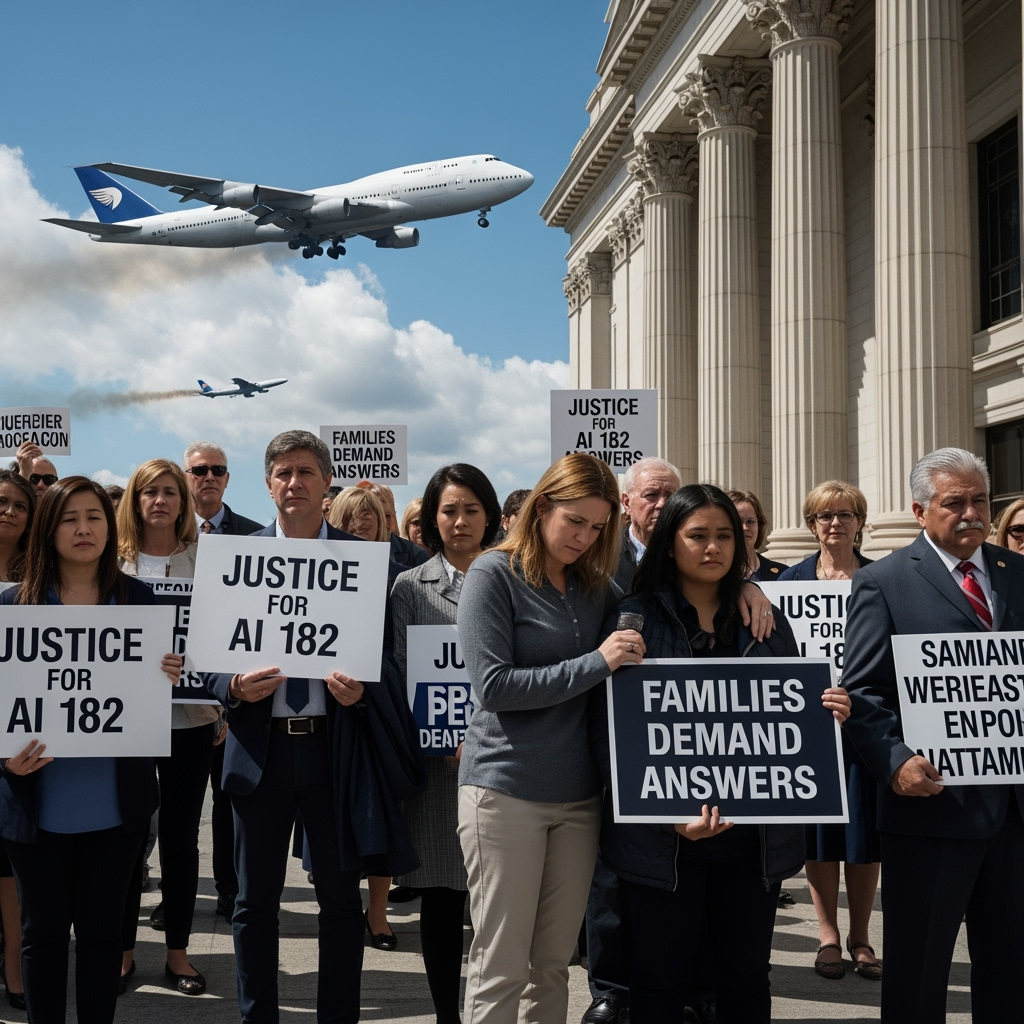
The families of four victims from the June crash of Air India Flight 171 have filed a lawsuit against Boeing and Honeywell, citing negligence and a defective fuel cutoff switch as the cause of the accident that claimed 260 lives.
Flight 171 crashed shortly after takeoff from Ahmedabad to London on June 12.
The lawsuit was filed on Tuesday in Delaware Superior Court, alleging that the locking mechanism for the switch on the Boeing 787-8 Dreamliner could be inadvertently turned off or missing, leading to a loss of fuel and thrust necessary for takeoff.
Stay informed with the latest news. Follow KT on WhatsApp Channels.
The plaintiffs assert that Boeing and Honeywell, who respectively installed and manufactured the switch, were aware of this risk, particularly after the US Federal Aviation Administration warned in 2018 about disengaged locking mechanisms on several Boeing planes.
The complaint stated that by placing the switch directly behind thrust levers, “Boeing effectively ensured that routine cockpit activity could accidentally cut off fuel.” It added, “What actions did Honeywell and Boeing take to prevent such a disaster? None.”
Boeing, headquartered in Arlington, Virginia, declined to comment on Wednesday, while Honeywell, based in Charlotte, North Carolina, did not immediately respond to requests for comments. Both companies are registered in Delaware.
This lawsuit is reportedly the first in the US concerning the crash.
It seeks unspecified damages for the deaths of Kantaben Dhirubhai Paghadal, Naavya Chirag Paghadal, Kuberbhai Patel, and Babiben Patel, who were among the 229 passengers who perished.
Twelve crew members and 19 people on the ground also died. One passenger survived. The plaintiffs are citizens of India or the UK and reside in those countries.
Investigators from India, the UK, and the US have not definitively identified the crash’s cause. A preliminary report by India’s Aircraft Accident Investigation Bureau in July suggested cockpit confusion before the crash. Also in July, US FAA Administrator Bryan Bedford expressed “high confidence” that a mechanical issue or accidental fuel component movement was not the cause. Boeing has faced over $20 billion in legal and other costs from two fatal 737 MAX crashes in 2018 and 2019. The aircraft was grounded for 20 months.
The case is Paghadal et al v Boeing Co et al, Delaware Superior Court, No. N25C-09-145.