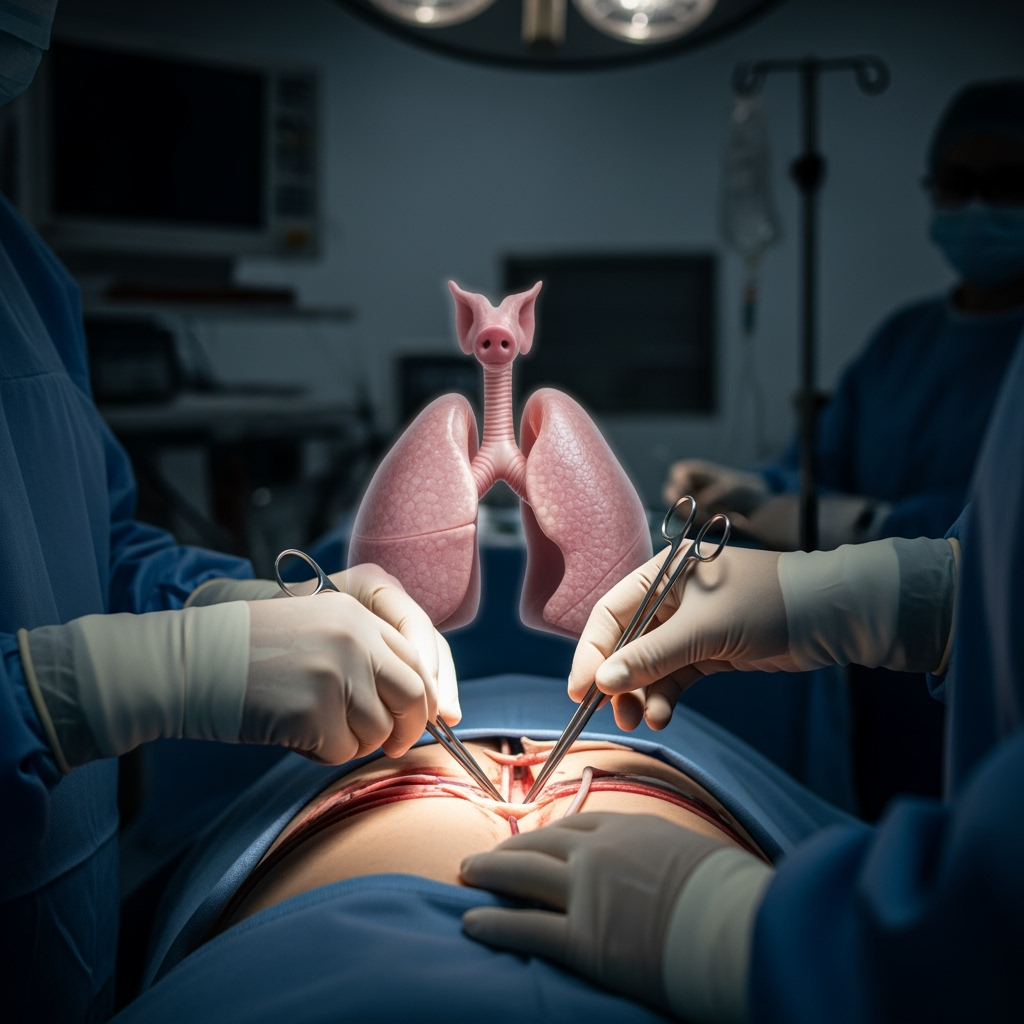
The experiment was conducted at the hospital affiliated with Guangzhou Medical University in China. The patient showed increasing signs of organ rejection before scientists decided to end the experiment, allowing the patient to pass away completely, according to ‘Science Alert.’ Surgeon Jianxing He from Guangzhou Medical University led a team to perform the procedure. The goal was not to achieve a successful transplant on the first try, but rather to monitor the patient’s immune response to the transplanted organ.
The patient was a 39-year-old man who was declared brain dead after a brain hemorrhage, and his family provided written consent for the experiment of transplanting a pig lung from the ‘Bama minipig’ breed, genetically modified with six genetic alterations using CRISPR technology to reduce immune and inflammatory responses in the patient.
The pig’s left lung was implanted into the patient’s chest cavity and connected to his airways, arteries, and veins. Initially, there were no immediate signs of acute rejection in the first hours after the operation. However, after 24 hours, severe swelling was observed, possibly due to the restoration of blood flow to the transplant site. Immune rejection caused additional damage on days three and six, leading to primary dysfunction of the transplanted organ, an acute lung injury occurring within 72 hours of transplantation and a leading cause of death in lung transplant patients.
By the ninth day, the lung began to partially recover, but the experiment was concluded. The experiment demonstrated the possibility of transplanting a pig lung into a human without immediate acute rejection, marking an important first step. Researchers emphasized the importance of preventing primary dysfunction of the transplanted organ in future lung transplants due to the early appearance of pulmonary edema (swelling).
They highlighted the need to improve immunosuppression systems, prepare genetic modifications, enhance lung preservation strategies, and evaluate long-term organ functions. This study provides crucial insights and genetic challenges to overcome, paving the way for further innovations in this field. This marks the first time a pig lung has been transplanted into a human, representing significant progress and posing new challenges for scientists to solve to develop this emerging medical technology.
Patients in need of organ transplants face a significant shortage of available human organs. To address this problem, doctors are exploring the possibilities of transplanting organs from genetically modified animals, especially pigs. These organs are not a permanent solution but are used as a ‘temporary bridge’ until a human organ becomes available. Clinical trials using pig kidneys and livers have shown promising results, but more development is needed. The lung is a complex challenge in organ transplantation due to its direct exposure to the external air, requiring it to be a primary line of defense against airborne pathogens and particles.