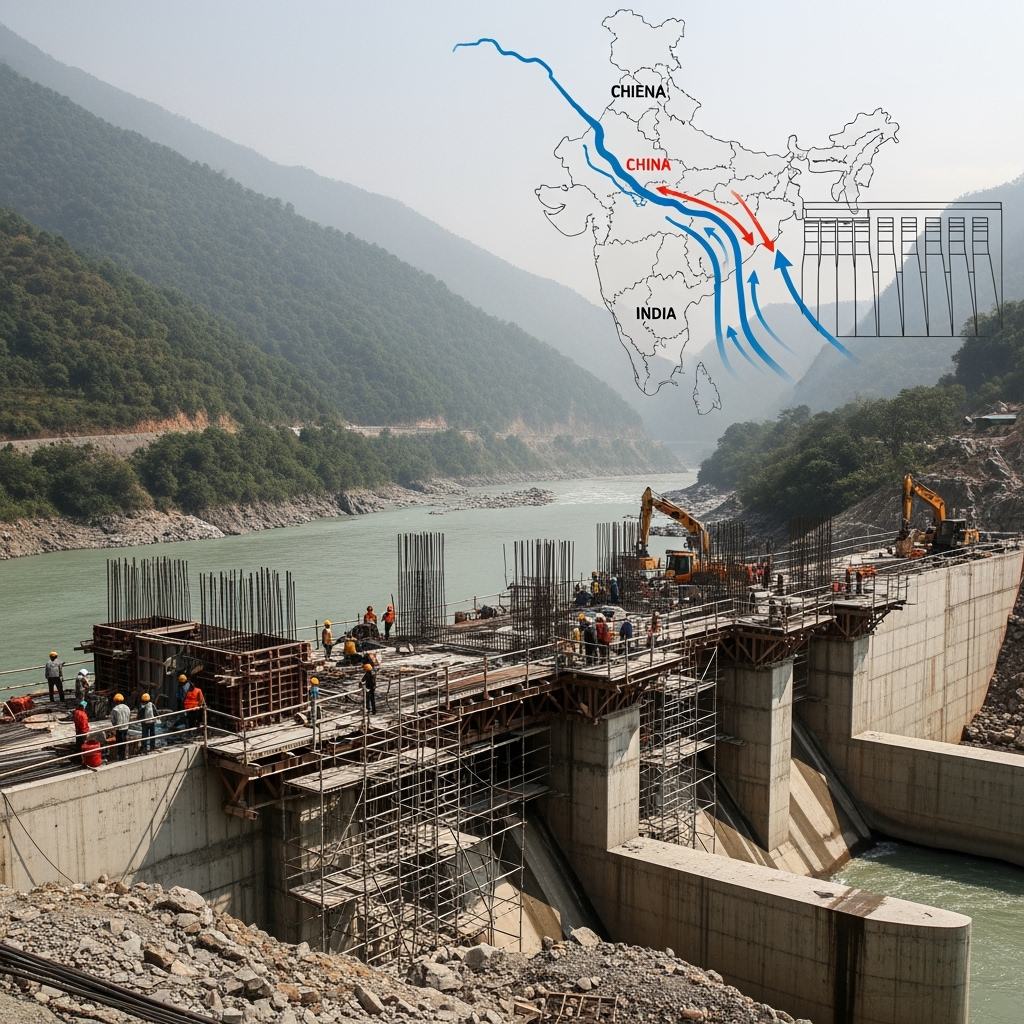
India is concerned that a proposed Chinese mega-dam in Tibet could decrease water flow in a key river by up to 85% during the dry season, according to four sources and a government analysis reviewed by Reuters. This has led Delhi to expedite its own dam construction plans to counteract these impacts.
Since the early 2000s, the Indian government has been exploring projects to manage water flow from Tibet’s Angsi Glacier, which supports over 100 million people downstream in China, India, and Bangladesh. However, these initiatives have faced strong opposition, sometimes violent, from residents of Arunachal Pradesh, who fear their villages and way of life may be destroyed by the dam.
In December, China declared its intention to build the world’s largest hydropower dam near the border, just before the Yarlung Zangbo river enters India. This announcement heightened fears in Delhi that its strategic rival, which has territorial claims in Arunachal Pradesh, might use its control of the river as a tool against India. The river, originating from the Angsi Glacier, is known as the Siang and Brahmaputra in India.
In May, India’s largest hydropower firm moved survey materials to a potential site for the Upper Siang Multipurpose Storage Dam, under police protection. This proposed dam would be India’s largest if completed. High-level meetings, including one led by Prime Minister Narendra Modi’s office, have been held to speed up construction, according to two confidential sources.
Concerns from Delhi are detailed in an undated Indian government analysis of the Chinese dam’s potential impact, corroborated by Reuters’ four sources. Beijing has not disclosed detailed plans for the dam, but the analysis is based on data from Indian institutions like the Central Water Commission and the expected size of the Chinese project, which began in July with an estimated cost of nearly $170 billion.
Delhi predicts the Chinese dam could allow Beijing to divert up to 40 billion cubic meters of water, over a third of the annual flow at a key border point. The impact would be most severe during non-monsoon months when temperatures rise and lands become barren in India. The Upper Siang project, with its expected 14 BCM storage capacity, could mitigate this by releasing water during dry periods. This could reduce the impact on Guwahati, a major city reliant on water-intensive industries, from 25% to 11% if the Indian dam is built.
The project could also counteract any sudden water releases by Beijing, the sources said. If the dam’s water level is low, it could absorb excess water from a breach in Chinese infrastructure. India is considering keeping 30% of its dam empty to manage unexpected surges, according to two sources.
A Chinese foreign ministry spokesperson told Reuters that their hydropower projects follow rigorous scientific research on safety and environmental protection, ensuring no negative impacts on water resources, ecology, or geology for downstream countries. “China consistently maintains a responsible approach to developing transboundary rivers and maintains long-term communication and cooperation with downstream countries like India and Bangladesh,” the spokesperson added.
India’s foreign ministry has stated that top diplomat S. Jaishankar raised concerns about the dam with his Chinese counterpart on August 18. A deputy to Jaishankar informed lawmakers in August that the government is implementing measures to protect the lives and livelihoods of downstream citizens, including building the dam.
India has been accused by Pakistan, a Chinese ally, of using water as a weapon. Earlier this year, Delhi suspended participation in a 1960 water-sharing treaty with Islamabad and is considering redirecting another important river away from its downstream neighbor. An international tribunal has ruled that India must adhere to the agreement, but Delhi claims the panel lacks jurisdiction.
DEVELOPMENT OR DESTRUCTION?
In May, when NHPC workers moved survey materials near Parong village, locals damaged equipment, destroyed a nearby bridge, and looted police tents guarding the operation. Many protestors are members of Arunachal’s Adi community who rely on farms nourished by the Siang river.
Villagers have established makeshift watchposts on regional roads to prevent NHPC workers from accessing the area, forcing security personnel to trek miles under cover of night to reach potential dam sites. At least 16 Adi villages could be submerged, directly impacting around 10,000 people, according to two sources. Community leaders estimate the impact could affect over 100,000 people.
“Our farming sustains our families and educates our children,” said Odoni Palo Pabin, an Adi grocer and mother of two. “We will fight against the dam until the end.”
The dam has support from Arunachal’s chief minister, a member of Modi’s party, who calls the Chinese project an existential threat. The state government stated the project would “ensure water security and provide flood moderation against potential surges,” and in June, began detailed compensation discussions with affected families.
Lawmaker Alo Libang, representing a potentially submerged area, believes locals could be persuaded to relocate with adequate compensation. NHPC plans to spend over $3 million on education and emergency infrastructure to encourage relocation, three sources said, citing directives from Modi’s office.
Progress has been made, with three villages recently agreeing to let NHPC conduct dam-related work, according to the Arunachal government and local residents.
India has a history of activism against large dams, which has sometimes delayed or scaled down such projects. Even if approved, the Upper Siang dam could take a decade to build, meaning it might be completed after China’s project, expected to start generating power by the early-to-mid 2030s.
This delay poses a risk during construction if Beijing releases water during monsoon season, potentially washing away temporary dams, said two sources.
Experts and Adi activists warn that building large dams in seismically active Tibet and Arunachal increases risks for downstream communities. “The Chinese dam is being constructed in a high-seismicity zone prone to extreme weather events,” said Sayanangshu Modak, an expert on India-China water relations at the University of Arizona. “Such events trigger landslides, mudslides, and glacial lake outburst floods, raising legitimate safety concerns. India should engage with China,” he advised.