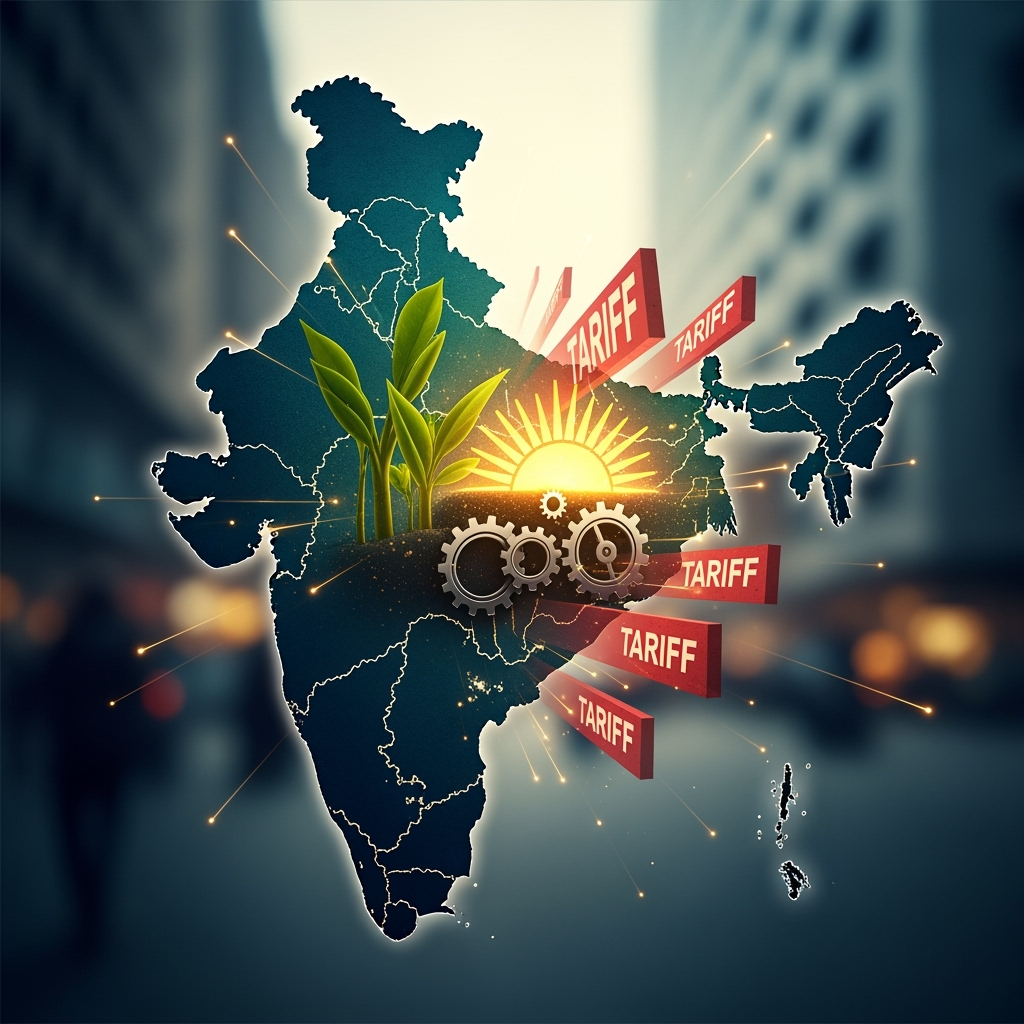
President Donald Trump’s decision to impose an additional 25% tariff, raising the total levy on Indian goods to 50%, has sparked strong criticism in New Delhi and apprehension among major industries.
However, rather than being a setback, this move could serve as a wake-up call for India to accelerate structural reforms, broaden its export markets, and solidify its role as one of the world’s most dynamic growth engines.
Former Niti Aayog CEO and G20 Sherpa Amitabh Kant aptly described the US action as “ironic,” emphasizing that this issue isn’t about Russian oil but about India’s energy security and strategic autonomy.
He stressed that India should not compromise its sovereign decision-making due to global pressures. Instead, he encouraged policymakers to seize this moment as an opportunity for once-in-a-generation reforms to bolster India’s resilience in an increasingly volatile global economy.
The tariffs, targeting sectors like textiles, leather, marine products, and gems and jewelry, are undeniably challenging.
Exporters are concerned about losing competitiveness in the US market, where India has established a strong presence over decades. Yet, economists and trade analysts insist that India is better equipped now than ever to withstand such challenges.
Unlike in the 1990s or early 2000s, India now has the strength of a $4.3 trillion economy (nominal GDP, 2025), ranking fourth globally, with projections to rise to third place this decade. The country’s macroeconomic fundamentals remain solid.
Growth in 2025 is expected to be between 6.5% and 6.8%, making India the fastest-growing major economy, according to the International Monetary Fund.
The World Bank has also highlighted India’s role as “the single largest contributor to global growth” through 2025–2026, driven by its expanding middle class and increasing consumption. Major consultancies and rating agencies remain optimistic.
Ernst & Young has projected that India is poised to become the world’s second-largest economy in purchasing power parity (PPP) terms by 2038, surpassing the European Union bloc. PwC forecasts that by 2030, India’s consumer market could be worth $6 trillion, fueled by urbanization, digital adoption, and an aspirational young demographic.
McKinsey underscores India’s emergence as the “nerve-center of global supply chains” as companies diversify beyond China, seeking resilient and cost-effective bases. These projections highlight why New Delhi views the tariffs not as an existential threat but as a catalyst to deepen its reform drive.
Policymakers are intensifying efforts on trade diversification, with expedited negotiations on free trade agreements with the EU, UK, Australia, and Gulf states. The recently concluded Comprehensive Economic Partnership Agreement with the UAE and the India-Australia Economic Cooperation and Trade Agreement are evidence of this momentum.
The structural shifts underway in the economy provide additional confidence. India is rapidly evolving into a manufacturing hub under its “Make in India” and “Atmanirbhar Bharat” programs, with electronics, renewables, defense, and pharmaceuticals attracting record investment inflows. Foreign direct investment reached $71 billion in FY2024, with global giants committing long-term capital.
Simultaneously, India is leading the clean energy transition, targeting 500 GW of renewable capacity by 2030, while also advancing in sunrise sectors like artificial intelligence, space technology, and green hydrogen. Amitabh Kant’s call to use this moment as a spur for reform reflects a broader consensus among Indian thought leaders that adversity often strengthens the country’s resolve.
Economists recall that the 1991 balance-of-payments crisis spurred the liberalization wave that transformed India into a global growth story. The current tariff challenge, while difficult, could similarly accelerate supply-side reforms, labor flexibility, logistics improvements, and export competitiveness. India’s critics warn that tariffs will inflict short-term pain on small exporters, particularly in labor-intensive sectors.
However, the government has responded swiftly with targeted credit lines, export incentives, and policy support to cushion the impact. Additionally, the rise of domestic demand offers a powerful buffer. With private consumption accounting for nearly 60% of GDP and rural recovery underway, India’s growth model is no longer overly reliant on external demand.
The broader message is clear: India is too large, too dynamic, and too strategically important to be sidelined in global trade. The country’s demographic dividend, with more than 65% of its population under 35, positions it as the world’s innovation and consumption hub for decades to come. International investors continue to see India as a rare bright spot, where growth prospects outweigh geopolitical risks.
The US tariffs may cause short-term difficulties, but they cannot derail the trajectory of a nation on the rise, economists argue. Instead, they may well propel India into taking bold steps that accelerate its progress towards becoming the world’s third-largest economic power before 2030 and the second-largest by PPP metrics within 15 years.
As the IMF recently observed, India “is not just participating in the global economy, it is shaping it.” The current standoff reveals not a story of vulnerability but of resilience.
India’s dynamic leap forward, reform momentum, and demographic strength ensure that it is uniquely positioned to turn challenges into opportunities. If history is any guide, the tariffs may end up reinforcing—not hindering—India’s rise as a global economic powerhouse.