“RESET SYSTEM” is scrawled in graffiti above a busy intersection in Yogyakarta, a city in Java, painted in bold green and pink after last week’s deadly protests in Indonesia.
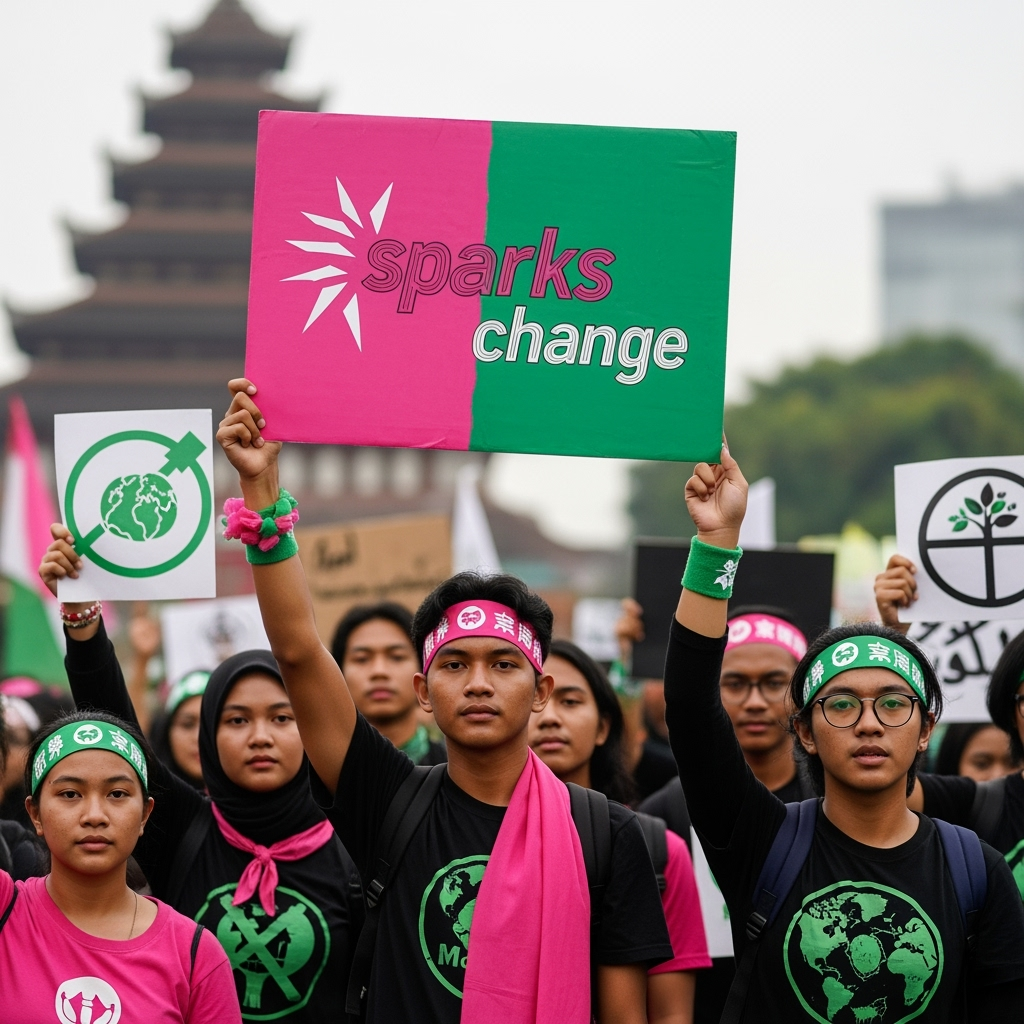
The colors pink and green have swiftly become symbols of a solidarity movement following violent protests driven by dissatisfaction over economic inequality and extravagant benefits for lawmakers in Southeast Asia’s largest economy.
In Jakarta, Dila, an office worker, paused to add a vibrant green and pink filter to her Instagram and WhatsApp profile pictures.
“What we need right now is solidarity among ourselves… as we still have a long journey ahead,” said 28-year-old Dila, who preferred not to disclose her surname.
Pink represents the hijab worn by a woman who protested outside the House of Representatives, defiantly waving the national flag in front of police.
Green has come to represent Affan Kurniawan, a 21-year-old delivery driver run over by a paramilitary police vehicle, fueling anger among workers facing significant pay cuts and longer hours.
Affan, wearing a bright green jacket typical of ride-hailing drivers in Indonesia, was killed while delivering food last Thursday.
“There has to be reform in our police force; impunity cannot continue,” Dila stated.
“This isn’t just about the current protests but an accumulation of past grievances.”
The demonstrations are the most significant unrest since President Prabowo Subianto, a former general and ex-son-in-law of dictator Suharto, took office less than a year ago.
‘Brave Pink, Hero Green’
The protest-born “Brave Pink, Hero Green” movement has pressured Prabowo and parliament to reconsider the perks that enraged Indonesians across the archipelago.
Those perks included overseas travel and housing allowances for MPs, nearly tenfold the Jakarta minimum wage.
Indonesia saw a growth surge in the year’s second quarter, driven by manufacturing and export demand.
Yet, everyday Indonesians don’t feel this, witnessing a corrupt political class enriching itself amid widening economic disparity.
“It’s the whole corrupt system; the gap between government and citizens is too vast,” Dila told AFP.
She and many others have embraced the “brave pink hero green movement” to raise awareness online, reaching those unaware or uninvolved in the protests.
Some create and design their images, while others use a free online image generator to modify their photos.
“Perhaps this is a way to remind people that this issue deserves attention,” Dila remarked.
‘We are not the problem’
A state-affiliated rights group reported at least 10 deaths and hundreds of injuries during the protests, while another NGO noted at least 20 missing persons.
The protests have subsided, and Prabowo, who called for calm, left Tuesday night for a major military parade in Beijing after delaying the trip.
Prabowo stayed back to address the demonstrations, describing some protesters’ actions as “bordering on treason and terrorism.”
Mutiara Ika Pratiwi of the women’s rights group Perempuan Mahardhika expressed dismay over Prabowo’s characterization of the protests.
“The people are not the problem. We have a right to protest because our voices have never been heard,” she told AFP.
“This goes beyond anger; it’s compassion evolving into a symbol of resistance,” Pratiwi said of the pink-and-green movement.
‘Crucial pillar’
Muhammad Dwiki Mahendra, 27, joined the movement from Germany, pursuing a master’s in peace and conflict studies.
“I believe this is a crucial pillar in countering the government’s narrative, which often claims community movements are manipulated by foreign forces,” he told AFP.
He criticized the government’s poor public communication, failing to address existing issues.
Change is possible, advocates of the pink-and-green movement say.
“I feel we are not alone when I see others using the same filter; it brings me joy,” said Sphatika Winursita, a 25-year-old from Banten province, who changed her Instagram profile on Monday.
“I’m proud we have each other to pursue our dreams.”