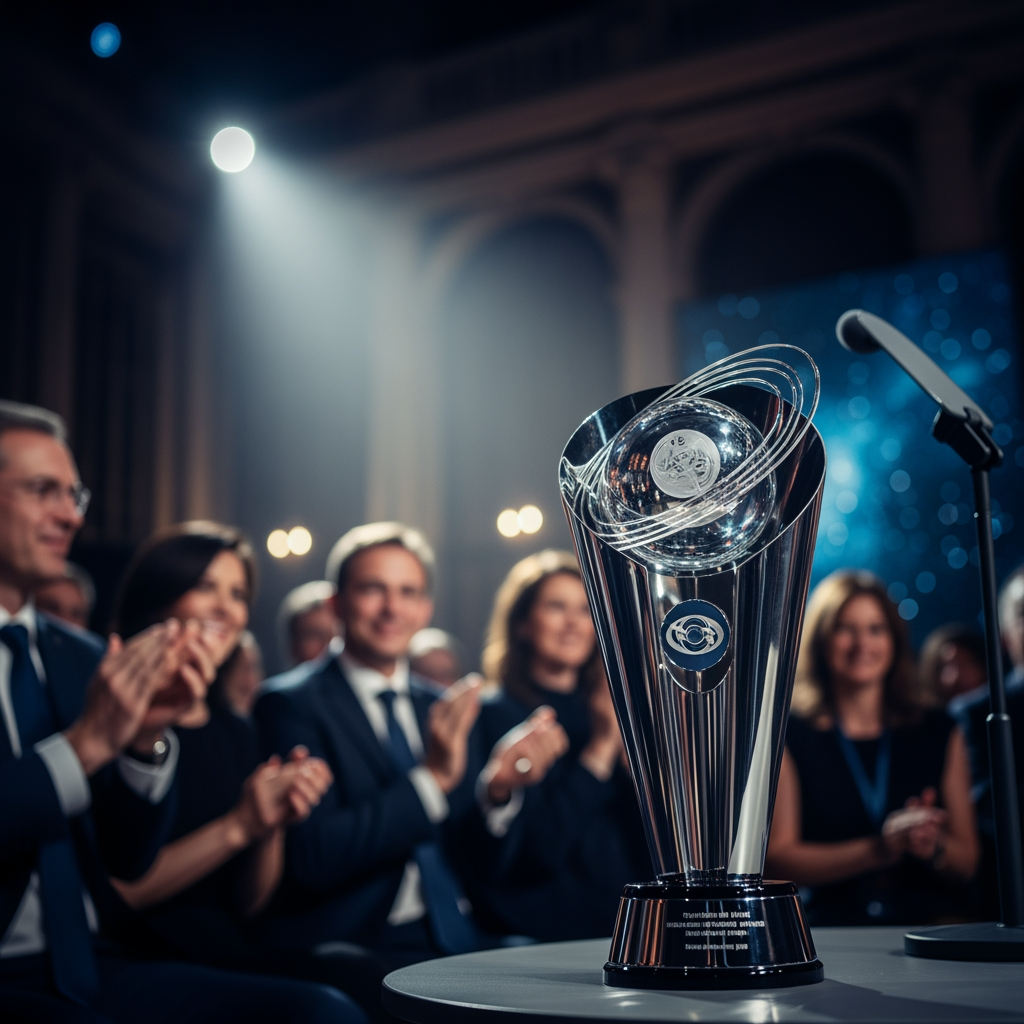
The event organizers confirmed that the award will become, after its success in the current edition, which attracted more than 2400 entries from around the world, including Russia, Africa, Asia, South America, Europe, and China. The total prize value was substantial. The ceremony was opened by Andrey Timonov, the Communications Director, affirming that the award represents a platform for dialogue, and the goal is not only to reward writers but to support ideas capable of changing the future.
He said, ‘Science fiction is a testing ground for the mind, where bold hypotheses are born. We have made an important decision: there will be a second international literary award in the field of science fiction.’ This announcement underscores the founders’ commitment to promoting literature that addresses future challenges with technological optimism.
During the event, a unique study conducted by the Public Opinion Research Center, a partner of the award, was presented. The study used techniques to analyze participants’ works. Konstantin Abramov, CEO of the center, revealed that most writers, despite cultural differences, share a pursuit for a common goal, emphasizing that modern science fiction is no longer limited to describing gadgets and spaceships but is concerned with ethical dilemmas and the relationship between mind and emotions.
The event was attended by prominent figures from literature, science, and culture, including a Russian writer, the head of the jury, who stressed the importance of the award in maintaining the generational connection between classic and contemporary science fiction pioneers. In his speech, he said, ‘The unique feature of science fiction is that it not only envisions the future but participates in shaping it. This is its greatest value, not only in literature but in life itself.’
The jury announced the winners in various categories, with the Colombian writer taking first place for his story in a specific category. In the Russian category, another writer won first place for his story. Additionally, awards were given by the partners, including a website award won by another writer and a publishing house award for a story by a female writer.
The CEO of the organizing foundation expressed her pride in hosting the event at the museum celebrating its second anniversary, affirming that science fiction has become a cultural necessity for envisioning a better future. She said, ‘It is only natural to celebrate the future here, in a place that combines science and culture. Authors embody the spirit of creativity that drives human progress.’
The ‘History of the Future’ award is the result of collaboration between the foundation and a company, with participation from the Russian Ministry of Education and Science and several major publishing houses, including AST and Alpina. Prose. The award aims to provide a positive model of future literature that connects technology with human values.
The public will be able to access the winning stories through a digital platform, with a special collection of winning works to be published by a publishing house soon. Thus, the evening in Moscow concluded with a confirmation that science fiction is no longer just a literary genre but has become a reality manifested in the words of writers who dream of a world where science serves humanity, not the other way around.