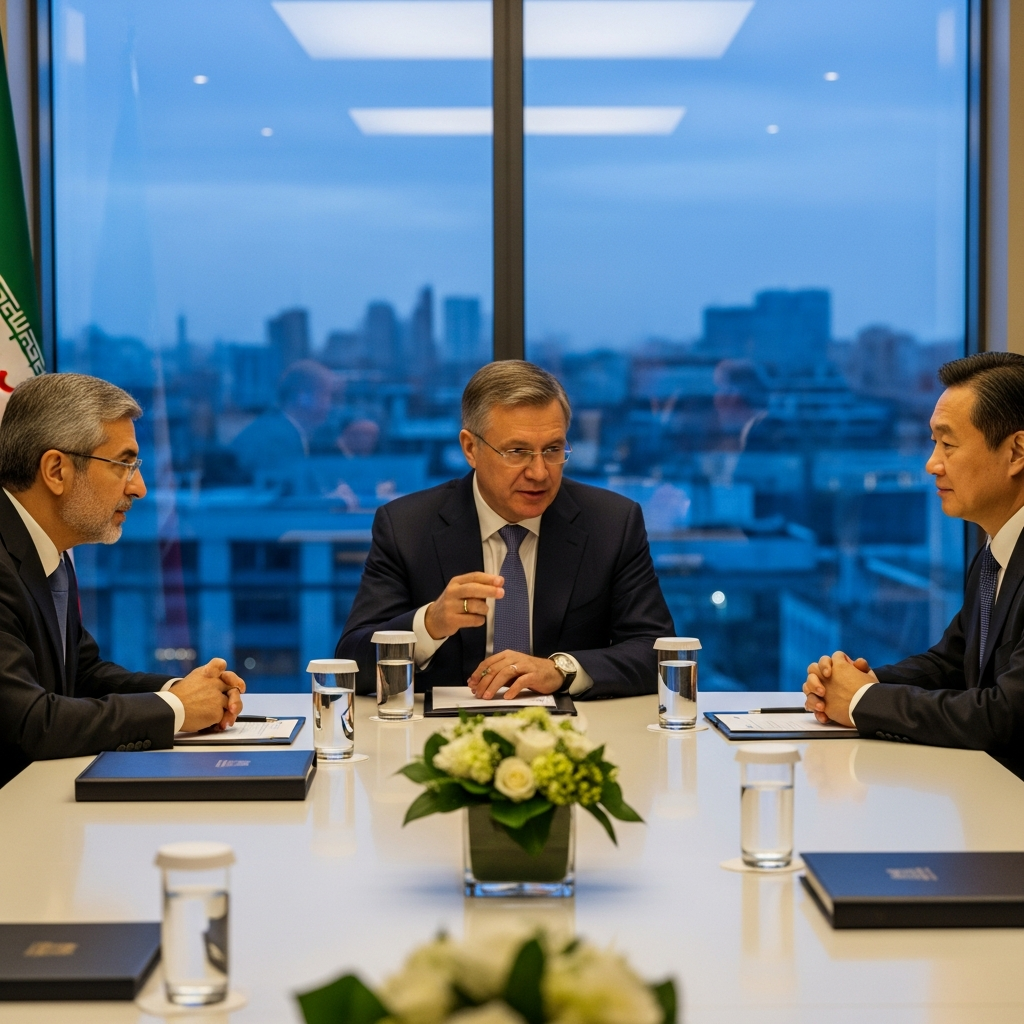
According to Iranian ‘IRNA’, the letter was signed by Amir Saeed Iravani, Iran’s permanent representative, Vasily Nebenzya, Russia’s permanent representative, and Fu Cong, China’s permanent representative. The letter stated that in response to the joint memorandum sent by the representatives of France, Germany, and the United Kingdom on November 20, 2025, the three countries recall the previous letter issued by the Foreign Ministers of Iran, China, and Russia on September 2, 2025, which clarified their position on the ‘snapback’ mechanism. The letter emphasized that this mechanism lost its validity for application to Iran following the United States’ withdrawal from the Joint Comprehensive Plan of Action (JCPOA) in May 2018 and its complete breach of the commitments contained therein, undermining the legal and political basis for the trigger mechanism without addressing this breach. The three countries reminded of a well-established principle in international law, affirmed by the rulings of the International Court of Justice, which states that a party that does not fulfill its commitments cannot claim the rights arising from those commitments.
Conversely, the letter stressed that Iran’s countermeasures, including suspending some of its commitments under the plan, came in response to the US withdrawal and the European troika and the EU’s failure to address the violation. Therefore, these actions cannot be considered a basis for activating the ‘trigger mechanism’. The letter also clarified that Resolution 2231 and the JCPOA are interconnected documents, and paragraph 11 of the resolution cannot be interpreted in isolation from Articles 36 and 37 of the plan. Therefore, the troika has no right to rely on paragraph 11 and initiate the ‘snapback’ process before completing the procedures required under Article 36, which has not occurred, according to the letter.
The three countries reaffirmed that all provisions of Resolution 2231 became null and void after October 18, 2025, and that fully terminating the resolution on time officially concludes the handling of the Iranian nuclear file in the Security Council, representing a step that enhances the credibility of the council and multilateral diplomacy. Iran, Russia, and China also renewed their commitment to constructive dialogue with council members and announced their readiness to support efforts aimed at ensuring the purely peaceful nature of the Iranian nuclear program. They called for adherence to political and diplomatic solutions based on mutual respect, avoiding unilateral sanctions and threats of force, and providing a conducive environment for the continuation of diplomatic efforts.
The three countries in the European Union (Germany, France, the United Kingdom) and the United States last week presented at a meeting of the Board of Governors of the International Atomic Energy Agency, which includes 35 countries, demanding Iran provide answers and allow access to its nuclear facilities and enriched uranium stockpiles that were bombed (last June). On the night of June 22, last year, the United States launched strikes on three Iranian nuclear facilities in Natanz, Fordow, and Isfahan, after Israel began a military operation on the night of the 13th of the same month, accusing Iran of executing a secret military nuclear program, targeting nuclear facilities, military leaders, and Iranian nuclear scientists.