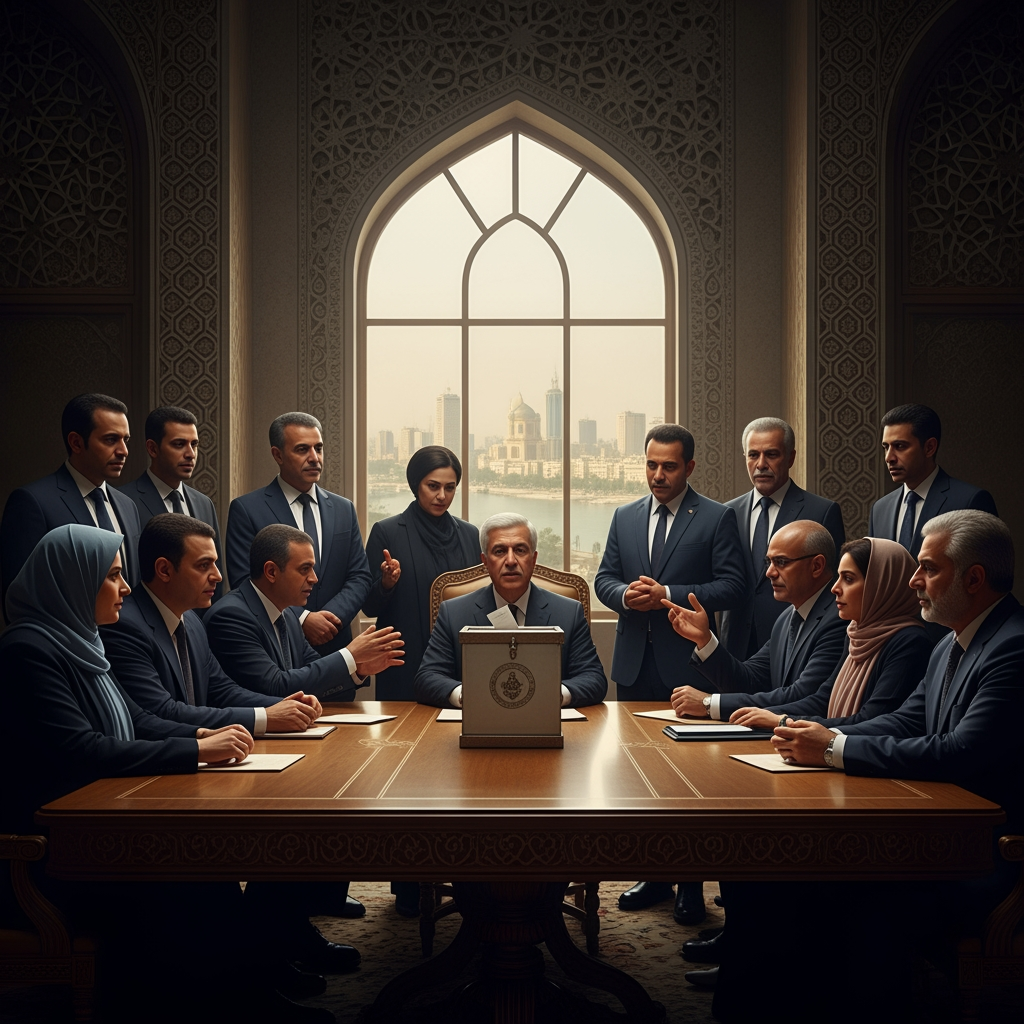
After Iraq’s recent parliamentary elections, the intricate process of appointing the country’s next leader is underway.
Current Prime Minister Mohammed Shia Al Sudani has declared victory for his coalition, as initial results indicate it is the largest bloc, though it lacks the majority needed to establish a government.
Sudani now faces the challenging task of garnering support from other parties, mainly from the Shia majority, to secure a second term.
With no single bloc dominating the upcoming parliament, significant parties might spend weeks or even months negotiating alliances to form the largest bloc and nominate the next prime minister.
Sudani ascended to power in 2022 through the Coordination Framework, an alliance of Shiite factions with varying ties to Iran.
While preliminary vote counts by province were released, seat allocations in parliament will be announced later.
Traditionally in Iraq, the prime minister is from the Shia community, the parliament speaker from the Sunni community, and the largely ceremonial presidency is held by a Kurd.
How is the government formed?
Appointing a prime minister and forming a government has traditionally been a challenging task involving extended political negotiations.
In past parliaments, Shia majority parties have reached compromises to collaborate and form a government, often sidelining main contenders.
Seats serve as bargaining tools, and newly-elected lawmakers can change allegiances.
With an outright majority nearly impossible to achieve by any single list, as seen in this week’s vote, the next prime minister will be chosen by the coalition that can gather enough allies to become the largest bloc.
Since the 2003 US-led invasion that ousted Saddam Hussein, only one prime minister, Nuri Al Maliki, has served two terms (2006-2014).
What are the possible outcomes?
Currently, no significant candidates have emerged apart from Sudani—although he was relatively unknown prior to his nomination.
A senior politician told AFP last month that the Coordination Framework is divided on supporting Sudani, with Maliki likely opposing a second term for the incumbent.
Long-term power brokers, including from the Coordination Framework, fear Sudani has gained too much power during his first term, making some hesitant to let him remain in office.
Sudani has also been accused of having members of his office wiretap politicians’ phones.
A source within a main party in the Coordination Framework told AFP that the alliance had previously agreed to regroup and create the largest bloc.
“They will appoint the next prime minister and participate in selecting the parliament speaker, his deputies, and the president,” the source stated.
What happened after previous votes?
In the 2010 election, former Premier Iyad Allawi’s bloc won the most seats, 91, closely followed by Maliki’s alliance with 89.
After months of disputes, political leaders reached an agreement, and Maliki was reappointed despite finishing second.
In 2021, influential Shia cleric Moqtada Sadr’s bloc won 73 seats, emerging as the largest, but still short of a majority.
His bloc withdrew from parliament after a dispute with other Shiite parties, leading to deadly confrontations in Baghdad.
Subsequently, influential parties united under the Coordination Framework to form a larger bloc, bringing Sudani to power.
What role do Tehran and Washington play?
For decades, Iraq has been a proxy battleground between the US and Iran, with government formation often influenced by these adversaries.
The next prime minister will need to maintain a delicate balance between their interests.
Since the US-led invasion, Iran has wielded significant influence in Iraqi politics and supports armed groups in the country, which have grown in political and financial power.
As Iran’s regional influence wanes, it seeks to maintain its power in Iraq and keep its market open to products from its struggling economy.
Meanwhile, Washington aims to diminish Tehran’s influence, urging Baghdad to disarm Iran-backed factions, many of which are labeled as terrorist groups.
Some of these groups will nonetheless hold seats in parliament and possibly in the government.