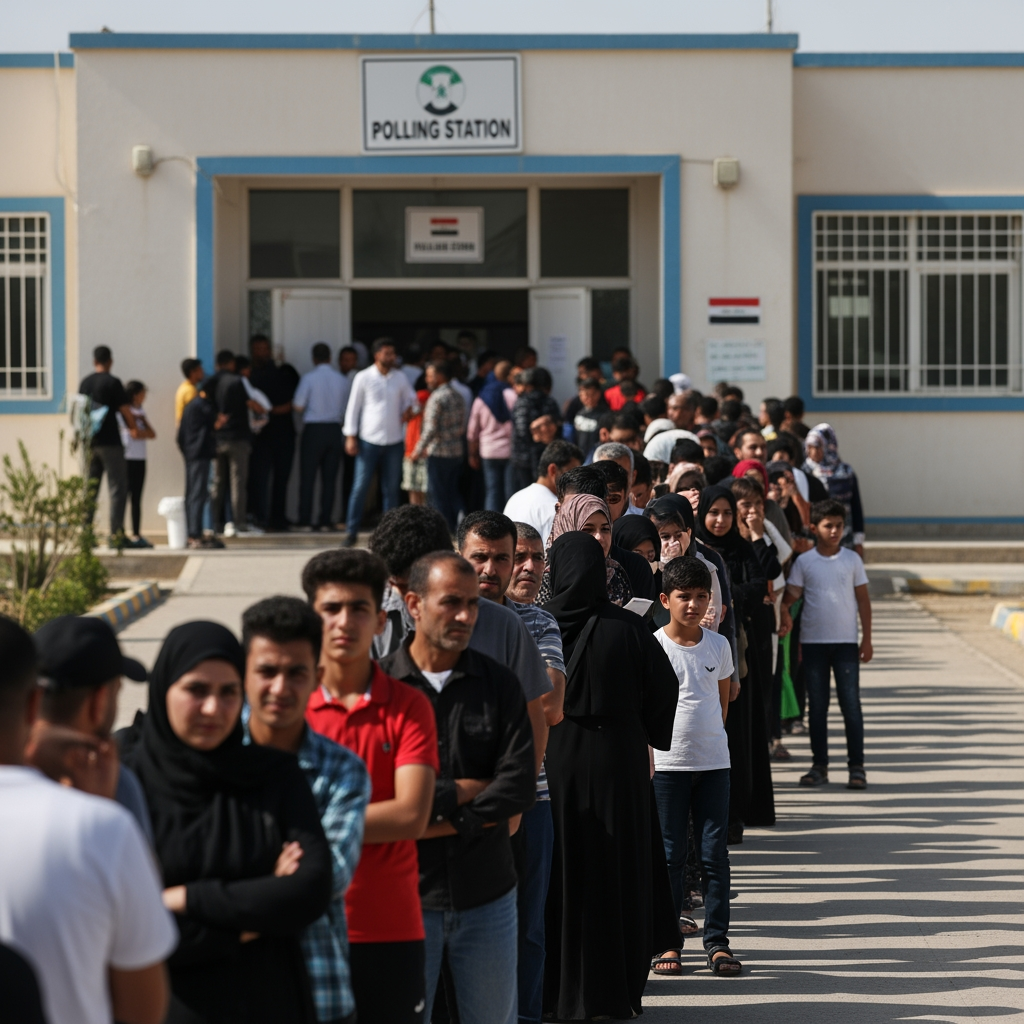
On Tuesday, Iraqis went to the polls to elect a new parliament, surprising many with a turnout exceeding 55 percent—an important moment for both Iraq and the broader region.
Despite being a battleground for proxy conflicts and under the watchful eyes of Iran and the U.S., Iraq has recently found a measure of stability.
However, as it attempts to move beyond two decades of conflict since the U.S.-led ousting of Saddam Hussein, Iraq, home to 46 million, continues to grapple with inadequate infrastructure, poor public services, and systemic corruption.
Iraq’s electoral commission reported that over 12 million voters participated out of 21 million eligible, despite a boycott call from influential Shia cleric Moqtada Sadr.
This unexpected turnout marks a significant rise from the record low of 41 percent in 2021, contradicting widespread apathy and cynicism.
Preliminary results are anticipated within 24 hours of the polls closing. Prime Minister Mohammed Shia al-Sudani, aiming for re-election, is likely to secure a significant bloc but fall short of an outright majority.
Many abstainers expressed doubt that these elections would bring substantial changes to their lives, viewing the vote as a charade benefiting political elites and regional powers.
No new leadership figures have emerged recently, with the same Shiite, Sunni, and Kurdish politicians maintaining their positions.
– Failed boycott? –
Analyst Hamzeh Hadad noted that the higher turnout, although less than the 62 percent seen in 2010 and 2014, “is a positive move for Iraq” and indicates that Sadr’s “influence is truly limited to his followers.”
“It signifies that no political leader can obstruct democratic elections in Iraq,” he added.
This election was marked by the absence of Sadr, who remains highly influential among Iraq’s Shia majority.
In 2021, Sadr had secured the largest bloc but withdrew from parliament after disputes with Shia factions led to deadly conflict in Baghdad.
Since the U.S.-led removal of Saddam Hussein, Iraq’s Shia majority has dominated, with most parties maintaining ties to Iran.
In post-invasion Iraq, tradition dictates that a Shia Arab serves as prime minister, a Sunni Arab as parliament speaker, and a Kurd as president.
Sudani is expected to win, yet with no single party predicted to gain a majority, he must build a coalition to form the largest bloc.
Sudani rose to power in 2022 with support from the Coordination Framework, a coalition of Shiite parties linked to Iran.
Although running separately, Shiite parties within the Coordination Framework are expected to unite post-election to appoint the next premier.
Sudani has highlighted his success in maintaining Iraq’s stability amid regional turmoil.
Sunni parties ran separately, with former speaker Mohammed al-Halbussi anticipated to perform well.
In Kurdistan, a rivalry persists between the Kurdistan Democratic Party and the Patriotic Union of Kurdistan.
– Delicate balance –
On the ground, Iraqis voted hoping for change.
“We have unemployment and people are exhausted. We need progress,” said Ali Abed, 57, from Mosul.
The next prime minister faces the complex task of balancing relations with Iraq’s allies, Iran and the U.S., especially as the Middle East undergoes significant shifts with new alliances forming and old powers declining.
Despite its waning influence elsewhere, Iran aims to maintain its hold in Iraq—its only close ally not targeted by Israel after Iran’s other allies suffered in Lebanon, Yemen, and Gaza since 2023.
Tehran has focused on securing interests in Iraq, challenging the U.S. with Tehran-backed armed groups and keeping Iraq’s market open to Iranian goods.
Conversely, Washington seeks to weaken Iran’s influence and has pressured Baghdad to disarm pro-Iran groups, maintaining its influence with deployed forces.