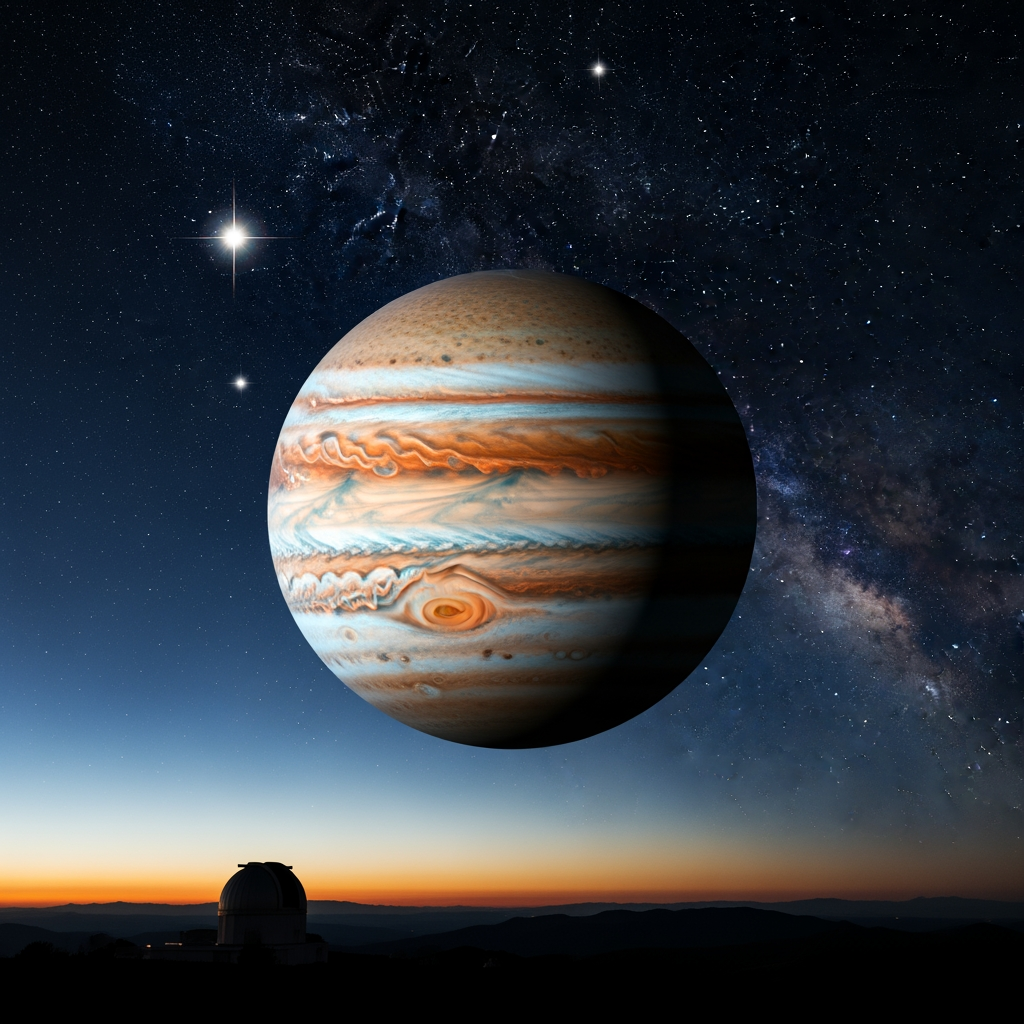
Tonight, Jupiter will shine as a bright white object in the sky, positioned directly below the luminous moon. Both celestial bodies reflect sunlight, making them visible as star-like points, with Jupiter’s massive glow easily distinguishable without any telescopes. The best time to observe this exceptional conjunction is approximately two hours before midnight local time. As the night progresses, Jupiter and the moon rise higher in the sky, enhancing visibility and the grandeur of the scene.
Jupiter, a gigantic gas giant composed of hydrogen and helium, is enveloped in dense layers of colorful clouds and swirling storms that rotate at high speeds, resembling massive belts visible even from Earth. Despite its size and visibility, many of Jupiter’s secrets remain mysterious. To uncover these mysteries, NASA launched the Juno spacecraft in 2011 to orbit Jupiter from pole to pole, collecting detailed data about its internal structure and magnetic environment.
What surprised scientists even more is the asymmetric shape of this magnetic field, a feature that differs from magnetic fields found on other planets.