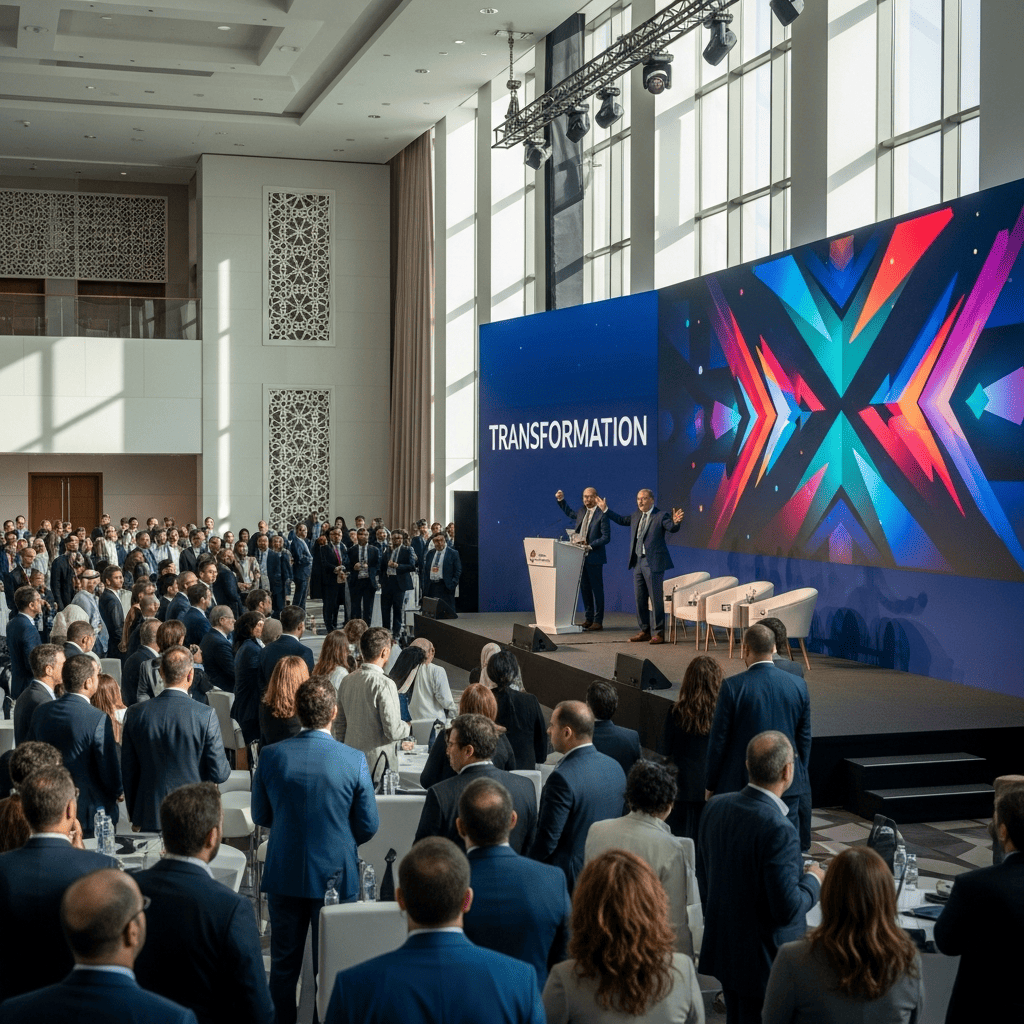
The conference continues with the participation of a select group of decision-makers, experts, investors, and innovators from the development sector, under the theme ‘Leading Developmental Transformation’ at the King Abdulaziz International Conference Center in Riyadh. The conference presented more than 30 panel discussions with over 100 speakers from various countries around the world and an exhibition featuring more than 20 entities from both the public and private sectors.
The conference highlighted several topics focusing on different development paths, starting with a session titled ‘How to Develop Resilience Against Global Economic Disruptions.’ During this session, Mohammed bin Mazyad Al-Tuwaijri, Deputy Chairman of the National Development Fund, emphasized that the core of the Kingdom’s Vision 2030 is diversification. He noted that the fund always considers several indicators, including ‘non-oil GDP, jobs, and local content,’ explaining that development funds have become a main tool for empowering the private sector and bridging funding gaps.
In the ‘Opportunities for Sustainable Investment’ session, Saudi Investment Minister Khalid Al-Falih stated that the Kingdom aims for infrastructure investments exceeding one trillion dollars by 2030, with 40 to 50% funded by the private sector. He added that the Kingdom has become the regional hub for green finance. Meanwhile, Minister of Tourism Ahmed Al-Khatib explained that tourism spending directly reflects on the economy, noting that the ministry started with a contribution of 3% of the GDP in 2019, reaching 5% last year, and expressed his aspiration to raise this percentage to 10% by 2030.
Prince Sultan bin Khalid bin Faisal, CEO of the Saudi Industrial Development Fund, highlighted during his participation in the ‘Sectoral Transformation Leaders – Development Funds and Their Systems’ session, which discussed the role of funds in enabling new industries and enhancing integration with the private sector, that ‘the fund’s journey has witnessed qualitative leaps since the launch of Vision 2030, achieving in recent years what was accomplished in the first 36 years of the fund’s history, reflecting the extent of transformation and expansion in its developmental and financial role to support promising industrial sectors.’
Meanwhile, Ismail Al-Salloum, CEO of the National Infrastructure Fund, confirmed that it has enabled the building of an integrated infrastructure system in the Kingdom through a clear identification of national needs, the establishment of institutions, governance frameworks, and supportive systems, and integrated planning across various sectors.
The second day’s events featured a series of panel discussions and workshops that addressed strategic themes, notably the impact of innovation in green finance, the role of global partnerships in accelerating development, and the role of cities as living innovation ecosystems.
The sessions included discussions on the gaming and e-sports industry, where Saudi and international experts reviewed the significant transformation the Kingdom has achieved from a lack of infrastructure 15 years ago to global leadership today, thanks to the national strategy for gaming and e-sports, and hosting major events like Gamers 8 and the e-sports World Cup, which attracted over 750 million viewers and 3 million visitors to Riyadh, strengthening the Kingdom’s position as the largest gaming market. Announcements were made about funding programs exceeding 300 million riyals, a venture capital fund worth 150 million riyals, and the largest gaming accelerator in the region valued at 306 million riyals, contributing to the financing of 59 companies, development of over 80 games, and attracting 14 global studios.