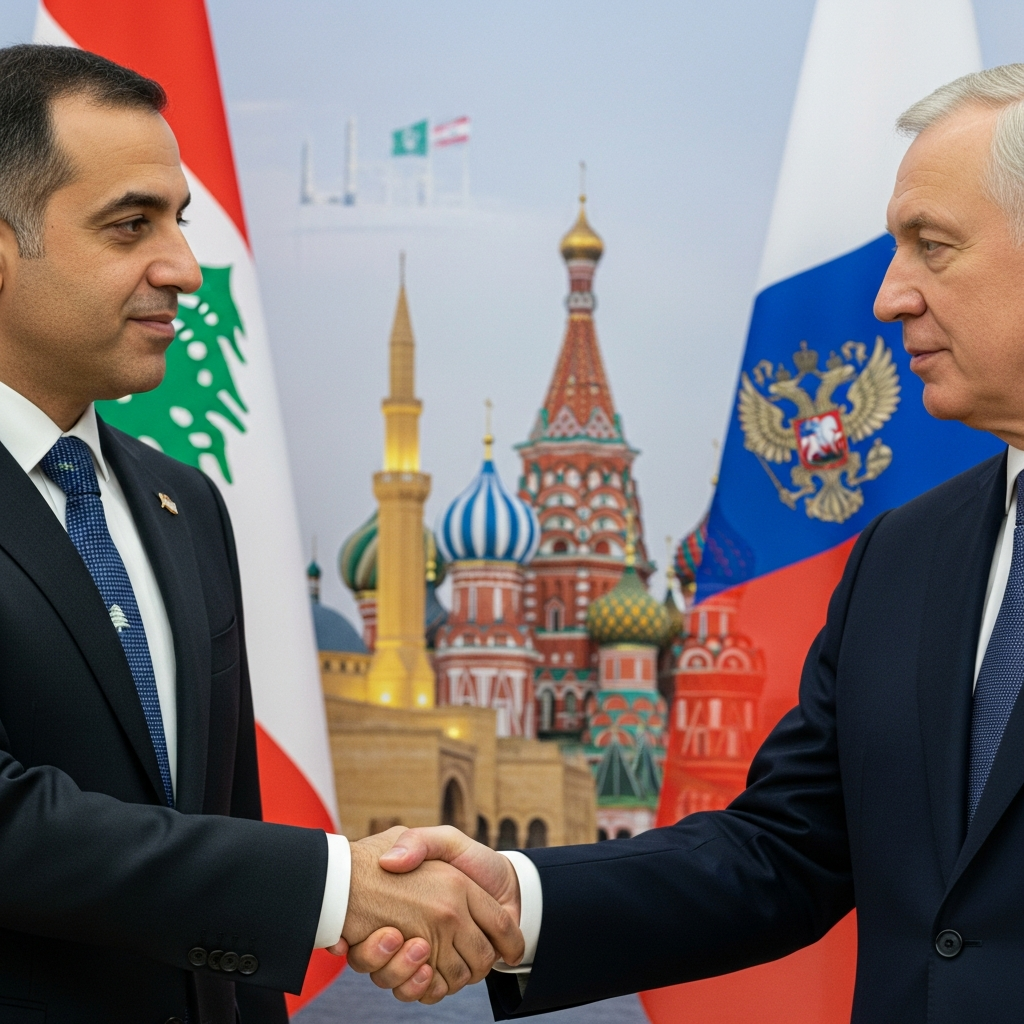
The Lebanese presidency published a statement this Monday morning, clarifying that the Russian ambassador emphasized Moscow’s desire to enhance relations between the two countries. According to the Lebanese presidency, the Russian ambassador assured the Lebanese president of Russia’s support for Lebanon’s positions regarding negotiations with Israel via the Committee for Implementing the Ceasefire Agreement, known as the ‘Mechanism Committee.’
The ‘Mechanism Committee’ held its meeting in the town of Naqoura in southern Lebanon, after Lebanese President Jozef Aoun tasked former ambassador and lawyer Simon Karam with chairing the Lebanese technical military delegation to the meetings of the ‘Mechanism’ Committee. The presence of a civilian member in the Lebanese delegation alongside the indirect military committee is in itself a positive development.
It is noted that the ‘Mechanism Committee’ serves as a framework bringing together Lebanon, Israel, and the United Nations Interim Force in Lebanon (UNIFIL), under American and French auspices, to monitor the implementation of the ceasefire agreement. It was officially re-established in November 2024, marking an evolution from the tripartite committee formed following Resolution 1701 after the July 2006 war.
The committee acts as an indirect communication channel, presenting daily field reports and discussing all kinds of violations, whether aerial, maritime, or along the Blue Line, as per the UN document. The committee is entrusted with four main tasks: monitoring the ceasefire implementation, establishing verification and inspection mechanisms at specific points south of the Litani River, gathering and exchanging field information via UNIFIL, and supporting the Lebanese army in deployment and control operations in the border area.
A ceasefire agreement between Lebanon and Israel came into effect on November 27, 2024, over a year after Hezbollah opened what it called the ‘Support Front for the Gaza Sector’ on October 8, 2023. Despite the agreement, strikes are occasionally launched in Lebanon, claimed to remove ‘Hezbollah threats.’