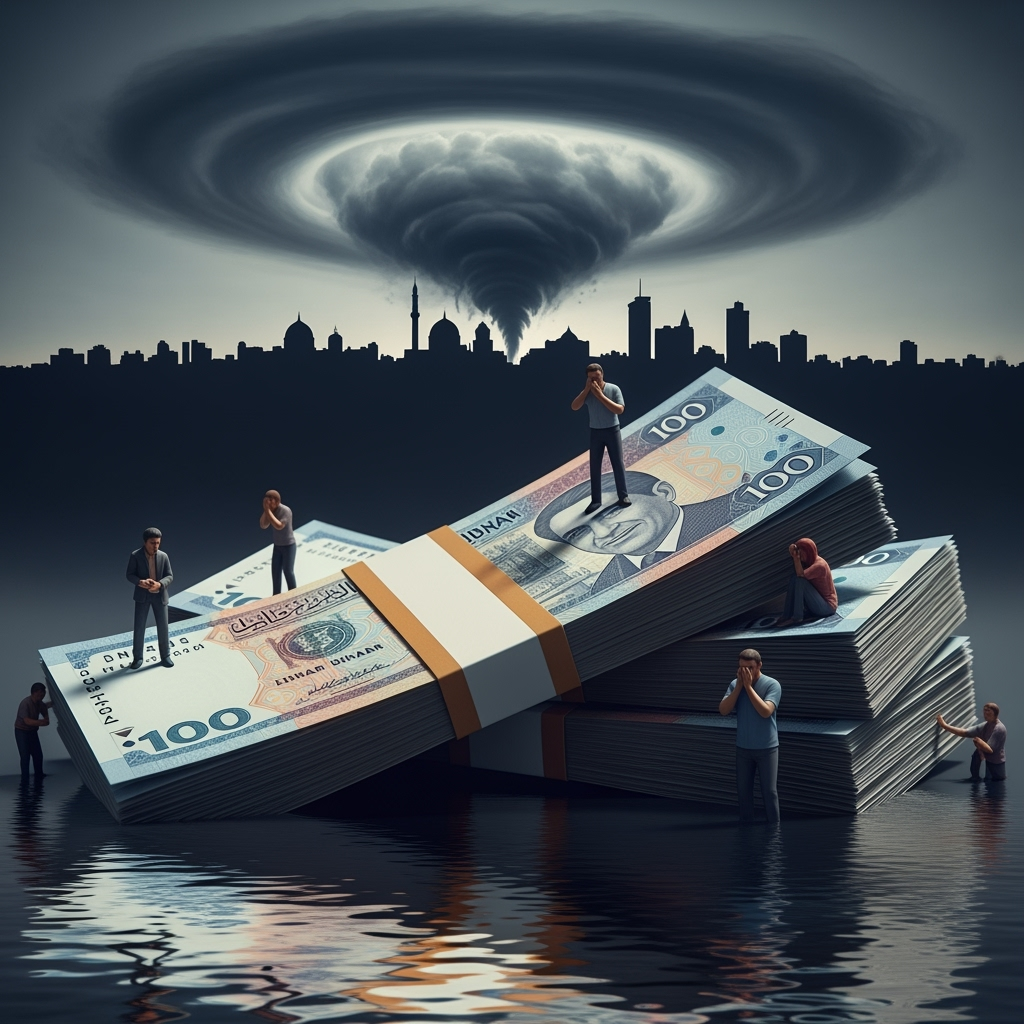
The fluctuation of the Libyan dinar exchange rate against foreign currencies emerges as one of the most significant challenges, leading to price increases and the erosion of purchasing power, raising questions about the future of the national economy in the absence of radical reforms. Economist Mohamed Drmeish stated that the main reasons for the deterioration of Libya’s economic situation are primarily due to poor management and not placing the right person in the right position. He affirmed that the state’s financial position is still very good, and the Libyan economy is inherently strong but requires efficient management of resources and funds. He emphasized that the state should activate its real tools in commercial, financial, and monetary policies as an integrated economic system, with a clear strategy for crisis management and regular monitoring of events to adapt to sudden changes, regulate trade and spending, continue implementing development projects, protect consumers, and manage money and resources in a new way that ensures diversification of national income sources, eliminates monopoly and poverty, and improves the living standard of individuals.
Economist Mohamed Drmeish also indicated that the opportunity today is more favorable than during the division period between 2015 and 2020, with a unified Central Bank capable of coordinating with economic policy tools in the country both east and west, despite the ongoing political division. He considered this moment a real opportunity to lay the foundations for comprehensive economic reform if political will and prudent management are present.
Economic affairs expert Ali Al-Mahmoudi said that the main reasons for the continued deterioration in Libya are due to the spread of corruption in various state institutions, in addition to the misguided policies adopted by the Central Bank of Libya and the massive waste in the National Oil Corporation. He noted that the decline in oil revenues had a significant impact on deepening the economic crisis.
Al-Mahmoudi explained that Libya, as a rentier state almost entirely dependent on oil, has neglected to diversify its income sources, making it vulnerable to oil price fluctuations and revenue declines, at a time when the National Oil Corporation failed to increase production despite spending tens of billions on this sector. He confirmed that all previous promises to reform the sector have failed.
He pointed out that random appointments in the oil sector and other sectors created additional financial burdens and a deficit in paying workers’ salaries, which negatively affected the national economy. Economic affairs expert Ali Al-Mahmoudi also explained that the fluctuation of the Libyan dinar exchange rate weakened traders’ confidence in the market, leading to continuous price increases, exacerbating citizens’ suffering and weakening their purchasing power.
He confirmed that Libya does not have real financial authority today but is witnessing a power struggle between financial institutions, primarily the Central Bank of Libya, which has not yet offered substantial economic reforms, merely relying on temporary measures that do not address the root of the crisis. Al-Mahmoudi stressed the necessity for the relevant ministries and institutions to develop a comprehensive and realistic economic plan, including strict measures to address the structural imbalance in the Libyan economy.
He affirmed that opportunities for reform still exist, but with the continuation of political division and the struggle over state resources and the central bank’s treasuries, there will be no imminent reform, and no serious signs of crisis resolution will emerge except through the unification of monetary, executive, and legislative authority and the establishment of prudent spending policies to restore balance to the national economy.