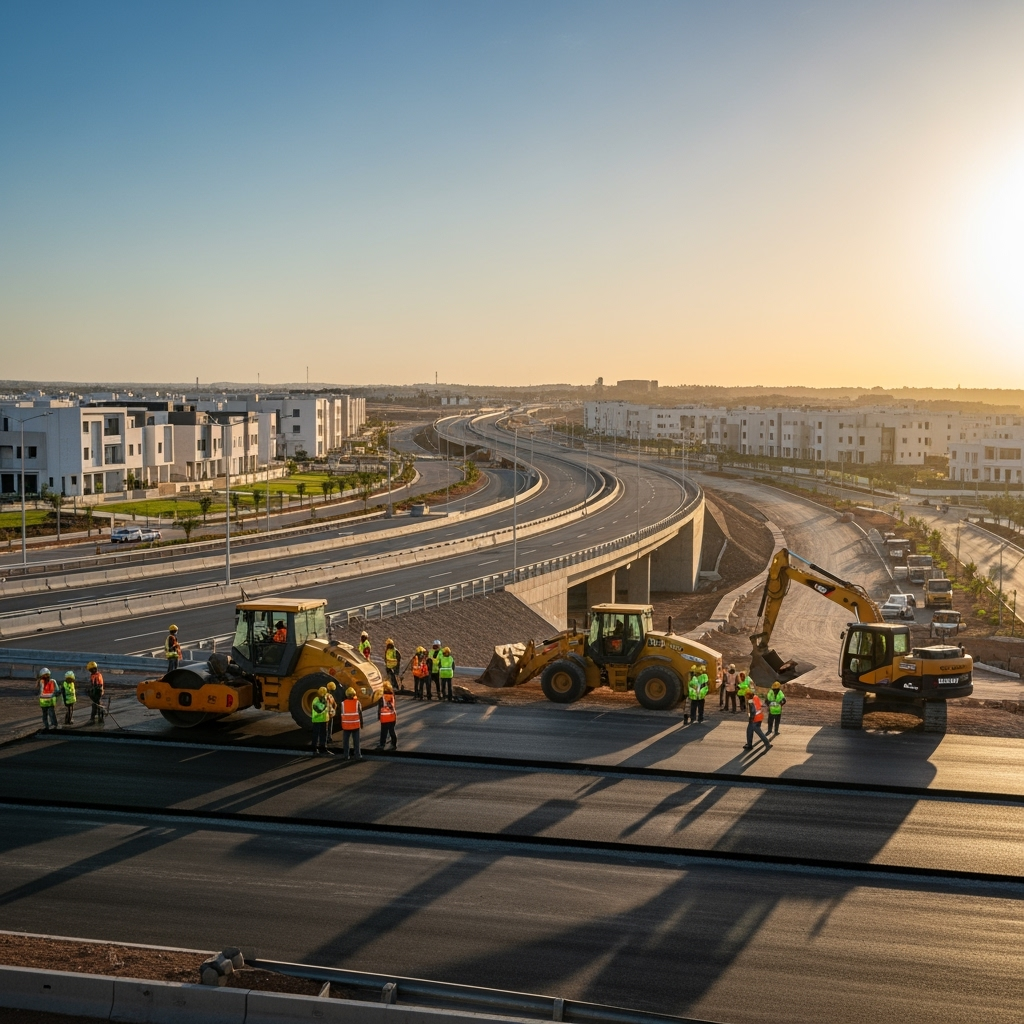
The Director of Studies at the Ministry of Equipment and Transport, Mr. Mohamed Ould Zarrouq, stated that development operations included the construction of more than 2200 km of paved roads. These efforts have contributed to linking many districts and administrative centers to the national network and rehabilitating 1260 km of vital roads, according to the Mauritanian News Agency. The Mauritanian announcement of developing internal roads was preceded by a Moroccan announcement last February, about a route passing through Amkala community to Bir Ankrin in Mauritania, spanning 53 km.
The establishment of a railway line linking Choum – Akjoujt – Nouakchott paves the way for effective logistical connectivity between the capital and northern regions, especially with the growing importance of Choum as an intermediate station towards Morocco. Dr. Mohamed Al-Amin Al-Jaid, a Mauritanian academic and political analyst, said that the project is part of Mauritania’s plans to enhance its infrastructure and facilitate transportation and trade within the country and with neighboring countries.
He emphasized that the relations between Mauritania and Algeria are strong, based on cooperation and mutual respect, and that the project is purely economic and developmental, not targeting any party, but aiming to enhance regional connectivity and serve the common interests of all peoples in the region. He continued, “Mauritania respects the principle of positive neutrality in regional issues and supports peaceful solutions according to United Nations resolutions.” He explained that the project is essentially economic and developmental, aiming to serve the interests of our people and enhance cooperation with all our neighbors without exception.
Khidisi added in his discussion with “Sputnik” that there is an economic and geostrategic shift for Mauritania, noting that the new railway is a project linking northern Mauritania, specifically the Choum area, with the capital Nouakchott via the Akjoujt area known for its natural resources. The long-term goal is to establish a railway crossing both countries and potentially heading towards the heart of Africa towards Senegal and other countries.
He explained that a significant portion of Moroccan-African exchanges currently pass through the Guerguerat crossing and Mauritania, and thus there is a general trend in Mauritania to exploit its strategic location to make Nouakchott a key area for the transit of Moroccan and even European goods towards Africa. Khidisi pointed out that aside from this railway, there is also a border crossing project underway “between the Samara area in southern Morocco and the Bir Ankrin area,” through the Amgala area known in the history of wars between Morocco and the Polisario.
He continued that Moroccan policy towards the Atlantic thought or Atlantic initiative aims to use Morocco as a means for Sahel countries to access the Atlantic, as well as deepening exchanges between Morocco and a group of African countries through Mauritania, in addition to the gas pipeline initiative between Morocco and Nigeria. All these are evidence of an essential partnership between West African countries and Morocco.
Khidisi concluded by saying that this strategic shift is a qualitative transformation through the centrality of Mauritania in this field, and that this line is part of a general initiative connecting North Africa via Tangier to the southern Sahara. According to the Mauritanian Statistical Institution (official) in 2024, the value of Mauritanian imports from Morocco during the first half of 2024 amounted to more than 1.8 billion Ouguiya (Mauritania’s local currency); while the value of Mauritanian exports to the Kingdom was set at 19 million Ouguiya, with Nouakchott recording a trade deficit with Rabat of more than 1.7 billion Ouguiya (39.61 Mauritanian Ouguiya per US dollar).
In February last year, Morocco and Mauritania signed agreements to benefit from electricity networks and exploit renewable energy resources in both countries. Moroccan media reported that “the Director General of the Moroccan National Office of Electricity and Water, Tarek Hamane, and the Director General of the Mauritanian Electricity Company, Salem Mohamed Al-Abed, signed the agreement in the Mauritanian capital, Nouakchott.” The electricity connection project between Mauritania and Morocco comes within the framework of the Moroccan Atlantic initiative aimed at strengthening African (South-South) relations.