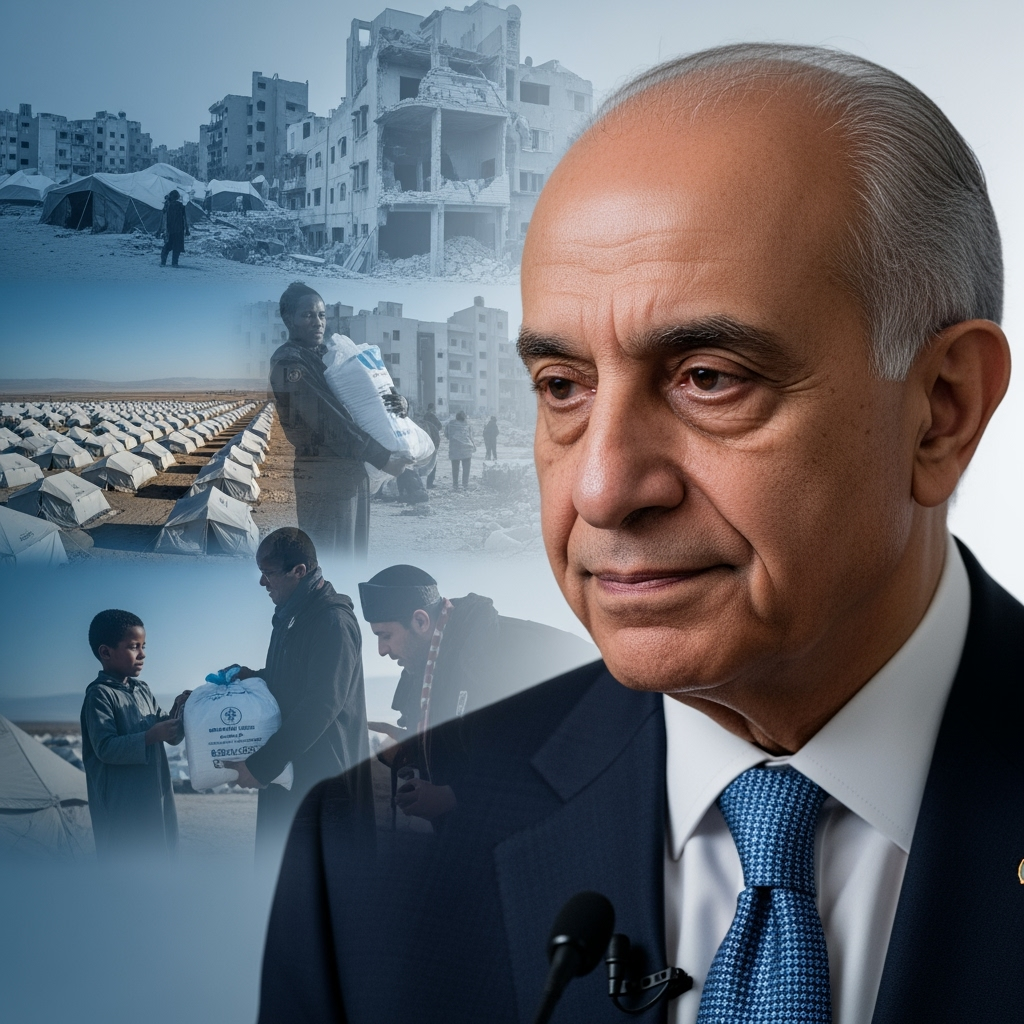
As a young boy in a Jordanian refugee camp, Omar Yaghi experienced severe water scarcity firsthand. Water would flow from the tap once every week or two, and only for a few hours. When news of water’s arrival spread, he would hurry to fill every container he could find. Every drop was precious.
Now, as a Nobel Prize-winning chemist, he’s developing technology to extract clean water from the air, even in the driest parts of the world like the Gulf.
In an exclusive Khaleej Times interview, Omar Yaghi, the 2025 Nobel Prize and Great Arab Minds Award laureate, revealed plans for the first commercial atmospheric water-harvesting systems to launch in late 2026, aiming to produce thousands of liters of water daily.
Stay informed with the latest updates. Follow KT on Whatsapp Channels.
“In 2020, I founded Atoco to transition this breakthrough from the molecular level to practical systems. After years of research, we are on the verge of bringing this technology from the lab into everyday life,” said Omar, who also serves as the Chief Science Officer at Atoco.
The California-based startup has a clear mission: addressing water scarcity with sustainable solutions using reticular materials, designed and refined by his team over the years.
How it Works
Reticular materials are porous, crystalline structures assembled by linking molecular building blocks like LEGO pieces. Their internal structure is filled with tiny cavities, each acting as a reservoir for water molecules.
“One gram of these materials can have an internal surface area the size of a football field,” he explained.
These materials are engineered to attract only water from the air. Once collected, the water is released with minimal temperature changes, allowing the system to function even in extreme climates with low humidity.
Why the Gulf
“The region faces water stress affecting communities and industries,” Yaghi stated.
He believes the Gulf can benefit early from the technology, as it provides new water sources without depleting natural reserves. This water can support food security, desert agriculture, remote communities, and irrigation far from the coast.
“Atoco is in discussions with regional companies. I am confident we will see our units generating water from air in the GCC,” he remarked.
Future Uses in UAE
The UAE has ambitious targets for green hydrogen production and AI infrastructure, both heavily reliant on water. Producing one kilogram of green hydrogen requires about 9 liters of ultra-pure water.
“So why not use the atmosphere?” he suggested.
Atoco’s systems can utilize waste heat from electrolysers to feed pure water back into the hydrogen production process.
For data centers, a booming sector in the UAE, atmospheric water can aid cooling systems by turning server heat into clean make-up water. “It absorbs heat while producing pure water,” he explained.
A Supplement to Desalination
The region heavily relies on desalination, which consumes energy and produces brine. Atmospheric water harvesting “enhances water supply resilience,” he noted, by generating water where needed, potentially without electricity. It won’t replace desalination but will diversify water sources in arid regions.
Winning the Nobel Prize
Yaghi was awarded the Nobel Prize in Chemistry “for discoveries that have conferred the greatest benefit to humankind.” “It’s an indescribable feeling,” he said. “I was genuinely surprised and deeply delighted.”
When asked by Khaleej Times if his life changed since, he said, “The biggest change is not in my routine, but in my sense of purpose. If anything, I’m more motivated than ever,” he added. “I view the prize as encouragement to advance science and bring our work to society.”
Message to His Younger Self
Yaghi often reflects on the child who first discovered molecular diagrams in a library.
“I would tell my younger self that it’s okay not to have all the answers,” he said. “If you remain curious, it can guide you through challenges and lead you to unimaginable places, like, in my case, the Nobel Prize.”