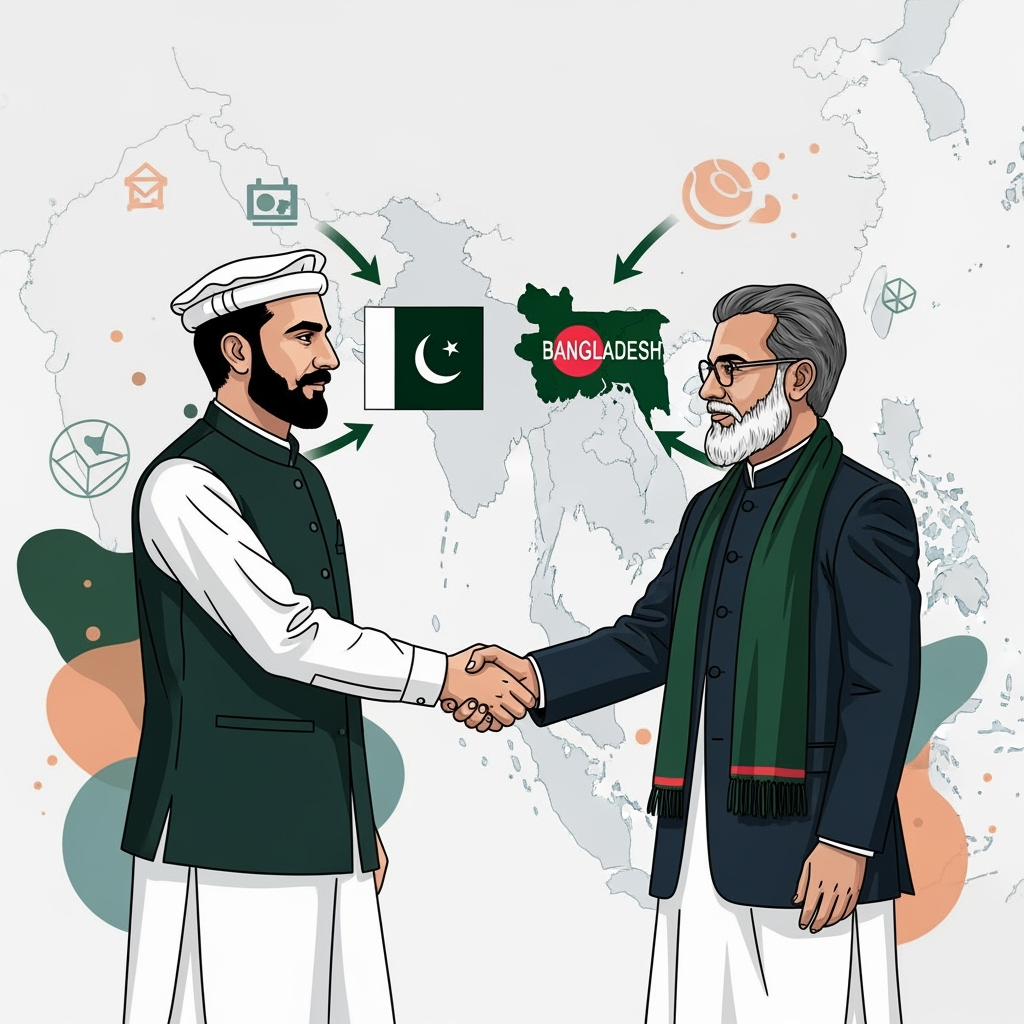
On Saturday, August 23, Pakistan’s Foreign Minister traveled to Bangladesh as both nations, former adversaries since their 1971 split, aim to strengthen relations amid shifting regional power dynamics.
Foreign Minister Ishaq Dar is the highest-ranking Pakistani official to visit Dhaka since 2012, marking what Islamabad describes as a “notable milestone in Pakistan-Bangladesh ties.”
Several agreements, including those on trade, are anticipated to be signed by the two Muslim-majority countries on Sunday.
Stay informed with the latest updates. Follow KT on WhatsApp Channels.
Pakistan’s foreign ministry announced that Dar would meet with Bangladesh’s interim leader, Muhammad Yunus.
Experts suggest that neighboring India, which engaged in a four-day conflict with Pakistan in May, will be observing these developments closely.
The relationship between Dhaka and New Delhi turned tense in August 2024 following a mass uprising in Bangladesh that ended Prime Minister Sheikh Hasina’s autocratic rule, leading her to seek refuge in India.
“Bangladesh was one of India’s closest allies in the region, but now it’s engaging with India’s primary rival,” commented Michael Kugelman, a US-based analyst, before the visit.
Pakistan and Bangladesh initiated sea trade last year, expanding governmental commerce in February.
Jam Kamal Khan, Islamabad’s Commerce Minister, conducted talks in Dhaka on Thursday, where he agreed to establish joint commissions to enhance trade and investment.
On Friday, senior military commanders from both countries convened in Pakistan.
During the 1971 war, Pakistan’s military faced accusations of widespread atrocities when East Pakistan seceded to form Bangladesh.
Hundreds of thousands perished—Bangladeshi estimates claim millions—and many in Dhaka still demand Islamabad’s apology for these killings.
Post-1971, Bangladesh relied heavily on India, which almost surrounds the nation of 170 million people.
However, Bangladesh’s interim government, led by Nobel laureate Yunus, is outraged that India harbored Hasina, who remains there and refuses to face her trial for crimes against humanity.
“The overthrow of Hasina was a strategic loss for India, and the warming of Bangladesh-Pakistan relations is a result of her removal,” stated Thomas Kean from the International Crisis Group.
This month, Dhaka accused India of supporting Hasina’s now-banned Awami League, a claim New Delhi denied, stating it “does not permit political activities against other nations to be conducted” from its territory.