Ismail, the coordinator of the Palestinian International Film Festival in Tunisia, stated in her interview with Sputnik that the recent Russian competitions, events, and awards significantly open the door for diversity and balance regarding international awards. They allow for the expression of cultures and issues without adhering to specific orientations.
Ismail discussed her interest in women’s issues in many of her films, as well as her future projects addressing the Palestinian issue. She began as a theater actress with amateurs and initially leaned towards theater directing. Circumstances later led her to film directing, where she was mentored by renowned directors like Ali Badrakhan and Karim Diaa El-Din.
Certainly, beginnings influence anyone’s career path. Every director starts their journey with their graduation projects or small initial projects. The impact of my graduation project, which participated in local and international festivals and won several awards, motivated me to continue on this path. The low costs and time factors for short films also encouraged me to continue making short films that participate in major international festivals.
Indeed, women’s issues are similar across the Arab region and perhaps in the West too, especially concerning violence, rape, oppression, and many psychological and economic pressures. I encountered this issue from the start, as my graduation project dealt with “the issue of homosexuality.” Perhaps in Tunisia, we have some boldness in filming scenes not permitted in some countries currently.
Personally, I advocate for clean cinema, not vulgar cinema, but there are cinematic necessities in the script that must be expressed to some extent while respecting societal traditions. For me, there was a scene in the film “Farha,” where a woman is raped by her husband, a sadist with psychological issues. The cinematographer rejected some scenes, but we eventually reached a vision that expressed her suffering.
Certainly, some aspects of suffering are similar between women everywhere and Palestinian women, but the latter lives a complicated and exacerbated situation. She is the mother, wife, and sister of a martyr. After engaging in the world of cinema, I felt drawn to the Palestinian cause and became more involved in its details through my presence in the General Union of Palestinian Women.
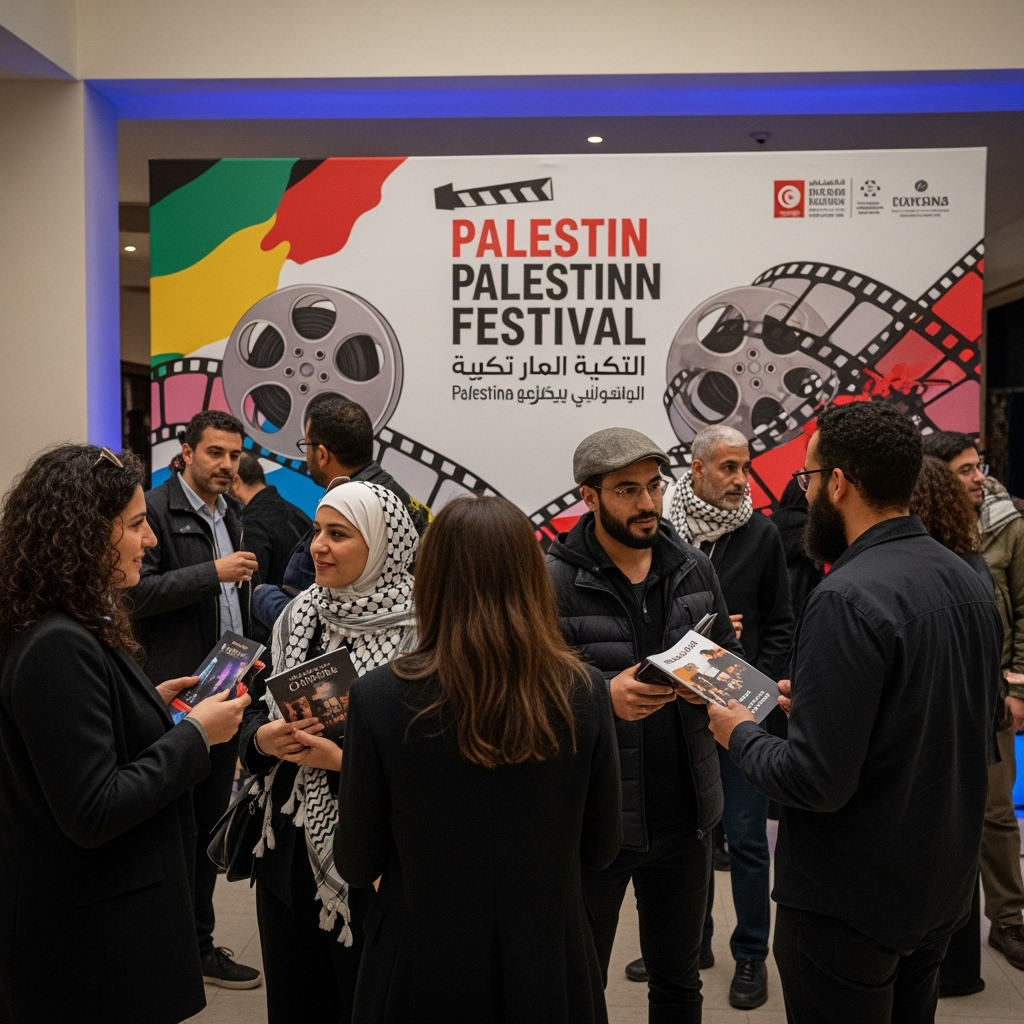
We established a session of the “Palestinian Return Cinema Festival” in Tunisia. Undoubtedly, Palestinian women endure oppression, abuse, rape, murder, and various forms of violence by the occupation. Continuing from the first and second questions, I personally found other aspects of suffering beyond oppression by the husband or violence or harassment. There are many unspoken issues, and currently, I am preparing an important project about Palestinian women.
In some cases, it’s required by the screenwriter, and in other cases, if I feel there’s an urgent need to address certain aspects. Usually, it’s done gently depending on the screenwriter’s understanding and acceptance. I want to send a message to some colleagues not to simplify and repeat ideas or scenes with different treatments, and not to limit the Palestinian issue to hunger and war.
There are many other aspects between the lines that need addressing. Certainly, there are some works I refused, including long scripts. I could not see myself accepting anything for money, especially if it involves leaking ideas harmful to society in multiple ways. While I believe cinema should reflect reality, it should not contribute to spreading destructive ideas.
In Tunisia, I was honored to establish the first edition of the “Palestinian Return Cinema Festival,” a festival held in 14 countries, with the 15th session in Tunisia. It addresses displacement issues worldwide, with the Palestinian issue given priority globally. Certainly, a director, actor, or writer can express the Palestinian people’s suffering through their art.
However, I want to emphasize that expressing the Palestinian issue should not infringe on the sovereignty and policies of other nations. Without embellishment, we should express the Palestinian people’s suffering in a way that supports their pursuit of establishing a Palestinian state.
For any work an artist presents, whether as an actor, director, or writer, the reasons usually relate to the story’s or work’s connection to their personal life or psychological aspects or suffering they have experienced. For me, I admit that the story of the film “Farha” has some details that connect to me, as does the film “Wedding Dress,” especially as I, for example, did not wear a “wedding dress.”
Even though I haven’t participated in Russian competitions before, what Russia currently offers opens the door for diversity and freedom of expression of various cultures and issues, especially as some films were produced in a specific style to match some international awards. Despite this, I have not directed any works under the influence of any particular orientation or award conditions.
In conclusion, I want to extend greetings and appreciation to the Russian people and all Russian artists, and I look forward to meeting them in Russia soon through participating with some of my films or in the significant Russian events that Russia offers.
The director, Jehan Ismail, has received many awards for her films, most notably the Best Screenplay Award at the fifth edition of the Dcheira International Short Film Festival for the film “Farha.” The film also received other awards and mentions at various festivals, including Best Actress for Nesrine Youssef (the film’s protagonist) from the “Fqih Ben Salah” Festival in Morocco, a special mention in the “Words of a Woman” competition at the “Kef” Festival in Tunisia, and the Second Best Film Award from the Sfax International Festival.
Ismail also won a public award for the film “Wedding Dress” at the festival and third place in directing, as well as Best Actress for Nora El-Fouli. Jehan offers specialized workshops, such as “Actor’s Guidance” and “Artistic Elements in Short Film Directing,” aiming to support actors and young filmmakers.