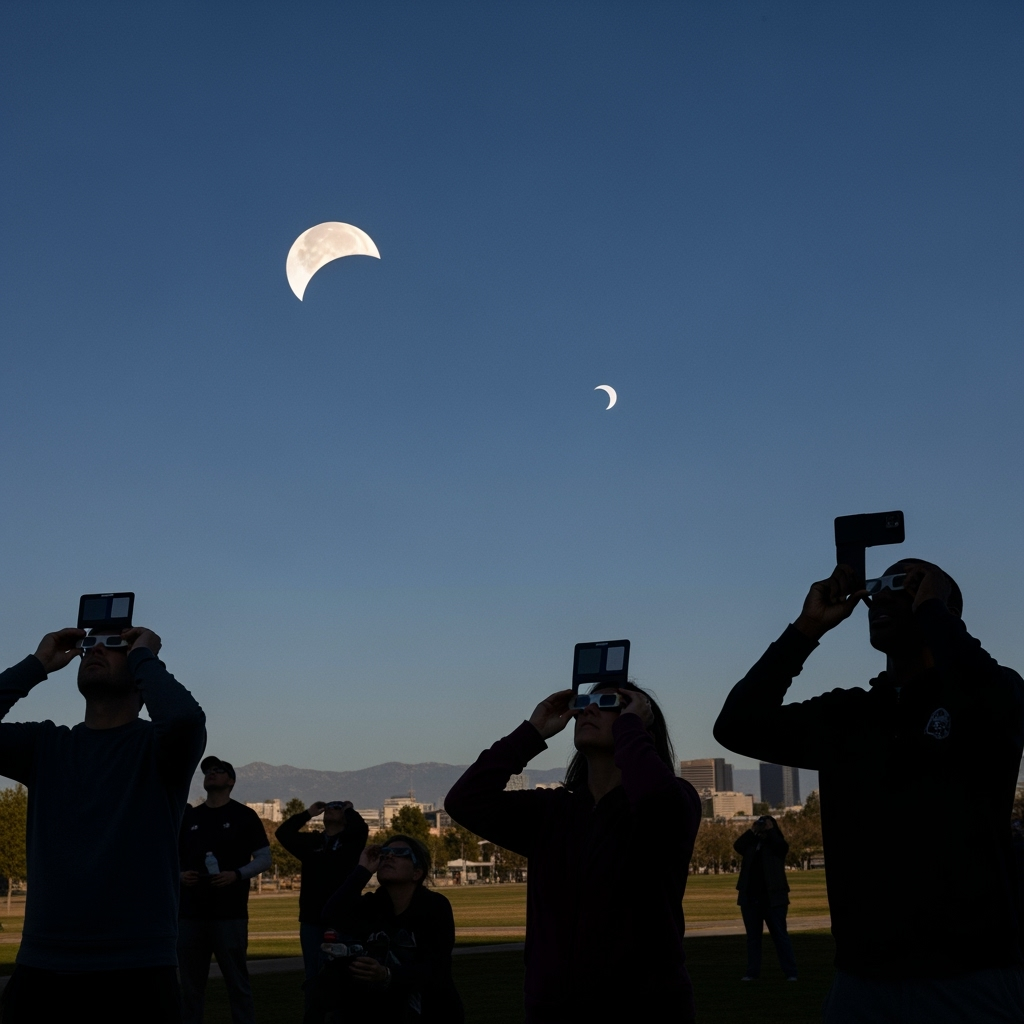
Ashraf Tadros, an astronomy professor at the National Institute for Astronomical Research in Egypt, stated on social media that this eclipse will primarily be visible in the southern continent of Australia, the Pacific Ocean, and Antarctica. It will reach its peak when the moon’s disk covers about 85.5% of the sun’s disk and will last approximately four hours and twenty-four minutes from start to finish.
Tadros explained in his post that this partial eclipse occurs roughly two weeks after the total lunar eclipse, emphasizing the astronomical relationship between the two phenomena: a solar eclipse only happens when the moon is in the new moon phase (between the sun and Earth), while a lunar eclipse only occurs when it is full (when Earth is between the sun and the moon).
Eclipses and lunar eclipses are important tools for confirming the beginnings and endings of lunar months, accurately reflecting the moon’s movement around Earth and Earth’s movement around the sun. Tadros pointed out the existence of a regular astronomical cycle for eclipses known as the “Saros cycle,” which lasts 18 years, 11 days, and 8 hours, discovered by the Babylonians, Chaldeans, and ancient Egyptians.
After the completion of this cycle, celestial bodies return to nearly the same relative positions, causing the event to repeat in a similar pattern. Despite the moon orbiting Earth monthly, eclipses and lunar eclipses do not occur every month due to the moon’s orbit around Earth being tilted by 5 degrees relative to Earth’s orbit around the sun. For an eclipse to occur, the moon must be near one of the ascending or descending nodes, where their orbital planes intersect.
This eclipse is the second and last of the year 2025 and will not be visible in the Arab region. The maximum eclipse is expected to reach 80% in the southern ocean between New Zealand and Antarctica.