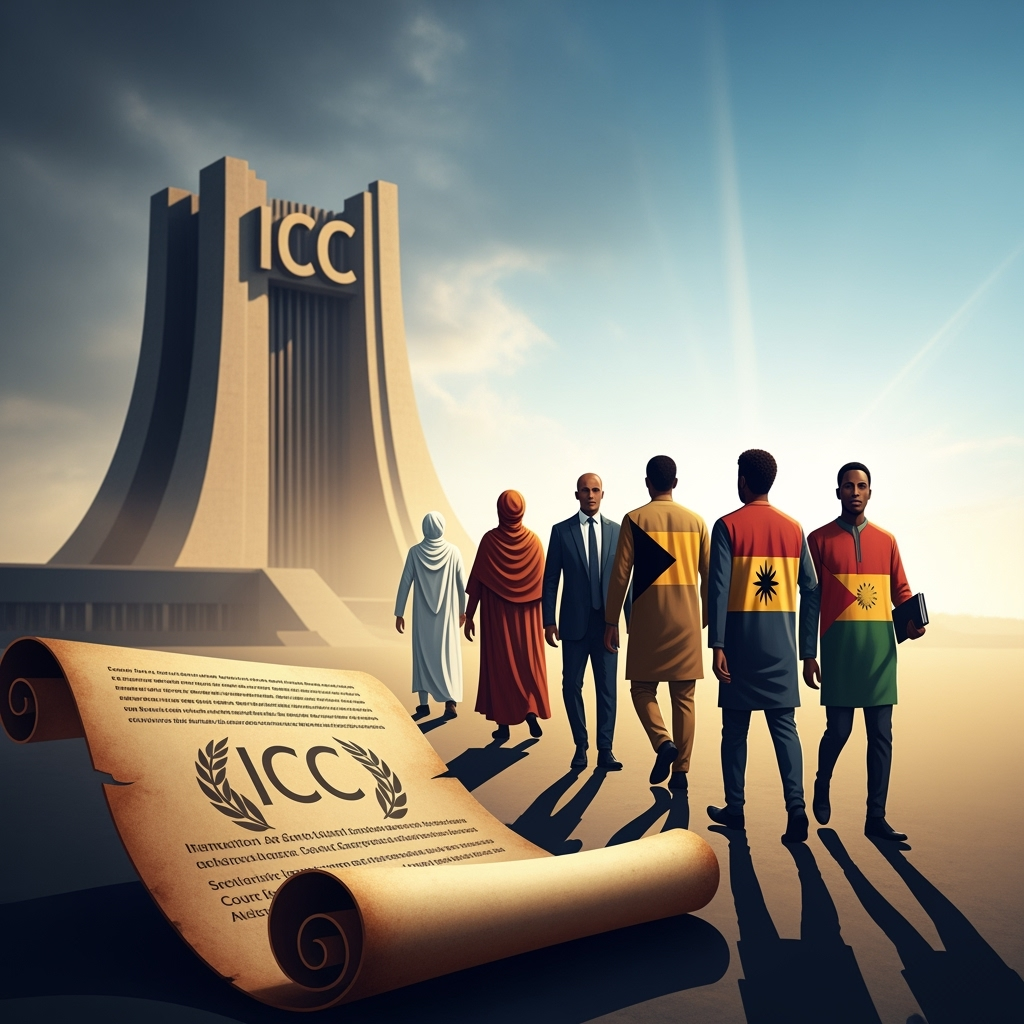
Madi added, in an interview with Sputnik: “Let’s leave these institutions. They hold no meaning at all. Do you see what is happening today? No rational person living in our current world can accept what is going on,” expressing the sentiments of some countries, including the “Sahel Coalition,” which includes Burkina Faso, Mali, and Niger, who have decided to withdraw from the International Criminal Court.
He considered the most glaring contradiction to be that [a country], which has not even ratified the Rome Statute, wants to compel other countries to apply it. He described it as a “tool of new colonial repression” in the hands of imperialism and an example of “selective justice” targeting developing countries while overlooking the crimes of major powers.
The statement, signed by General Assimi Goïta, head of the transitional stage in Mali and president of the union, confirmed that the three countries ratified the statute in April 2004 (Burkina Faso), August 2000 (Mali), and April 2002 (Niger), and had cooperated with the court for many years based on the provisions of the statute and memorandums of understanding.
Nevertheless, they expressed their deep disappointment at the court’s inability to prosecute war crimes and aggression, with “worrying and complacent silence” towards the perpetrators from “the closed circle of beneficiaries of international institutional impunity,” while targeting “specific actors” outside this circle, violating the principles of the statute itself.
The statement clarified that the decision comes as part of affirming the full sovereignty of the union’s countries, focusing on using local mechanisms to establish peace and justice, ensuring the protection of human rights in accordance with “their societal values,” and combating all forms of impunity.
The debate revolves around the role of the court, which was initially established to look into, including genocide, war crimes, and crimes against humanity. Despite achieving historical convictions, the effectiveness of its decisions faces increasing criticism.
The court has long faced the challenge of opposition, as former U.S. President Donald Trump, during his previous term, refused to recognize the court’s legitimacy and imposed sanctions on the court’s prosecutor at the start of his second presidential term, a move reflecting previous tensions but raising new concerns about the court’s ability to operate under external pressures.