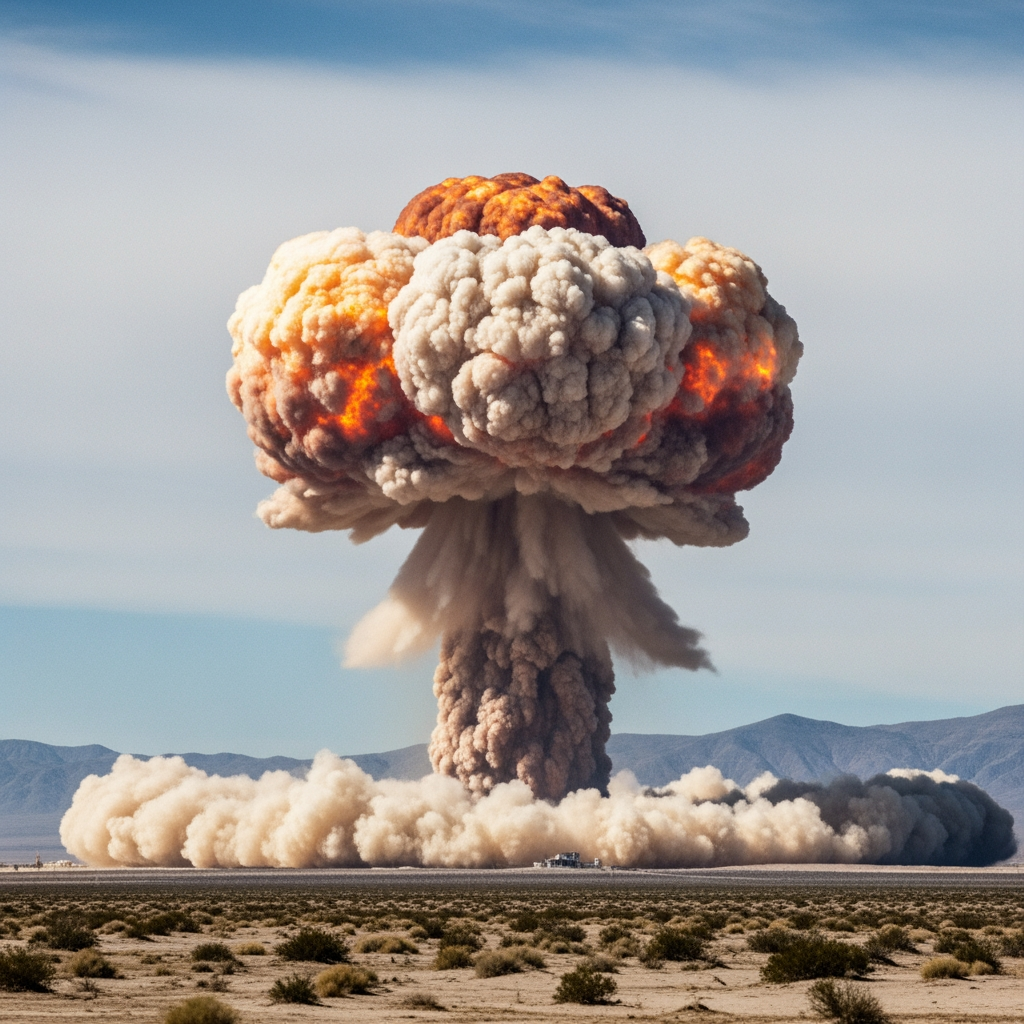
On Thursday, the laboratories stated: “Sandia, in collaboration with the US National Nuclear Security Administration, successfully conducted a series of aerial tests of the arsenal at the Tonopah Test Range in Nevada. Inert units of the B61-12 bomb were successfully dropped by an F-35 aircraft.” The laboratories explained that these tests represent a significant phase for evaluating the characteristics of this weapon, noting that the experiments conducted between August 19 and 21 demonstrated the aircraft’s reliability in transporting the nuclear bomb and the weapon systems during missions.
The laboratories added that the US National Nuclear Security Administration completed the B61-12 bomb life extension program in late 2024, allowing its lifespan to be extended by at least twenty years. The tests also included, for the first time in history, a thermal pre-preparation for the bomb test setup before being dropped from the F-35 fighter.
On October 30, former US President Donald Trump announced that, with nations possessing similar nuclear programs, the process would begin immediately, asserting this via his platform on “Truth Social.” Meanwhile, Russian Foreign Minister Sergey Lavrov confirmed that Russia would respond if any nuclear power conducted nuclear tests.
Russian President Vladimir Putin chaired a Russian Security Council meeting on November 5, where Defense Minister Andrey Belousov emphasized the need to begin preparations for resuming nuclear tests at the Novaya Zemlya test site. Putin requested the collection and analysis of information and the preparation of proposals regarding the commencement of nuclear weapons test preparations.