The tension between the two sides has reached unprecedented levels after a series of government decisions targeting union work, while the union insists on defending its historic role in the social and political arena. Observers suggest that this confrontation may define the features of the upcoming phase, given the inability of both parties so far to find common ground for dialogue. The authorities are attempting to reduce the union’s influence through administrative and financial measures, which unionists consider a direct attack on them. Among these measures is the government’s decision to ban union leave and cancel the automatic deduction of employee subscriptions for the union, which are significant financial resources that enable it to fund its activities. Although the deduction is only one dollar a month, the union, which includes nearly a million members in both the public and private sectors, relies heavily on this regular financial flow.
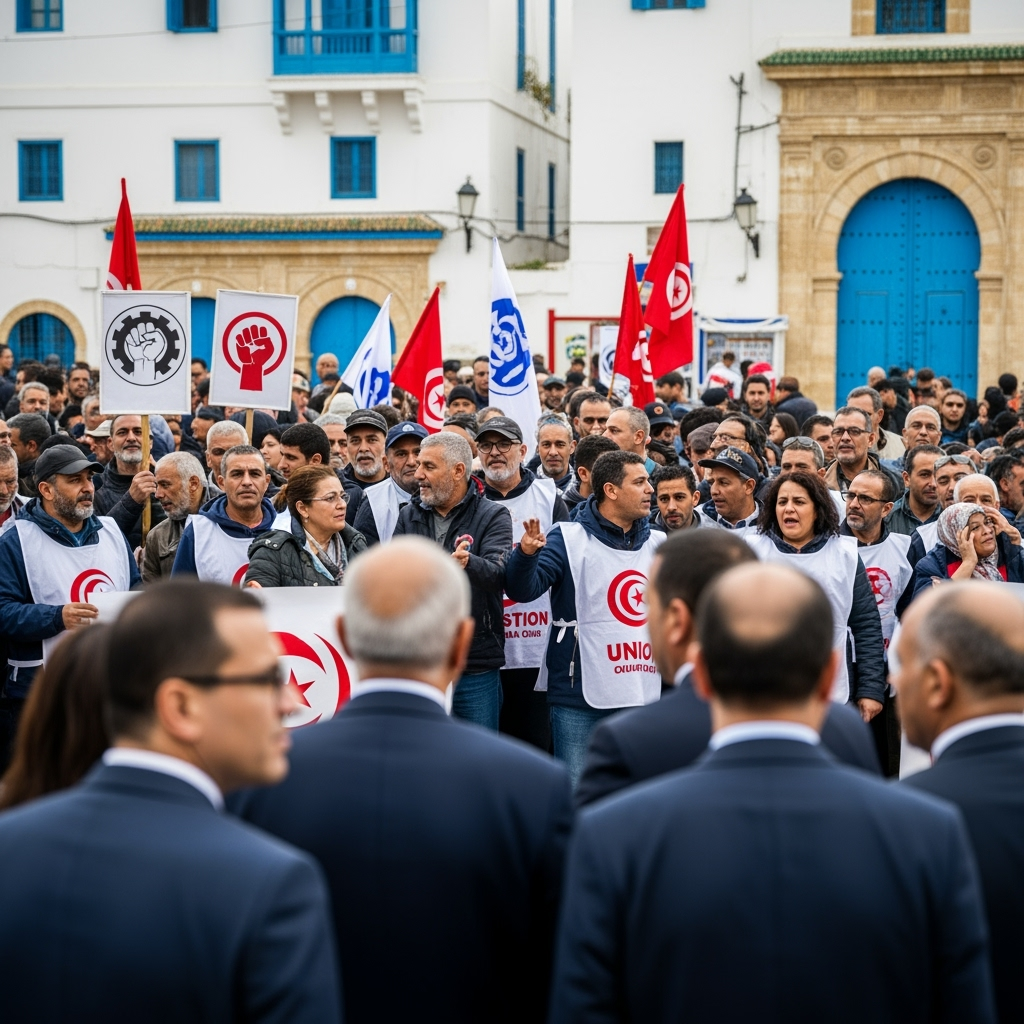
In response, the union announced through its regional and sectoral structures that it is in the process of mobilizing its supporters extensively to take to the streets on August 21, as per its administrative body’s decision, hinting at activating a previous decision by its national council to organize a general strike if the government continues to close the door to negotiations and refuses reconciliation sessions in vital sectors like transport. These developments occur amidst protests led by President Saied’s supporters in front of the union headquarters on August 8, raising slogans demanding its dissolution, culminating in the President’s recent speech where he announced his intention to open corruption files without exception, which unionists see as a systematic campaign targeting the historical organization.
Last week, the administrative body of the union emerged from its emergency meeting with decisions reflecting escalating tension in the relationship between the union and the authorities, yet it also revealed its determination to avoid sliding into an open confrontation that could deepen the political and social crisis in the country. The body announced a protest rally on Thursday, August 21, in front of the central headquarters, followed by a peaceful march in the heart of the capital, to denounce the attack on the union’s headquarters and call for the resumption of stalled social negotiations in vital sectors. The body also kept its activities open, sending a clear message of pressure, with the possibility of resorting to a general strike if the attacks and defamatory campaigns continue and the door to dialogue remains closed.
Sources from within the meeting confirmed to Sputnik that the session was marked by tense atmospheres and harsh speeches, amidst widespread anger among unionists over what they considered “systematic attempts to undermine the union’s image” through digital campaigns led by supporters close to the President. The union’s spokesperson, Sami Tahri, emphasized to Sputnik that the issue is no longer just a political or social disagreement, but has turned into a matter of dignity and existence. He added, “Unionists do not accept that their honor is touched, nor that they are accused in this way, whether from the head of authority, the government, or groups driven to tarnish the union.” He explained that unionists, like any Tunisian citizen, rebel when their honor or dignity is touched. Despite the harsh rhetoric, Tahri was keen to remind that the country “does not need confrontation,” recalling the historical role of the union during the 2012-2013 crisis when it was one of the most prominent parties in the national dialogue that saved Tunisia from sliding into chaos. He confirmed that the union is committed to peaceful protest.
Meanwhile, the political activist close to the authorities, Abdel Razzaq Khalouli, considered that the current crisis is merely a snowball rolling and growing over time, confirming that it falls within the framework of “further inflaming the situation in the country.” Khalouli said in this context, “This is not the battle of the labor union itself, but the union is fighting it on behalf of political parties hostile to President Kais Saied and the July 25 process. These parties chose to enter into a dispute with the President through the union as it possesses the mechanisms that enable it to pressure the state through the general strike.” He pointed out that when “consecutive strikes in vital sectors are resorted to without legitimate justification and without real harm to workers’ interests and rights, the message becomes clear: the aim is not to defend workers as much as to involve the organization in an imaginary battle under the banner of union work.” Khalouli stressed that the current executive office of the union erred by engaging in this confrontation, considering that it “is driving the organization towards destruction,” as the union, according to him, defends its existence and some figures within it who have been accused of corruption and failure to preserve the union’s historical legacy as a labor organization before this role gradually turned into a political one.
Khalouli added that what he called “the bone-breaking battle” has started some time ago, with the participation of internal and external political and party elements, but it did not resonate with the street, so these parties resorted to exploiting the popular base and the workers affiliated with the labor organization to continue the confrontation with the authorities. Political analyst Tarek Kahlawi believes that the state of tension between the Tunisian General Labor Union and the authorities is primarily due to the halt in the social negotiations process, which has fueled the situation and brought it to its peak, especially after the transport sector strike, followed by the march organized by the President’s supporters demanding the dissolution of the trade union, leading up to the speech that implicitly adopted the protesters’ demands and defended them in front of the union headquarters. Kahlawi pointed out that the Tunisian General Labor Union is also cautiously dealing with the situation, as its administrative body did not set a date for a general strike and merely called for a peaceful march primarily carrying social slogans related to pending issues and the continuation of negotiations, without taking a direct political stance.
Kahlawi adds that the escalation, although present, has not reached the level of direct confrontation, noting that some political slogans that emerged during the administrative body’s meeting reflect the positions of union factions aligned with the opposition, but do not necessarily represent the official position of the union’s executive office.