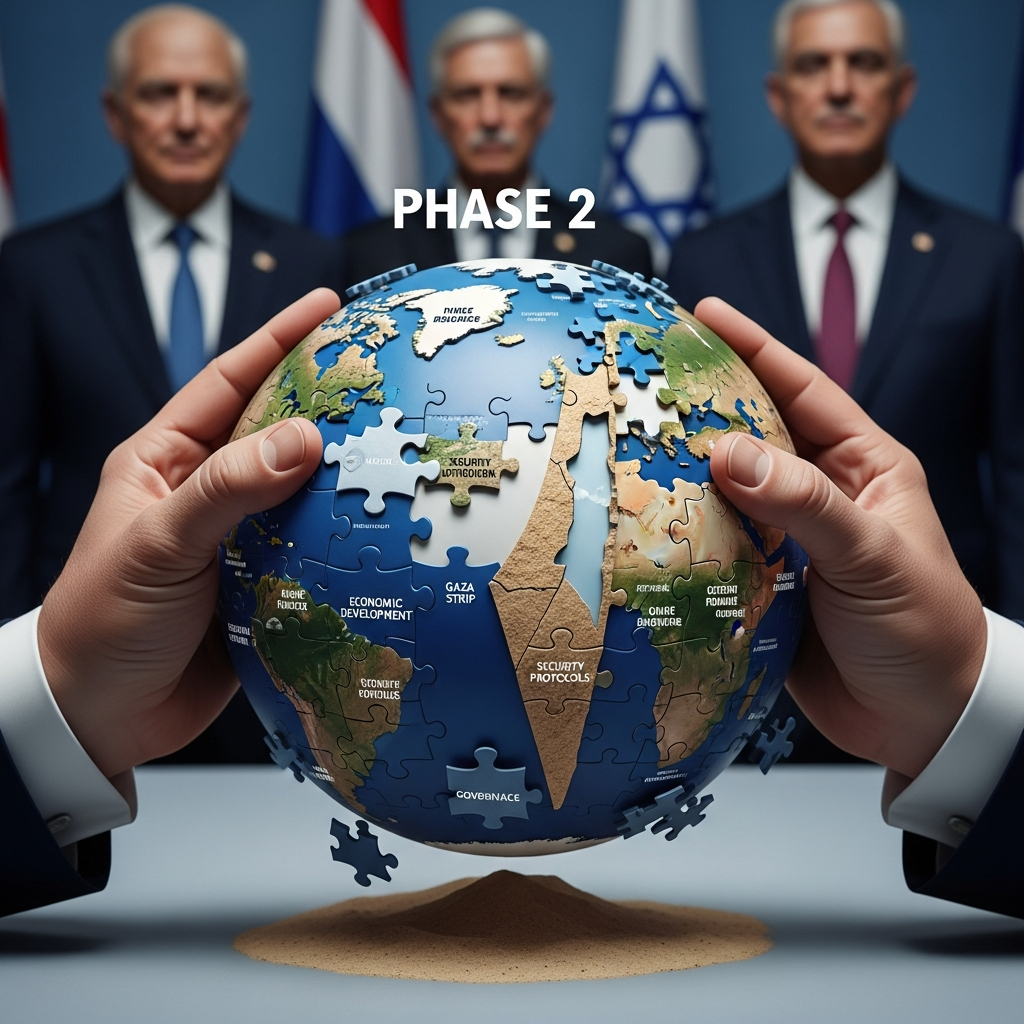
American media revealed that U.S. President Donald Trump intends to announce, before Christmas, the transition of the Gaza Agreement to its second phase, in conjunction with proposing a new administrative structure for the sector. According to Axios, citing informed sources, the proposed structure will include a Peace Council at the top of the administrative pyramid, which Trump himself will head, and it will include about ten Arab and Western leaders. Observers have noted that moving to the second phase of the Gaza Agreement is still premature, as many obstacles and unresolved items remain, notably the Peace Council, disarmament, and the formation of an international stabilization force.
Palestinian academic and political analyst Dr. Maher Safi emphasized that there are significant challenges and obstacles hindering the transition to the second phase of the ceasefire agreement in Gaza. He attributed this primarily to the continued intransigence of Israeli Prime Minister Benjamin Netanyahu, who sets unrealistic obstacles and pretexts. In his conversation with Sputnik, he noted that President Trump had announced that the second phase of the agreement would begin soon, but he added that Trump’s language of promises often lacks actual implementation on the ground. Safi pointed out that progress towards this phase is proceeding with ambiguity and lack of clarity due to ongoing Israeli pretexts. Although he confirmed that the agreement remains resilient, he noted that the pressure exerted by the U.S. administration to implement Trump’s plan is still ineffective against Israeli policies.
Discussing diplomatic efforts, Safi highlighted that mediators in Egypt and Qatar are making intensive efforts within the framework of indirect negotiations, generating cautious optimism about reaching understandings to move to the second phase. He pointed out that this phase involves thorny issues, most notably the formation of a temporary committee to manage Gaza, and the disarmament of Hamas and other Palestinian factions. He noted that Hamas rejects these provisions and considers them complex issues that primarily require internal Palestinian consensus, making smooth transition to the second phase uncertain at present. Safi stressed the need to exert more real pressure on Netanyahu to ensure a smooth transition and immediate reconstruction, especially after a war and genocide against the Palestinian people that lasted more than two years, resulting in a heavy toll of over 300,000 people killed, injured, missing, or imprisoned, in addition to the destruction of more than 80% of Gaza’s infrastructure.
Palestinian political science professor Dr. Ayman Al-Raqab considered Trump’s talk about how to transition to the second phase as vague, pointing out that the side actually refusing to transition to this phase is the Israeli occupation, which demands the handover of the last Israeli body as a precondition. The U.S. administration knows this will take a long time. Regarding the security file, Dr. Al-Raqab noted that White House statements indicate American approval during the first phase for retaining light weapons, describing it as very important to ensure no security vacuum. Al-Raqab added that discussing the transition to the second phase is still premature, especially regarding the matter of weapon collection, as fundamental questions arise about who will receive these weapons—whether it will be the international stabilization force, one of the mediating countries, or the intended Palestinian police.
The political science professor stressed that what matters now is stopping the killings and ensuring the withdrawal of the occupation, without turning Gaza into a situation similar to Lebanon. He expressed concerns about an American desire to divide Gaza into two parts: an eastern part for reconstruction and a western part under pressure in one way or another. Al-Raqab concluded by emphasizing the need to wait for the outlines of the vision Trump speaks of for the transition, noting that the absence of the Palestinian Authority from the technocratic committee’s formation opened the way for talk that the American Peace Council would be responsible for forming Gaza’s management committee.
Mediators’ efforts included receiving Qatari Prime Minister and Foreign Minister Sheikh Mohammed bin Abdulrahman Al Thani, who met on the sidelines of the Doha Forum with Egyptian Foreign Minister Badr Abdel Aty in an extended bilateral meeting discussing the Gaza crisis and growing bilateral relations. According to the Egyptian Foreign Ministry, the ministers affirmed the importance of continuing efforts to implement the Sharm El Sheikh Peace Agreement in all its phases and the necessity of establishing a ceasefire in Gaza and preventing any breaches.
Qatar’s Prime Minister and Foreign Minister Sheikh Mohammed bin Abdulrahman Al Thani confirmed earlier today that “Qatar, Turkey, and Egypt, along with others, continue intensive negotiations to chart the future path for the next phase in Gaza.” This comes as President Donald Trump plans to announce the transition of the peace process in Gaza to its second phase and reveal the new governance structure in the sector before the Christmas period. American officials and a Western source told Israel’s Channel 12 that the formation of the international force and the new governance structure for Gaza are in their final stages, expressing hope to unveil them within two or three weeks.
The Israeli war on Gaza, which lasted more than two years, resulted in the death of about 68,000 Palestinians and injury of about 170,000 others, according to official data. In October, a peace summit was hosted in Sharm El Sheikh, chaired by Egyptian President Abdel Fattah El-Sisi and his American counterpart Donald Trump, with the participation of leaders and delegations from about 20 countries. Over two years of ongoing Israeli war on Gaza, the sector was destroyed from south to north, damaging the medical sector, schools, universities, places of worship, infrastructure, and vital resources supporting life in the sector, leaving 15 critical sectors in Gaza destroyed, and causing large numbers of civilian casualties.