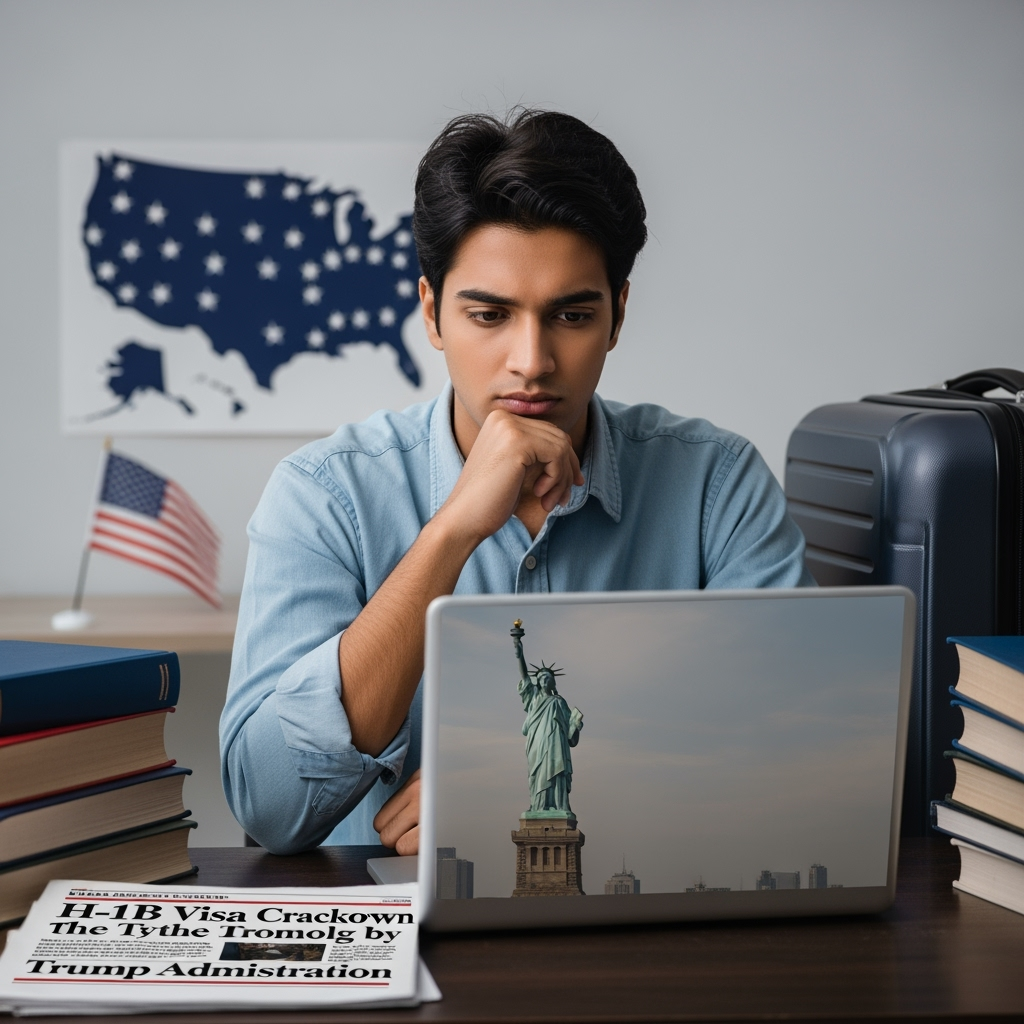
Paridhi Upadhaya was preparing to pack her bags for a computer science scholarship in the U.S. when news of President Donald Trump’s recent H-1B visa crackdown led her family in Lucknow, India, to rethink their plans.
“Trump’s relentless immigration policies are making us consider other countries for her education,” said Rudar Pratap, her father. Upadhaya is just one of the many Indians whose American dream of top-tier education, prosperous careers, and improved living standards is fading due to stricter U.S. visa rules and unpredictable policies. For decades, the H-1B visa has been a key to a new life for young engineers and scientists from India, China, and other nations, offering high-paying jobs and the possibility of permanent residency.
However, Trump recently proposed increasing the cost of new H-1B visa applications to $100,000, a steep rise from the previous $2,000 to $5,000 employers paid to sponsor workers.
Thousands of miles away in Dallas, Texas, an Indian student studying for a master’s in computer science faces $80,000 in debt and an uncertain future.
“My main goal now is to complete my degree, secure an internship, and manage my debt,” said the student, who wished to remain anonymous due to fears of immigration scrutiny.
“I might move to Canada or Europe—places that actually welcome us.”
H-1B VISA: IS THE GATEWAY CLOSING?
While supporters hail H-1B visas for attracting essential talent, Trump believes they depress wages and disadvantage American workers, making it a contentious immigration issue.
Notable Indians who benefited from the program include Microsoft CEO Satya Nadella, IBM CEO Arvind Krishna, and Alphabet CEO Sundar Pichai, all of whom came to the U.S. as students.
India was the biggest recipient of H-1B visas last year, accounting for 71% of approved applicants, with China following at 11.7%, according to U.S. government data.
The H-1B visa, typically granted for three years and renewable for another three, has allowed U.S. tech firms to employ millions of skilled foreign workers to address talent shortages.
Foreign graduates of U.S. universities often use the Optional Practical Training program to gain work experience before securing an H-1B. This visa has become a vital step towards long-term employment and, for many, the highly sought-after Green Card. But Indian students are now reconsidering U.S. education and employment opportunities, exploring more immigrant-friendly countries, as education consultants, professors, and students told Reuters.
“Many students and parents are adopting a ‘wait and see’ approach, evaluating options like the UK, Australia, Ireland, and New Zealand,” said Piyush Kumar of IDP Education.
The U.S. hosted 465,000 Indian students in 2023, the highest number among 1.3 million abroad, followed by Canada, the UK, and Australia, according to Indian government data. “Students are demanding a Plan B upfront because return on investment is crucial,” said Patlolla Bharath Reddy, managing partner at Uni Planet Overseas Education.
Others suggest a long-term perspective. “We’ve been reassuring them that the policy may face legal challenges and things might change by the time they graduate,” said KP Singh of IMFS, an overseas education consultancy.
AS U.S. CLOSES BORDERS, CHINA OPENS UP Countries like China, South Korea, the UK, and Germany are actively targeting foreign talent.
Philipp Ackermann, the German ambassador to India, stated in a post on X this week that Germany’s migration policy is “like a German car – reliable, modern, and predictable.” An Indian computer science student at the University of Minnesota is considering Germany over the U.S. for further studies, citing stable immigration policies, strong demand for skilled workers, and affordable, high-quality education.
“Someone from a rural area like me can’t afford to stay here,” he said.
While Germany offers stability, China is aggressively attracting global talent with new incentives.
Beijing has introduced a new visa category allowing successful applicants to enter, study, and work in China without needing a job offer or research position first.
On the day Trump announced the $100,000 H-1B visa fee, Chinese cities like Jinan and Nanjing held major job fairs aimed at overseas talent—Jinan featured over 2,000 employers, while Nanjing offered more than 20,000 jobs.
“Ultimately, this is a losing strategy for the U.S.,” said Deepa Ollapally, a research professor at George Washington University’s Elliott School of International Affairs.