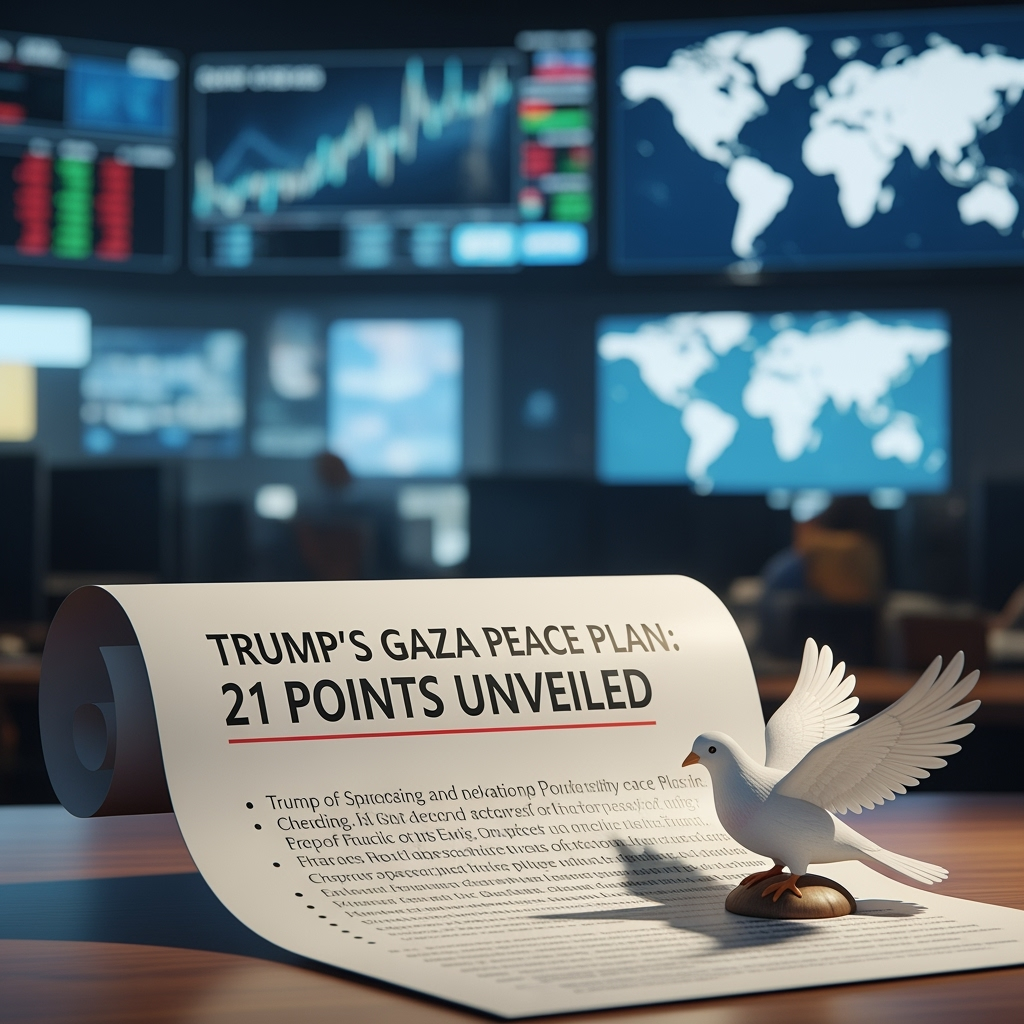
Accompanied by his special envoy Steve Witkoff, Donald Trump presented a new plan aimed at ending the war in the Gaza Strip and outlining governance post-Hamas during a meeting with leaders of Arab and Islamic countries on the sidelines of the United Nations General Assembly meetings, according to an American news site. The site explained that this plan, which consists of 21 points, is the first of its kind presented by Trump to end the conflict in Gaza and was well-received by the leaders present. Sources familiar with the meeting reported that Trump emphasized the urgent need to end the war, warning that the ongoing conflict increases Israel’s international isolation.
Observers stated that any plan to stop the war and end Israeli aggression is important at this time. However, the provisions of Trump’s initiative face many obstacles, most notably the refusal of the far-right led by Netanyahu to stop the war, Israel’s attempts to separate the West Bank from Gaza, and the unclear role of the Authority and Hamas the day after. Israeli affairs expert Khalil Abu Karsh confirmed that former U.S. President Donald Trump’s plan regarding the Palestinian-Israeli conflict is still not officially clear. There are media talks about a 21-point American vision believed to potentially lead to the end of the war.
He told Sputnik that what has been leaked and made public from the elements of this plan might be important and contribute to pushing towards ending the war and reaching a settlement for the day after. However, he warned that this is not the first time Americans have talked about a plan and vision, pointing out that the danger lies in the seriousness of implementation. Abu Karsh noted that some elements mentioned in the plan seem to contradict the vision of the Israeli right led by Benjamin Netanyahu. He questioned the possibility of the presence of Arab forces and the funding for reconstruction and rebuilding in Gaza without a specific timeline for ending the war, emphasizing that it is not possible for Arab forces and the Israeli army to coexist in the Gaza Strip simultaneously.
He pointed out the existence of an Arab condition refusing to start reconstruction without real guarantees against the recurrence of aggressive Israeli measures, stressing that the American stance still needs more clarity. Concerning the issue of hostages, he said that Israelis talk about the return of hostages while Hamas seeks to secure its position the next day, threatening the plan’s acceptance by the movement. He highlighted major threats to the plan, including the far-right in Israel, which does not want to end the war and does not wish to withdraw from the Gaza Strip, and seeks to displace Palestinians. Meanwhile, Hamas, which everyone talks about not being there the next day, reduces the chances of the American plan’s success.
On the other hand, Abu Karsh emphasized a significant driving force behind this plan, represented by the international consensus recognizing the State of Palestine and the broad Arab-Islamic agreement on the need to end this war. He believes that this pressure may push Israel to reconsider and sends a message to America that Israeli policies increase Israel’s and the United States’ isolation from the peace process in the Middle East. He also pointed to another threat concerning the plan’s implementation, which is Israel’s desire to geographically and politically separate the West Bank from the Gaza Strip, posing a significant threat, especially amid Israeli measures in the West Bank, such as settlement and land seizure and the establishment of barriers.
He concluded by saying that there is an Israeli desire to prevent the presence of the Palestinian Authority the next day, complicating the scene and reducing the chances of the American plan’s success. Thair Noufal Abu Atiyeh, Director of the Arab Center for Research and Studies in Palestine, stated that Donald Trump’s 21-point plan, presented on the sidelines of the UN General Assembly meetings, falls within American efforts to reduce the international isolation facing Israel. He added to Sputnik that this isolation results from the ongoing war on Gaza and the global sympathy with the deteriorating humanitarian situation in the sector, including escalation, killing, starvation, closing humanitarian crossings, destroying Gaza City’s landmarks, and displacing its residents.
He continued by explaining that Trump’s plan comes at a very crucial time, as many countries around the world, especially European ones, continue to acknowledge the State of Palestine, putting Israel in an awkward position of international isolation, something the American administration does not desire. He pointed out that the plan coincided with a wave of successive international recognitions of the Palestinian state and great interaction with the Palestinian people and their just cause during the 80th session of the United Nations General Assembly currently held in New York. Abu Atiyeh mentioned that informed sources who spoke to the media reported that the American proposals essentially represent a variation of ideas discussed over the past six months, including updates to previous ideas and proposals by Kushner and Blair.
He clarified that the basic principles of the American proposals include the release of all remaining Israeli hostages in the Gaza Strip, a permanent ceasefire, and a gradual Israeli withdrawal from the entire Gaza Strip. Additionally, the plan includes a post-war governance mechanism in Gaza without Hamas’s participation, establishing a Palestinian security force that includes forces from Arab and Muslim countries, and providing financial support for the new administration in the Gaza Strip for reconstruction purposes.
He confirmed that Trump’s plan comes amid ongoing international recognition of the Palestinian state, meaning it is a proactive step to mitigate global criticism, particularly European, towards the clear American bias towards Israel in its continuous escalation on Palestinian territories, especially the ongoing war on the Gaza Strip. He noted that Trump has repeatedly announced his intention to stop the war on Gaza, yet nothing tangible exists on the ground so far. In fact, the humanitarian situation is becoming increasingly difficult, especially amid the Israeli military operation on Gaza City, displacing its residents and destroying its landmarks.
He stressed that the plan for Gaza’s future needs actions, not just statements and words. It requires urgent practical implementation that acknowledges the daily suffering of the Gaza Strip from military escalation, killing, starvation, tightening the siege, and closing humanitarian crossings and outlets, in addition to the repeated displacement and exodus of thousands of families.
He emphasized that the plan must prioritize recognizing the Palestinian people’s right to life by stopping all forms of escalation in Palestinian territories and ending the war on Gaza. Trump must declare his full recognition of the Palestinian people’s rights to freedom and independence and the establishment of their independent state. He explained that this can be achieved through the announcement of the launch of a global Arab-Palestinian conference leading to a two-state solution and ending the conflict within a specific timeframe.
He concluded by saying, “If the plan does not envision the freedom of the Palestinian people and the establishment of their independent state, then all that is proposed aligns with the Israeli occupation plans, because the essence and basis of the issue is the implementation of the two-state solution project stipulated by international covenants and laws.” He expressed optimism, saying, “We are confident in the possibility of achieving a breakthrough in the coming days.” Sources indicate that the plan is based on ideas discussed in recent months, with updates developed by Jared Kushner, Trump’s son-in-law, and former British Prime Minister Tony Blair.
The plan includes main principles such as releasing all hostages, a permanent ceasefire, a gradual Israeli withdrawal from Gaza, establishing a governance mechanism free from Hamas’s control, and forming a security force combining Palestinians and elements from Arab and Islamic countries. The plan also includes funding from Arab and Islamic countries to support the reconstruction and management of the sector, with partial participation from the Palestinian Authority.
Arab and Muslim leaders were called to support these principles and commit to participating in the implementation of the post-war plan in Gaza, in a move aimed at establishing stability in the region. Israel continues its war on the Gaza Strip since October 2023, a war that has claimed the lives of more than 65,000 Palestinians and injured over 167,000, according to the Ministry of Health in Gaza.