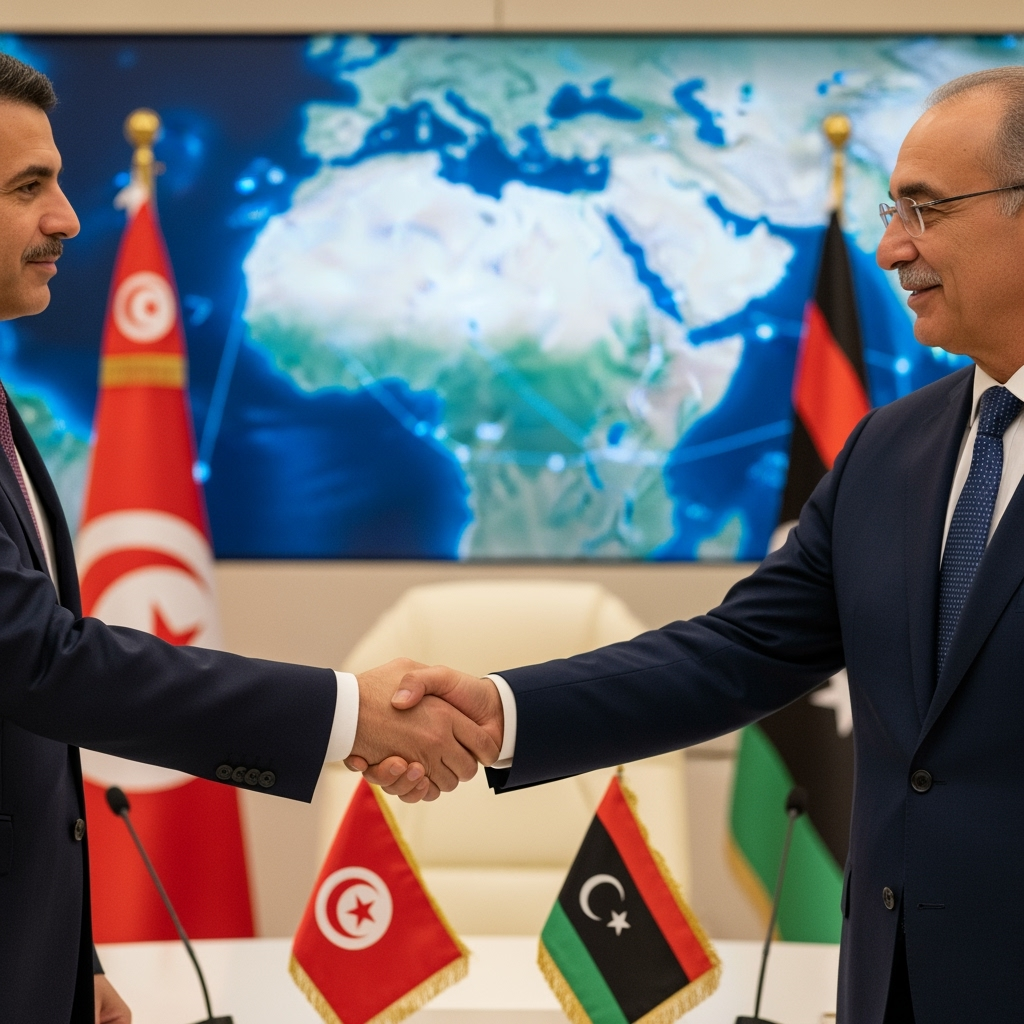
According to a statement issued by the Tunisian Presidency, a copy of which was obtained by Sputnik, this visit aims to ‘strengthen the longstanding fraternal relations between the Tunisian and Libyan peoples and continue consultations on regional and international issues of common interest.’ However, its timing raises questions about whether it is an attempt to recalibrate diplomatic directions in the region, especially amid rapid movements on various security, economic, and political fronts.
The discussions between the two sides included files on bilateral cooperation, particularly in the fields of security, economy, and irregular migration, in addition to enhancing joint coordination in facing transboundary challenges. The importance of developing continuous consultation mechanisms was emphasized to serve stability and development in the region and bolster the resilience of its countries against increasing threats.
This visit comes a few months after an official visit by Menfi to Tunisia between April 22 and May 31, 2024, which was described at the time as a crucial step in rebuilding trust between the two parties after periods of coolness and divergence in political positions.
In this context, observers see that the recent visit carries dimensions beyond bilateral cooperation, possibly paving the way for reviving the trilateral initiative between Tunisia, Libya, and Algeria, amid escalating security challenges in the Sahel and Sahara, and the political transformations the region is witnessing.
He added that ‘the migration file, alongside the border file, as well as supporting inter-trade, represent strategic topics that serve as permanent communication channels between Tunisia and Libya, and are once again being raised as priorities in bilateral dialogue.’
Rifai also pointed out that Libya is Tunisia’s primary economic partner, granting this visit significant economic importance, particularly as it represents a direct follow-up to the outcomes of the joint Libyan-Tunisian customs technical committee meeting, held last April at the Libyan Customs Authority headquarters in Tripoli.
That meeting resulted in the signing of an official record containing a package of recommendations aimed at developing customs cooperation and facilitating trade and passenger movement across shared border points. Economically, Libya emerges as a strategic partner for Tunisia, with trade exchanges between the two countries showing a qualitative leap.
According to data from the Export Promotion Center, the volume of trade exchange between Tunisia and Libya reached 2,392 million Tunisian dinars in 2023, compared to 1,507 million dinars in 2019, a growth rate of 59%. These figures show a noticeable development in Tunisian exports to the Libyan market, which increased by 37% over the same period, reflecting a recovery in economic relations and an expansion of bilateral cooperation opportunities.
The minerals and natural resources sector stands out as one of the sectors that witnessed remarkable growth, with exports in this area rising from 15 million dinars in 2019 to 125 million dinars in 2023, a growth rate exceeding 88%, reflecting Tunisia’s repositioning as a major supplier to the Libyan market in several vital sectors.
Ibn Mabrouk explained that the talks between the two delegations focused on ways to expand economic cooperation, particularly in the sectors of energy, transport, investment, and inter-trade, which both parties see as promising prospects for mutual economic growth serving the interests of both peoples.
He emphasized that this visit expresses the eagerness of the leaderships in Tunisia and Tripoli to enhance dialogue and coordination on major regional issues, foremost among them the fight against irregular migration, combating smuggling, and addressing cross-border security threats, in addition to developing cooperation in the Mediterranean space.
Ibn Mabrouk noted that the visit is a significant platform for discussing future cooperation projects and exploring new investment opportunities in infrastructure, pointing out that these files not only concern the economic side but also intersect with issues of sovereignty and regional security.
Amid the intertwined challenges facing the region, this visit, according to Ibn Mabrouk, underscores the importance of rebuilding Maghreb alliances based on mutual interests and shared visions, away from international tensions and regional alignments.
In a broader reading of the dimensions of Libyan Presidential Council President Mohamed Younes Menfi’s visit to Tunisia, observers link this step to an attempt to reset the date of the anticipated trilateral summit between Tunisia, Libya, and Algeria, which was scheduled to be held in the Libyan capital, Tripoli, last July, before its fate became uncertain due to repeated postponements.
In this context, Mahmoud Ibn Mabrouk considered the visit ‘a correction of the trilateral summit’s path and an affirmation of a highly significant regional entitlement, aiming to unify positions and policies among the three countries, particularly concerning regional security and economic and security cooperation projects.’
It is noted that the ambiguity surrounding the last trilateral summit, despite the political momentum that accompanied it, raised many questions about the extent of alignment among the regional agendas of the three countries, especially in light of differing national priorities on one hand and increasing geopolitical pressures on the other.
The trilateral summit held in Algeria on March 4, 2024, concluded with a preliminary agreement to organize a regular summit every three months, enhancing political, security, and economic coordination among the three countries. It was followed by a founding summit hosted by Tunisia in April of the same year, during which the ‘Carthage Document’ was announced, which included key decisions, most notably the formation of joint task forces to monitor and secure borders, and combat, alongside developmental projects in strategic sectors such as infrastructure and energy.