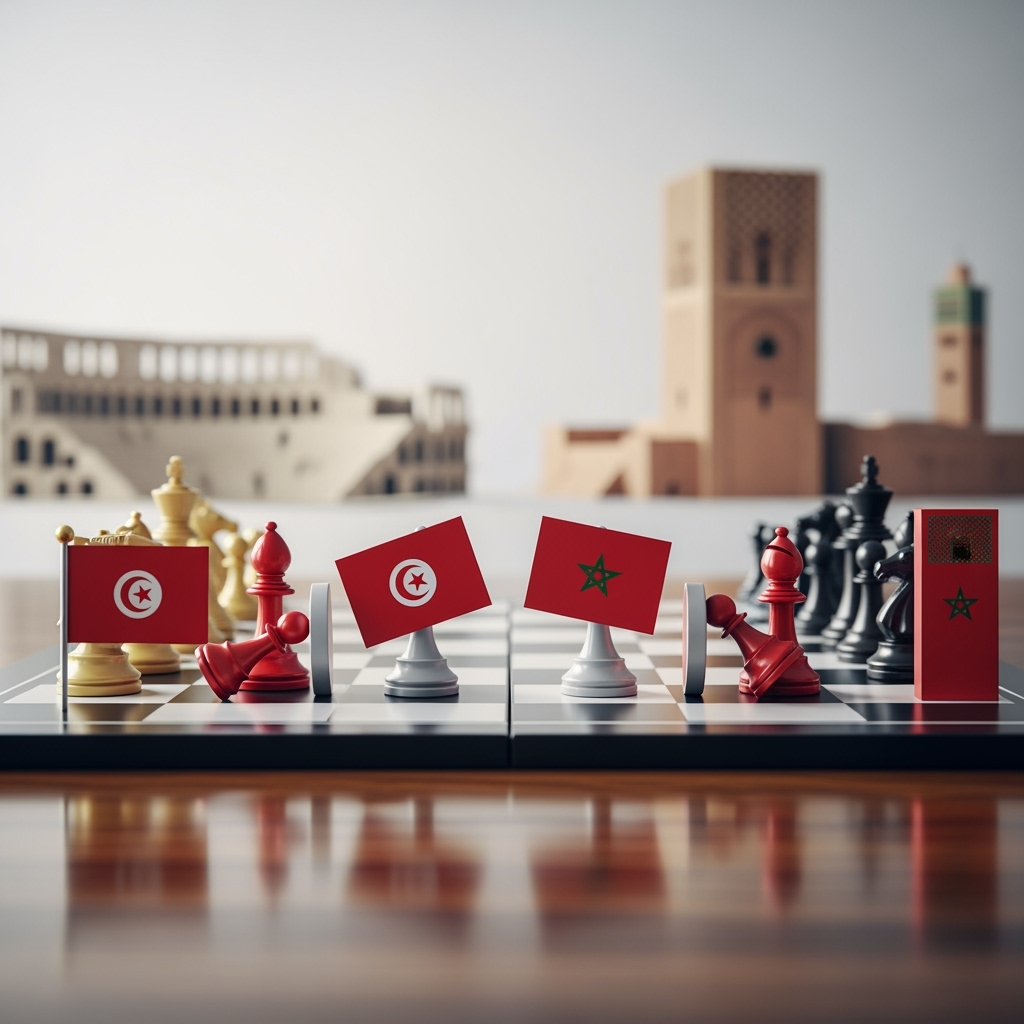
The crisis erupted when the President of the Republic, Kais Saied, received the leader of the Polisario Front, Brahim Ghali, on the sidelines of the Tokyo International Conference on African Development (TICAD 8), hosted by Tunisia. This action angered Rabat, which considers the Polisario Front a separatist movement threatening its territorial integrity. Since then, bilateral relations have entered an unprecedented path of tension, marked by Morocco withdrawing its ambassador from Tunisia and leaving the position vacant to this day, a move seen by observers as an unofficial message of rupture. This deterioration extended beyond diplomatic dimensions, casting shadows on economic and cultural cooperation that historically formed the pillars of the relationship between the two countries. Despite timid attempts to contain the dispute, reconciliation efforts remain stalled amid regional and international complexities, notably Tunisia’s rapid rapprochement with Algeria in recent years, which adds further sensitivities for Morocco. Amid this scene, the question arises: Will the unannounced Tunisian efforts succeed in restoring the situation, or will unresolved disagreements continue to prevent overcoming the crisis? The meeting between Moroccan Prime Minister Aziz Akhannouch and former Tunisian Foreign Minister Nabil Ammar in August 2024 in Marseille, on the occasion of the 80th anniversary of the liberation of southern France, was considered by many political observers in Tunisia a preliminary indicator of a potential breakthrough in the crisis between the two countries. In a conversation with ” “, the spokesperson for the “July 25 Process”, Mahmoud Ben Mabrouk, stated that there are unannounced diplomatic attempts recently pushing towards mending relations between Tunisia and Morocco. He explained that Tunisia’s position has historically been characterized by neutrality regarding the Western Sahara issue, refraining at several points from explicit bias toward any party in the conflict. He added, “This neutral approach remained even during the 2022 crisis. However, the protocol reception of the Polisario Front leader, Brahim Ghali, during the TICAD 8 summit, was interpreted in Rabat as a breach of this tradition, while Tunisia viewed it as a symbolic step that does not conflict with its foreign policy but falls within the context of expanding communication channels with various Maghreb parties.” Ben Mabrouk pointed out that the Tunisian President has emphasized on multiple occasions the unity of the Maghreb, affirming that Morocco is an essential part of this shared space, and that the two countries are linked by historical and fraternal ties that should not be hindered by temporary disagreements. He also called for moving past the incident of reception and opening a new chapter in bilateral relations, including developing trade exchanges that have been noticeably affected by the crisis. Notably, data from the Moroccan Exchange Office showed a decline in Moroccan exports to Tunisia since the beginning of 2024, with a 3.3% decrease in January, followed by a 9.5% drop in February of the same year, indicating tangible impacts of the diplomatic crisis on both sides. In the same context, political analyst Salah Al-Din Al-Jourshi sees that the course of the crisis between Tunisia and Morocco cannot be separated from regional developments, notably Rabat’s decision to normalize relations with Israel on December 10, 2020. Al-Jourshi confirmed to “Sputnik” that this decision negatively impacted the Tunisian stance, and the disagreement deepened further with Israel’s announcement on July 17, 2023, recognizing Morocco’s sovereignty over Western Sahara. According to Al-Jourshi, it was possible for both parties to contain the repercussions of the Polisario Front leader’s reception crisis in Tunisia, but subsequent developments pushed relations towards further deterioration, leading to the continued absence of ambassadors between the two countries until today, which practically means “cutting off official communication channels and halting exchanges,” as he put it. Despite this, Al-Jourshi expressed hope that ongoing diplomatic efforts will bear fruit, considering that Morocco and Tunisia share strengths that can be leveraged to reactivate bilateral relations, but he stressed that these initiatives came late and could have been launched years ago to avoid deepening the rift. Al-Jourshi points out that part of the scene’s complexities is related to recent times, after receiving direct financial support in the form of a $150 million deposit at the beginning of 2020, followed by additional loans and grants at the end of 2022, as well as a series of cooperation agreements. On the energy front, Algeria remains the main gas supplier to the Tunisian market, with supply contracts extended until 2027, giving it an additional leverage in regional relations. Political analyst Salah Al-Din Al-Jourshi, in his statement to “Sputnik”, suggested it would have been better for the Tunisian side to insist on involving Morocco, even at a consultative level, when Algeria proposed holding a mini-Maghreb summit. He added, “Excluding Morocco from this path contributed to deepening the state of stagnation,” adding, “The failure of the agreement between the three parties so far has left the Arab Maghreb Union in a state of continuous paralysis.” Al-Jourshi notes that restoring Tunisian-Moroccan relations does not only have a bilateral dimension but could contribute to reviving the Maghreb Union, which has remained frozen and paralyzed for years due to political disagreements. The last Maghreb Union summit was held in Tunisia in 1994, before alternative consultation mechanisms emerged, the most prominent being the trilateral framework that focused on security, irregular migration, and border area development issues. The last trilateral summit took place in Tunisia in April 2025, attended by Tunisian President Kais Saied, Algerian President Abdelmadjid Tebboune, and Libyan Presidential Council Chairman Mohamed Younis Menfi, indicating Morocco’s continued absence from the new regional dynamic. It is worth mentioning that the treaty aims to achieve economic integration among member states, coordinate views and positions on international issues, in addition to strengthening fraternal ties between the peoples of the region, and contributing to maintaining peace based on justice and fairness. However, ongoing bilateral disagreements, especially between Morocco and Algeria, and later between Morocco and Tunisia, have made these major goals hostage to political tensions.