
For years, the UAE was notable for one key reason: no income tax on salaries. This straightforward promise, coupled with business-friendly laws and dazzling infrastructure, transformed the young federation into a global hub for talent and investment.
The concept was simple — move to Dubai, Abu Dhabi, or Sharjah, work diligently, and keep all your earnings. Over time, this simplicity became legendary, a cornerstone of the nation’s economic identity.
However, as the global economy evolved, so did the UAE. The once “tax-free” haven is now becoming more sophisticated. The nation introduced a 5% VAT, excise duties on harmful goods, and recently, a 9% corporate tax on business profits.
Starting January 2025, the regulations tighten further for the world’s largest companies, as the UAE implements a 15% domestic minimum top-up tax in alignment with OECD global standards.
These changes aim not to diminish the nation’s allure but to strengthen it, ensuring the UAE’s global competitiveness for the future.
A Real Test of the New Era
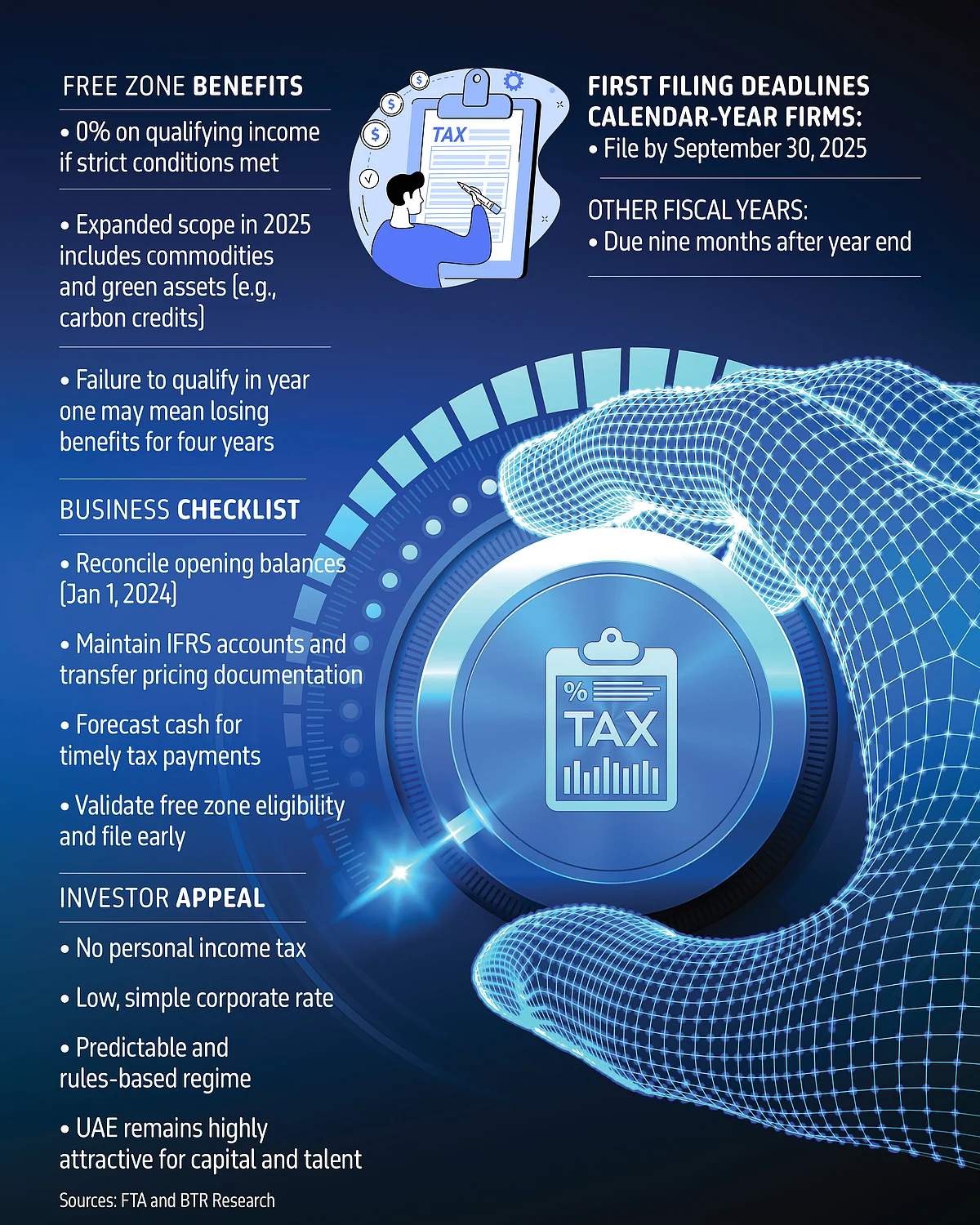
The real challenge of this new era is approaching. By September 30, 2025, thousands of companies must submit their first corporate tax returns. This is more than just a deadline; it represents a cultural shift. Filing VAT returns was relatively easy, but corporate tax demands higher discipline. Businesses must calculate profits according to international accounting standards, document transactions with related entities, and maintain financial records fit for scrutiny. Choices made in the initial filing — how revenue is recognized, how expenses are matched — will have long-term implications, shaping tax obligations for years. While the learning curve is steep for some, the broader message is clear: the UAE is progressing from light regulatory oversight to full financial maturity.
What Remains Unchanged
Yet, much remains the same. Individuals still enjoy no personal income tax, a point the government emphasizes repeatedly. This assurance is significant for the millions of expatriates who call the Emirates home.
VAT, introduced in 2018, is now an established part of the economic landscape, while excise duties introduced a year earlier continue to encourage healthier consumption habits. The depth of the framework has evolved. Although modest by global standards, the corporate tax introduces a structure that requires companies to plan, document, and operate with global best practices.
Benefits for Small Businesses
Small businesses are protected. Profits up to Dh375,000 are tax-exempt, meaning many micro-enterprises owe nothing. Yet, the requirement to register and file returns encourages even the smallest firms to adopt professional standards. The burden is lighter for them, but the benefit is long-term credibility with banks and suppliers. Over time, even the smallest café or consultancy will find that its IFRS-compliant statements open doors to better financing and larger opportunities.
For multinationals, the new domestic minimum tax ensures compliance with OECD’s global reforms while safeguarding the UAE’s tax base. Without it, profits earned in Dubai or Abu Dhabi could be taxed elsewhere. By acting early, the UAE maintains control of its fiscal future while demonstrating to the world that it is a serious, rules-based jurisdiction. The Emirates’ allure for these companies — infrastructure, skilled workforce, advantageous time zone, and enviable lifestyle — remains, now enhanced by the credibility of modern regulation.
Renewed Free Zone Clarity
Free zones, once the gems of the UAE’s economic model, have gained renewed clarity. Investors have long asked what types of income qualify for the celebrated zero-percent corporate tax rate. The answer arrived through new ministerial decisions in 2025. These refine the list of qualifying activities, expand commodity trading to include environmental products like carbon credits, and link zero-rate benefits to transparent, recognized price benchmarks. By tightening the rules, the government preserves the spirit of free zones — promoting trade, innovation, and sustainability — while preventing misuse. For companies in Jebel Ali, Kizad, or DIFC, the new guidelines provide confidence that their incentives are grounded in solid law.
Reshaping Business Rhythm
The impact of these reforms extends beyond taxation. They are reshaping the rhythm of business life. Under VAT, quarterly reconciliations were sufficient; under corporate tax, continuous discipline is required. Monthly closings, rolling forecasts, reconciled balances, and transfer pricing documentation become standard. This is a cultural shift toward permanence and predictability, reassuring investors and lenders that the figures they see are reliable. Companies that adapt quickly will gain a competitive advantage: lower borrowing costs, easier cross-border market access, and greater trust from stakeholders.
Investors, in particular, are observing closely. What they see is a jurisdiction that has outgrown the need to rely solely on “tax-free” branding. The UAE offers something rarer: stability. Tax bases and rates are legally set, not left to opaque discretion. Incentives are preserved but tied to legitimate activities. Enforcement is digital and data-driven, not arbitrary. The message is clear but powerful — this is a place where you know the rules, and you can plan accordingly.
Resounding No to Income Tax
Of course, speculation never fully dissipates. Occasionally, talks resurface about whether the UAE might introduce personal income tax one day. For now, the official stance is a resounding no. Analysts who entertain the possibility envision that, if it ever occurred, it would be light-touch, high-threshold, and carefully targeted.
The reality is that the UAE’s allure extends far beyond taxation. In 2024, the country attracted 6,700 new millionaires, the most globally. In 2025, that number is expected to rise to nearly 9,800. They come not just for tax benefits, but for long-term visas, a safe environment, exceptional connectivity, and a cosmopolitan lifestyle that few other places can match.
Perhaps the least obvious but most transformative benefit of tax reform is data. With companies now required to document intercompany pricing, reconcile accounts monthly, and file detailed disclosures, regulators and executives gain sharper insights into the economy. This transparency allows lenders to better assess risks, boards to make quicker decisions, and policymakers to design evidence-based incentives. Over time, this cycle of compliance leading to clarity, and clarity driving capital, is likely to be one of the most enduring benefits of the UAE’s new fiscal regime.
Keep the Books Clean
For businesses, the checklist is becoming second nature: maintain clean books, file on time, plan cash flow around tax payments, and validate free-zone eligibility according to the latest guidelines. Those that do so will not only avoid penalties—they will earn trust. In a world where capital pursues credibility, trust is the ultimate asset.
In conclusion, the UAE is not abandoning its identity as a pro-business nation; it is upgrading it. By not taxing personal income, setting a modest corporate rate, implementing global minimums only where necessary, and clarifying free-zone rules, the country is building a system that is both competitive and durable. It is no longer just “low-tax.” It is “high-trust.” And for global investors weighing risk and reward, that combination may prove even more attractive than the old promise of tax-free living.
A New Chapter
The Emirates has embarked on a new chapter — not of retreat, but of renewal. As the first wave of corporate tax returns is filed and businesses adjust to the new rhythm, the world will see a country that has embraced global norms while retaining its unique edge. In doing so, the UAE is not only safeguarding its reputation as a hub for capital and talent but also future-proofing its economy for the next decade of growth.