The UAE’s space sector is ushering in a new era of innovation and growth, positioning the nation as a global center for investment, research, and business opportunities.
Since 2017, the UAE has been actively monitoring the growth of its space economy through initiatives like the UAE Space Economic Survey, assessing its impact on GDP, R&D investment, workforce development, and downstream industries that benefit from space technologies.
This framework aligns with OECD and UN standards, boosting global comparability and investor trust.
Stay informed with the latest updates. Follow KT on WhatsApp Channels.
Expanding R&D and industry impact
Recent data indicates promising trends. A 2021 survey noted a 14.8% increase in R&D spending, significant contributions from the communications sector, and a rise in scientific publications, indicating a maturing and diverse UAE space ecosystem.
Speaking to Khaleej Times at the Space Economic Survey 2025 announcement, Fatima Al Shamsi, Director of Space Policy and International Relations at the UAE Space Agency, mentioned that the survey assists policymakers and industry in tracking progress in crucial areas.
“We emphasize increasing private companies and startups in the space sector. We trust youth and talent to drive innovation. Another focus is understanding the cross-sectoral impact of our missions—how space technologies apply to industries like agriculture, telecom, and climate monitoring.”

Fatima Al Shamsi. Photo: Nandini Sircar
She added that the UAE is committed to ensuring regulations and support systems foster growth.
“We simplify authorization for space companies and have launched initiatives like the Space Economic Zones program, which offers incentives for startups to thrive. We also engage continuously with our ecosystem through workshops, partnerships, and international events.”
Startups in major missions
The UAE Space Agency’s ‘Space Means Business’ initiative is a key step in integrating startups into flagship missions.
Al Shamsi explained that the Emirates Mission to the Asteroid Belt is designed to create opportunities for local companies.
“Executing such a mission involves various components that can be developed with private sector contributions. Even if startups play a small role, it ensures their presence in major projects and benefits from the knowledge and contracts generated.”
Salem Butti Al Qubaisi, Director-General of the UAE Space Agency, noted that national industry contributions are already shaping mission development.
“The design review of the MBR Explorer was completed successfully earlier this year, and the spacecraft is beginning to take shape. Initial testing, including vibration trials, has already started. Our national industry is directly involved in developing the lander—a UAE contribution to this mission—that will eventually land on one of the asteroids.”
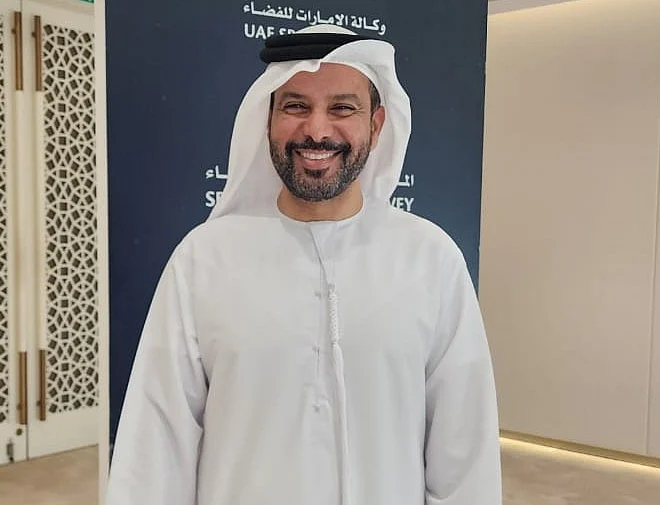
Salem Butti Al Qubaisi. Photo: Nandini Sircar
Non-space sectors benefit from space services
The UAE broadly defines its space economy, covering satellite manufacturing, launch systems, and propulsion technologies, along with non-space sectors benefiting from space services such as telecom, transport, agriculture, and climate monitoring.
This approach fosters cross-sector innovation and attracts foreign investment.
Highlighting future steps, Al Qubaisi added, “We aim to strengthen partnerships, especially with the private sector and R&D centers in the UAE, to enhance midstream and upstream activities in the value chain. Insights from the survey and our engagements highlight areas where we need to align strategies, improve infrastructure, and streamline licensing processes. Our goal is to make these processes efficient and supportive, not obstructive, for stakeholders to execute their initiatives.”