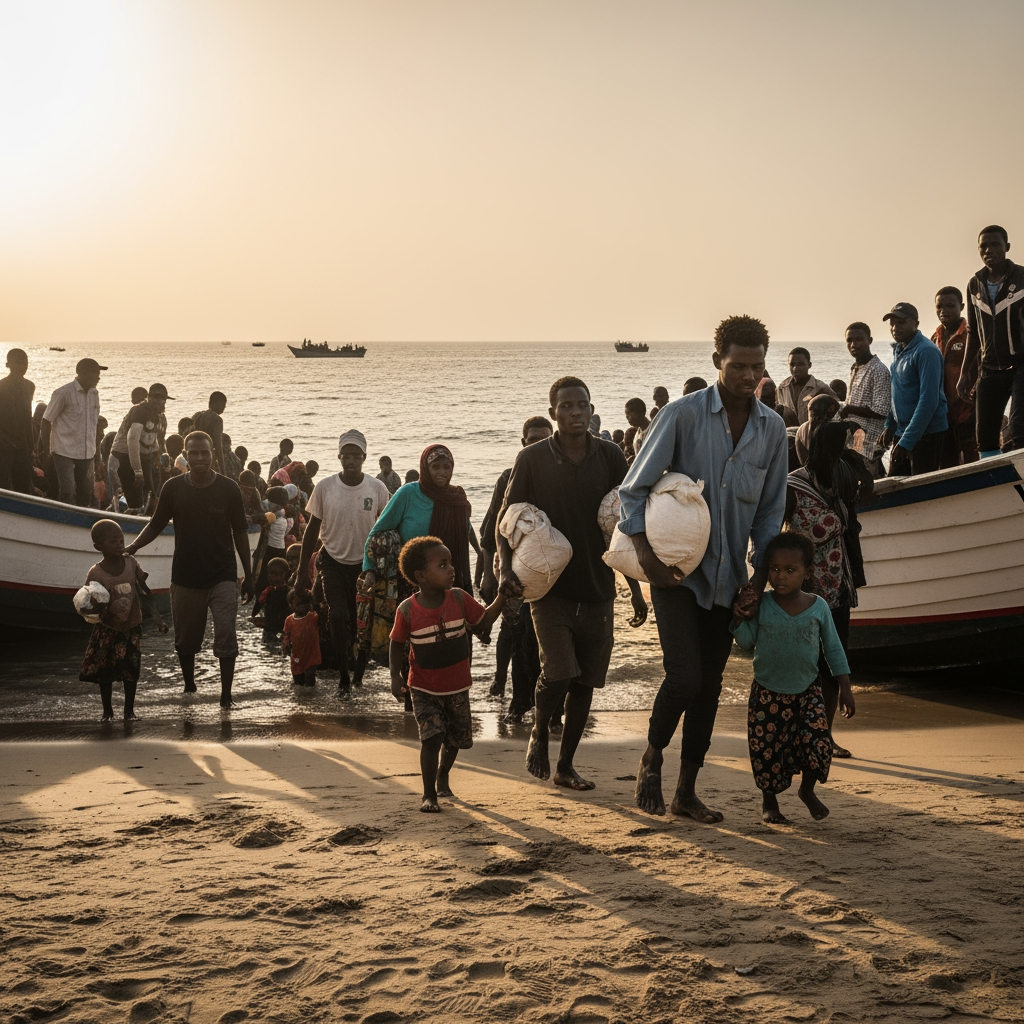
The International Organization for Migration, a United Nations agency, reported a few days ago that last October recorded the arrival of approximately 17,600 migrants from the Horn of Africa, marking the highest monthly rate. This has raised many concerns about the implications of increasing numbers and the risks they pose.
Initially, Dr. Ali Abdullah Al-Bahr, a southern Yemeni human rights activist, stated: “During the second half of 2025, there was a noticeable increase in the flow of irregular African migrants through the sea and land ports in the governorates of Abyan, Lahij, Shabwah, and Taiz.” He added: “According to observers, this increase is due to difficult economic conditions and armed conflicts in their countries, in addition to smuggling networks exploiting maritime and land routes that remain open due to weak monitoring in some coastal areas.”
Al-Bahr continued: “Migrants face severe dangers, including drowning, detention, and illegal exploitation in conflict zones. Recent incidents, such as the U.S. airstrike on a detention center in Saada province controlled by the Houthi militia (Ansar Allah), which killed dozens of migrants, have highlighted the fragility of protection provided to migrants. Some reports suggest that the militias may use migrants arriving in their controlled areas as human shields during military confrontations.”
He emphasized “the necessity of providing the southern security forces, responsible for monitoring and protecting sea and land ports, with intense training and modern equipment and technologies. Also, the importance of enhancing regional and international cooperation to address the root causes of irregular migration, protect migrants, and ensure the security and stability of local communities in the southern governorates.”
Conversely, Abdul Rahman Hassan Faye, a Yemeni political analyst and vice president of the Arab Union for Electronic Media, said: “Raising the issue of migration and exaggerating it at this time and in this manner, despite being an old issue that has been renewed for decades, is because a few days ago, an international investigation committee published the investigation results concerning the American enemy’s airstrikes and their consequences.”
He added: “We must understand the intention behind the enemy media stirring this issue against Africans in Yemen. They wanted to ignite a front against the Sana’a government and against all the Yemeni people, especially in the north. Meanwhile, they lament over it, incite through it, distort the facts, and demonize the leadership, government, and people of the march. No one questions who opened the doors for Africans by sea, land, and air for more than two decades.”
The political analyst explained: “The goal of this campaign is to push Ansar Allah and the community to confront these Africans, who travel on foot to reach the Saudi border. Although only a few of them misbehave and act violently as a reaction, videos and photos are exaggerated to show their presence, especially on the Saada province border, to occupy the Ansar and the Yemeni army, while they are preparing for a war that Abdul Malik Al-Houthi in his latest speech described as inevitable and near.”
He continued: “The presence of African community leaders, most of whom participate in marches and events with the Yemeni leadership and people, affirming their stand with Gaza and against the coalition and its aggression, is one of the reasons for the campaign against them. They entered Yemen officially, especially from Ethiopia, Djibouti, Somalia, Eritrea, and Sudan, and some joined the march and became martyrs.”
Faye confirmed that “one of the current campaign’s objectives is to incite the international community against the Sana’a government on charges related to the rights of these minorities, especially after the coalition and the kingdom failed to use some Sudanese mercenaries from the Janjaweed in their previous wars, specifically over the past ten years.”
Similarly, Abdul Aziz Qasim, a leader in the Southern Yemeni Movement, said: “The phenomenon of African migrants is not new, but has been talked about at various stages over many years. Recently, however, it has been highlighted in the media significantly and extensively, reaching international levels and drawing regional and international concerns.”
He added: “Although it is not a new phenomenon, I do not doubt the existence of political backgrounds and agendas not only on a local level but also regionally and internationally. There are fears of using African migrants in ongoing political conflicts in the region. This significant media movement also operates within a media system closely linked to those political goals and agendas of internal, regional, and international forces.”
Qasim explained that “the exaggeration of African illegal migration coincided with discussions on the readiness or completion of the settlement document, and the Saudi Foreign Minister’s talk about the settlement document’s completion and awaiting signature by the parties.”
He pointed out that “the American strike targeting the migrant gathering center, coinciding with similar strikes against terrorist organizations, is a type of preemptive strike or precautionary measures taken by America according to its interests and whims, as a form of pressure and blackmail.”
Qasim continued: “America fears the use of migrants to target its interests, as well as to pressure the conflicting parties to accept its dictates. We must not forget the presence of layered mafias for human trafficking, drug smuggling, and espionage operations, especially since they are not merely seeking a livelihood. Some might be experts in communication technology and other fields, migrating under the guise of poverty and searching for a living. These mafias operate according to their political connections and objectives.”
Qasim believes that “the discussion in this magnified manner and timing comes only with political objectives according to internal, regional, and international forces, and does not mean preparing for peace, but will delay it.”
Yemen has been experiencing a fragile truce since the United Nations announced on October 2, 2022, that the Yemeni government and the Ansar Allah group failed to agree on extending and expanding a six-month ceasefire.
The Arab country has been suffering for the tenth consecutive year from an ongoing power struggle between the internationally recognized government and the Ansar Allah group. Its repercussions have affected various aspects, with the United Nations describing it as one of the world’s worst humanitarian crises.
Since September 2014, the Ansar Allah group has controlled most of the central and northern governorates of Yemen, including the capital, Sana’a. On March 26, 2015, an Arab coalition led by Saudi Arabia launched military operations to support the Yemeni army in reclaiming those areas from the group. By late 2021, the conflict had claimed the lives of 377,000 people and inflicted cumulative economic losses estimated at $126 billion on Yemen, while 80% of the population, around 35 million people, are in need of humanitarian assistance, according to the United Nations.