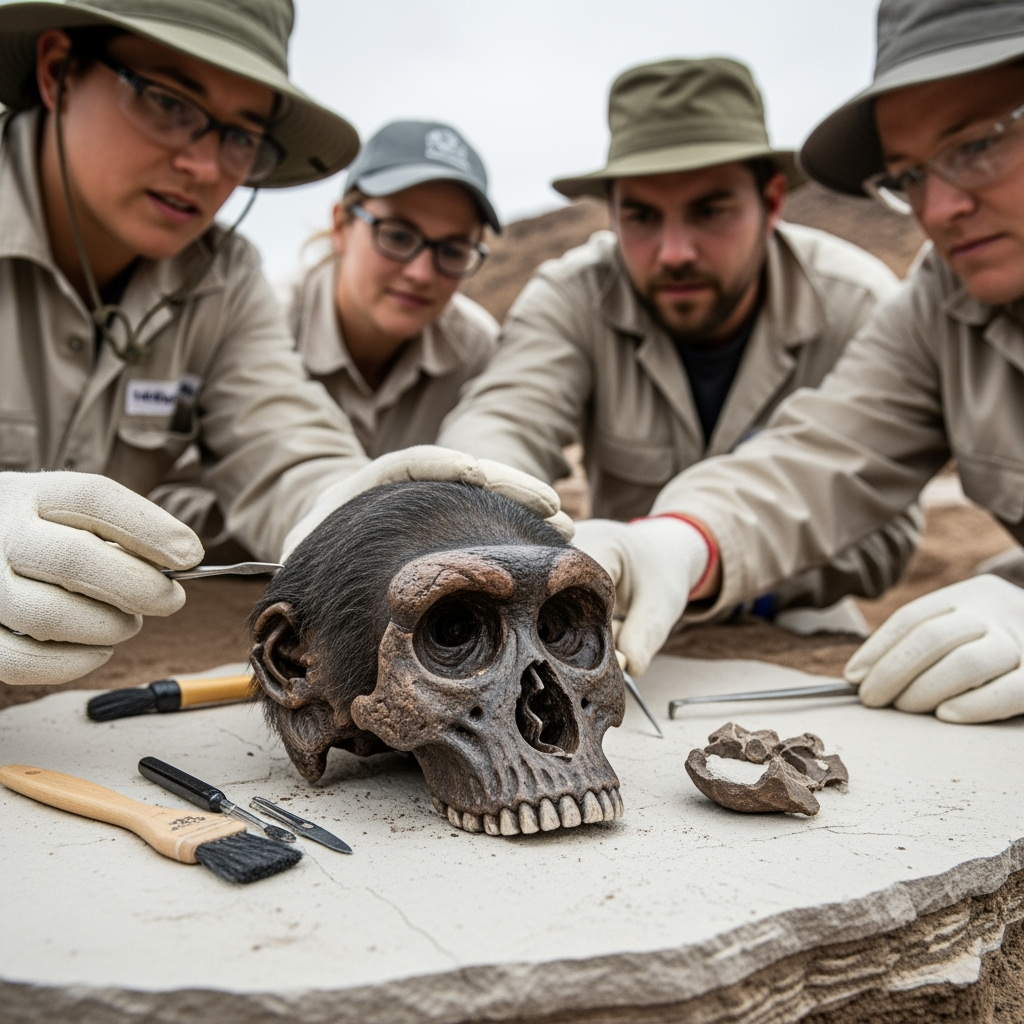
For nearly a hundred years, researchers have studied puzzling fossils belonging to a distant and unfamiliar relative of early humans, known as Paranthropus Robustus. This species, which walked upright, was adapted for powerful chewing, equipped with large jaws and massive teeth covered with a thick layer of enamel. Evidence suggests it lived approximately between 2.25 million and 1.7 million years ago. The first fossils of Paranthropus Robustus were discovered in South Africa in 1938, and today’s human lineage includes a wide range of ancient relatives and ancestors who lived millions of years in the past.
Fossil evidence traces the evolution of these early relatives back to Australopithecus Africanus, who lived 3.67 million years ago. These remains also represent major evolutionary milestones, such as the shift to bipedal walking, the emergence of tool use, and the growth of brain size. Ultimately, modern humans (Homo sapiens) appeared in South Africa around 153,000 years ago.
Using prior methods, African and European researchers in molecular sciences, chemistry, and paleoanthropology discovered that the fossil evidence found in Africa belonged to two male and two female individuals. Analyzing protein sequences revealed subtle genetic differences between the fossils, with one notable variation occurring in a gene responsible for enamel production, a key protein involved in tooth enamel formation. Two individuals shared an amino acid found in both early and modern humans, as well as in chimpanzees and gorillas. The other two possessed an amino acid not yet identified among African great apes, except in Paranthropus.
Most surprisingly, one individual carried both amino acids, providing the first recorded example of heterozygosity (having two different versions of a gene) in proteins dating back two million years. These findings offer a new perspective on human evolution, potentially altering how scientists interpret diversity among early ancestors. They also provide some of the oldest human genetic data retrieved from Africa, paving the way for a deeper understanding of relationships among individuals and increasing the possibility of determining whether the fossils represent different species.