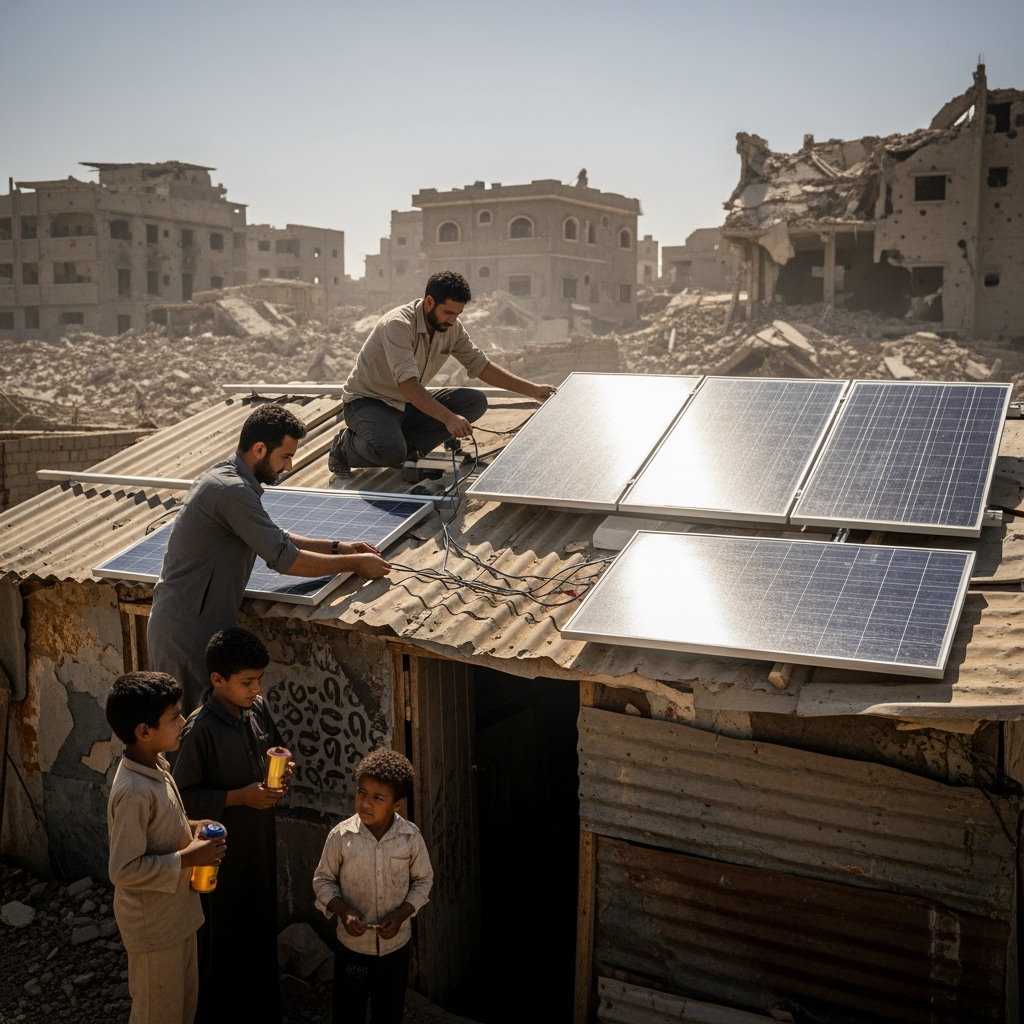
Cairo – Sputnik. The shift to solar energy comes after oil exports, which were the main source of government revenue, stopped due to attacks by the “Ansar Allah” group on export ports in October 2022. This pushed the government to search for solutions amidst a severe financial crisis affecting essential services, particularly electricity. The high cost of fuel used in traditional power plants further encouraged the government’s move towards solar energy. Former Prime Minister Ahmed bin Mubarak announced in May 2024 that the government spent over 1 trillion and 10 billion riyals on fuel in 2023.
In the second phase of the project, launched with support from Abu Dhabi last week, an additional 120 megawatts were added, bringing the total production capacity to 240 megawatts. This phase is expected to cover the needs of about 687,000 homes annually and reduce approximately 142,000 tons of carbon dioxide emissions each year.
The second solar power plant in Yemen was established in Shabwa Governorate, inaugurated with a capacity of 53 megawatts. The station includes over 86,000 panels and can expand its capacity to 120 megawatts in the future. Additionally, the “Al-Khoukha” station in Al-Hudaydah Governorate was inaugurated in 2023, with a capacity of 20 megawatts, operating over 32,000 solar panels over an area of 403,000 square meters, with plans to increase its capacity to 40 megawatts in the future.
These solar power projects are expected to directly improve the living standards of Yemenis by providing continuous electricity to homes, helping residents carry out their daily tasks more efficiently. These projects also enable schools and educational institutions to operate without interruption, positively impacting the quality of education and students’ futures.
According to those involved in these initiatives, the projects funded by the UAE in Yemen are not just a source of clean electricity but represent an effective model for sustainable development and humanitarian concern. In this context, Anwar Al-Tamimi, spokesperson for the Southern Transitional Council, stated on the “X” platform that “building solar power plants represents strategic projects in every sense of the word,” affirming that “UAE support goes beyond emergency relief to building sustainable economic and service infrastructure, driving development in the benefiting areas.”
This comes amid a fragile truce in Yemen since the UN announced on October 2, 2022, that no agreement was reached between the Yemeni government to extend and expand the truce that lasted six months. Since “Ansar Allah” took control of most provinces in northern and central Yemen, including the capital Sanaa, in September 2014, the Saudi-led Arab coalition launched military operations in March 2015. By the end of 2021, the war had claimed the lives of about 377,000 people and caused losses to the Yemeni economy estimated at $126 billion. Meanwhile, 80% of the population – about 35 million people – need humanitarian assistance, according to UN reports.