Zohran Mamdani, the incoming mayor of New York City, recently found himself covering the floor of his $2,300-a-month apartment with towels due to a leaking sink. The building super was called in to fix the issue, but that wasn’t the only challenge he faced.
“My wife and I have realized that a one-bedroom apartment is now too small for us,” he shared on “The New Yorker Radio Hour,” after describing the plumbing problems.
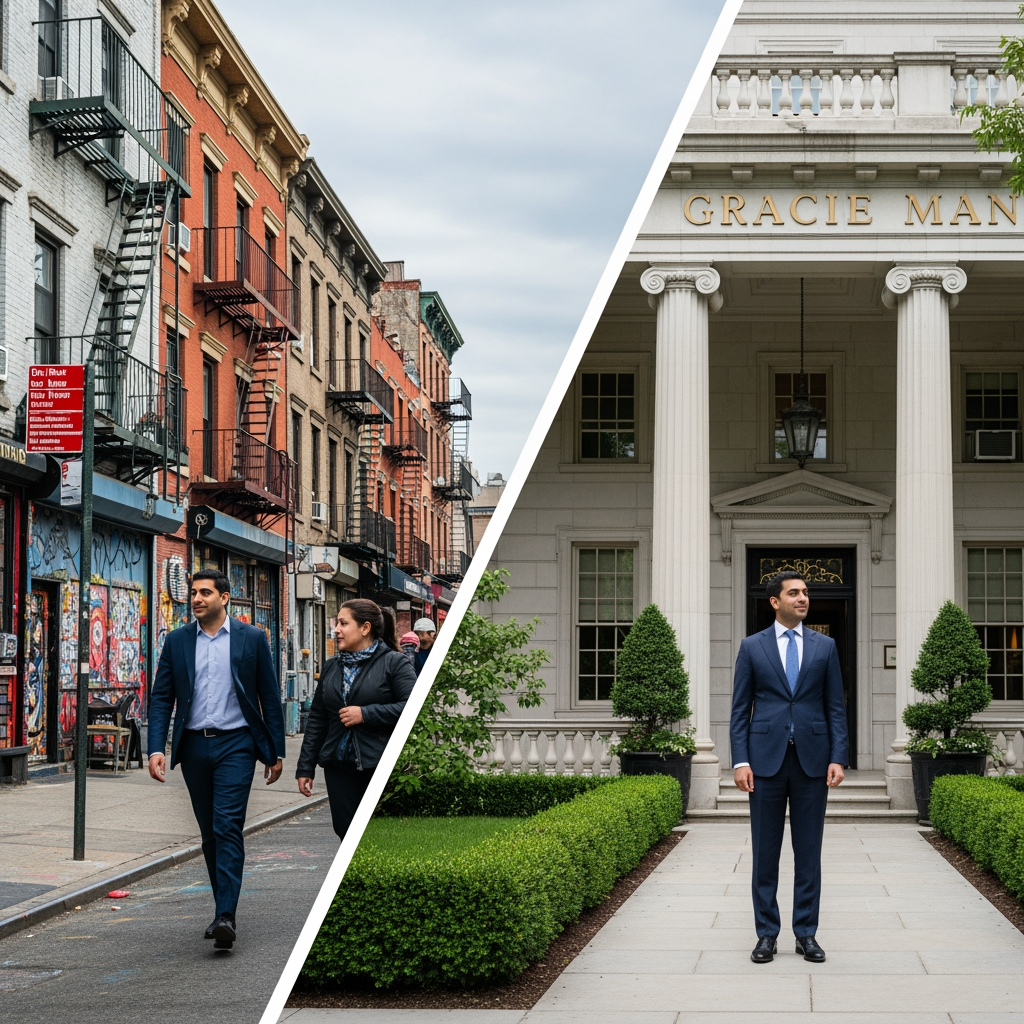
If Mamdani opts to move into Gracie Mansion, the official residence for New York City’s mayor, he likely won’t have to handle such everyday issues for much longer, and his new home will certainly be more spacious.
Stay informed with the latest updates. Follow KT on WhatsApp Channels
The contrast between Mamdani’s current modest rent-stabilized apartment in Astoria, Queens, and Gracie Mansion is significant. Gracie is a 226-year-old, 11,000-square-foot historic home on the Upper East Side, adorned with chandeliers, faux mahogany doors, and surrounded by a large lawn with apple and fig trees, along with a vegetable garden.
Dante de Blasio, who moved into Gracie Mansion as a teenager when his father Bill de Blasio became mayor, felt like “the luckiest kid in America” upon their arrival in 2014.
“Growing up in New York, space is a luxury,” he commented. “Suddenly, we had a lawn and a ballroom.”
However, he noted it could feel isolating. “You become disconnected from the daily life in New York City, with all its highs and lows,” he added.
Despite Mamdani’s plans to move out of his current apartment, he was noncommittal about relocating to Gracie Mansion when asked Wednesday morning.
“I don’t have a definitive answer yet on where I’ll live,” he mentioned in a TV interview, “but I can confirm where I’ll be working, and that’s City Hall.”
Later that day, during a news conference, the mayor-elect joked about receiving a late-night message from his super.
However, Gracie Mansion is where most mayors eventually reside, due to its security and space for gatherings, whether they prefer it or not.
Here’s how Mamdani’s current apartment differs from what could be his future residence.
Heat and hot water included
When Mamdani’s Queens apartment was last on the market in 2018, the listing highlighted a key benefit, as mandated by New York City law: heat and hot water included in the rent.
Additionally, the kitchen featured a window, the bedroom had two closets, and the super lived onsite.
While the apartment lacked a washer or dryer, a communal laundry room was available in the building.
The building, a low-rise from 1929 with pale brick, includes an elevator, which brokers note is uncommon in Astoria.
Though Mamdani’s campaign team didn’t discuss the details, brokers estimate the unit is about 800 square feet at most.
Or a full-time chef and on-site ballroom?
Conversely, Gracie Mansion has been described by a New York Times journalist as a “pale lemon cake of a house.” Located atop Carl Schurz Park beside the FDR Drive, it offers expansive views of the East River from its summer veranda.
Mayors, after their downtown duties, are chauffeured through Gracie’s secure gate to the front door, which features a mezuza, a scroll of Torah verses, first installed by Mayor Abraham Beame in the 1970s.
The ground floor is ornately decorated in Federal style and is off-limits for the mayor to alter. It features a grand fireplace in an entertaining room where Mayor John Lindsay’s children hung their Christmas stockings in the late 1960s, along with a sitting room and a dining room wrapped in Parisian garden wallpaper.
Meals for mayors are prepared by Gracie’s full-time chef.
The ballroom, opened in 1966, was noted by the Times for being “as formal and as balanced as a Haydn quartet.”
The upper floor houses five bedrooms.
Several mayors have worked to make this formal mansion feel more homey.
De Blasio’s family hired a decorator from West Elm to modernize the residence, converting one room into a home office. Beame’s family turned another room into a dinette for occasional midnight snacks.
The daughters of Lindsay, Rudy Giuliani, and Michael Bloomberg, as well as Chirlane McCray, de Blasio’s wife, have all etched their names on a windowpane downstairs.
The ultimate perk: Room for parties
Hosting a lively party in a one-bedroom apartment like Mamdani’s, with neighbors nearby, is challenging. However, Gracie Mansion was designed for events.
Mayor Eric Adams has hosted receptions honoring Arab, Ecuadorian, and Guyanese New Yorkers, along with events for Fleet Week, Women’s History Month, and Nowruz, all within a few weeks this year.
Adams’ son, Jordan Coleman, a rapper, once held a holiday party there, performing songs from his new album.
Giuliani was evicted by his then-wife Donna Hanover after announcing their divorce in a surprise news conference. He later remarried on the lawn, with a tuxedoed Donald Trump in attendance.
Dante de Blasio encouraged Mamdani to utilize the house fully instead of treating it like a museum.
“You should host parties,” Dante advised. “I had some great birthday parties.”
Astoria versus the Upper East Side
Astoria, represented by Mamdani in the Assembly, has been a haven of affordability for young people and families who settle on its peaceful residential streets, enjoy its waterfront park, and send their children to good public schools. The neighborhood is home to immigrants from Greece, Egypt, and Morocco, along with a significant Latino population.
It’s a pleasant, though not particularly upscale, part of the city.
Then, there’s the Upper East Side.
This area has long been one of New York’s most affluent and elite neighborhoods, housing some of the world’s most renowned museums and Instagram hotspots like Bemelmans Bar at the Carlyle Hotel, where patrons can sip on $28 martinis and stay overnight for $1,000 or more.
The area is quiet, often nearly empty during summer weekends when residents retreat to the Hamptons or Nantucket.
While it’s easy to find a cheeseburger or spaghetti pomodoro, discovering the type of cuisine Mamdani enjoys in Astoria, one of the city’s premier dining neighborhoods, requires more effort.
Mamdani recently recommended the raw spicy beef at Pye Boat Noodle, a Thai restaurant in his neighborhood, and frequents his favorite local seafood spots: Bahari Estiatorio, Elias Corner, and Abuqir, where a whole branzino is priced at $23.99.
On the Upper East Side, at the Mark Hotel’s restaurant near Central Park, a piece of grilled black sea bass costs $72.
Safety first
Mamdani’s current apartment lacks a doorman or sophisticated security system.
The real advantage of Gracie Mansion may be its high fence, monitored by cameras, and the police officers stationed outside.
This is why the de Blasios eventually moved in, and the former mayor urged Mamdani to do the same: “He definitely should go to Gracie.”
Fiorello LaGuardia, the first mayor to reside at Gracie, reluctantly moved from his East Harlem apartment at Robert Moses’ urging during World War II due to safety concerns.
LaGuardia attempted to rebrand Gracie Mansion as Gracie Farm. The name didn’t catch on, but his wife managed the housekeeping and dried the family’s laundry on the lawn.
Mayor Eric Adams has identified a different kind of threat.
“There are ghosts in there, man,” he joked during his first year in office.
The mayor, who reportedly spends only a few nights a week at Gracie, according to cell phone data from federal prosecutors, was not home around 4 a.m. on New Year’s Day this year when an unarmed man scaled the fence and entered the mansion, taking a Christmas ornament.
Michael Bloomberg never moved into Gracie, preferring his nearby townhouse, which is even more luxurious.
Ed Koch continued living in his rent-stabilized apartment in Greenwich Village after his election but soon faced numerous calls from constituents, as he hadn’t changed his home phone number. Eventually, he opted for practicality and moved to Gracie, although he kept his apartment.
“I said you can get used to posh very quickly,” Koch reflected after losing his 1989 reelection bid. “And I did.”