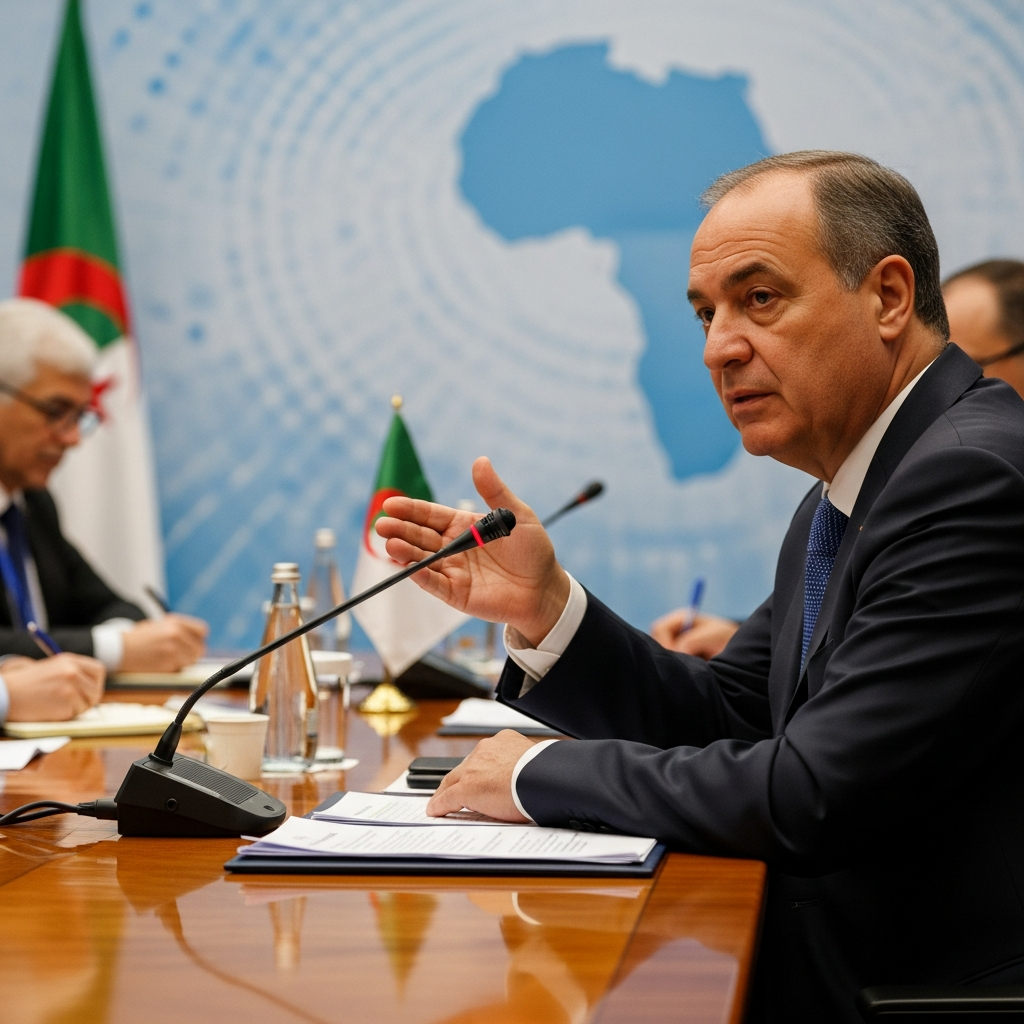
Algerian Foreign Minister Ahmed Attaf said at the conclusion of the session: “Our session had unique importance, as it highlighted the major security and political challenges facing our African continent at this stage. These are challenges that arouse concern, challenges that require sounding the alarm bells, and challenges that awaken in us a sense of continental duty and the spirit of collective responsibility.” The Algerian minister added that “the unconstitutional changes of governments have unfortunately become a familiar scene in Africa, to the extent that the continental organization was recently forced to suspend the membership of two countries within a brief period not exceeding forty-two days.” Attaf continued: “Foreign interventions have dominated most of the areas of tension, crisis, and conflict in Africa, to the point that the keys to resolution and decision-making are in the hands of foreign intruders, not the local parties of the land and nation, and not the sovereign decision-makers.” The Algerian Foreign Minister added that “the complementary relationship between the African Peace and Security Council and the group of African members of the UN Security Council must be strengthened,” emphasizing that “the unity of the African Peace and Security Council creates the unity of the African members of the UN Security Council,” and that “the unity of the group of African countries in the UN Security Council grants them weight, credibility, strength, and stability in the face of polarizations, divisions, and disputes, and the unity of the African countries in the UN Security Council gives them a powerful voice and a significant influence when it comes to issues of peace and security in Africa.” Political analyst Mostafa Bourzama told Sputnik, “The African Peace and Security Conference is part of the Algerian state’s strategy to unify African opinion on issues of peace and security that trouble the African continent,” confirming that “Attaf spoke about a very important trilogy: firstly, the unconstitutional path pursued by some African countries which puts the continent at risk of division.” He added: “Algeria always emphasizes the constitutional path and advocates against terrorism, which has gained significant ground in some African countries. Given Algeria’s strength in combating terrorism, it has always called for drying up the sources of terrorism by identifying those who fund it with money and advanced weapons and use it as tools for instability.” The director of the newspaper “Akhbar Al-Watan,” Riad Houili, told Sputnik that “the African Peace and Security Conference tried to bring Africans together around a unified roadmap, despite all the alignments in the continent fueled by foreign and internal interventions. However, this does not prevent Africa from having the African Union as a mechanism for conflict resolution, consultation on African issues, and defining Africa’s relationship with the outside world, the United States, China, Europe, Japan, and others. Therefore, the African Union can, through this conference, draw a roadmap to resolve conflicts in the African continent.” The speaker considered that “Algerian Foreign Minister Ahmed Attaf summarized Algeria’s role for the African continent. Algeria advocates for solving African problems and believes that some countries can play a pivotal role in Africa to build real development, which involves controlling political, economic, and social conflicts. Algeria wants to expand the powers of the African Union to be more effective.” He concluded that “economic integration is possible today, and this is what Algeria calls for through many energy and economic development projects funded by Algeria, without neglecting the debt cancellation it has done for 14 African countries. It helps countries, especially border ones, without interfering in their internal affairs, which has earned it the respect of African countries. This is a deeply rooted view in Algerian foreign policy.”