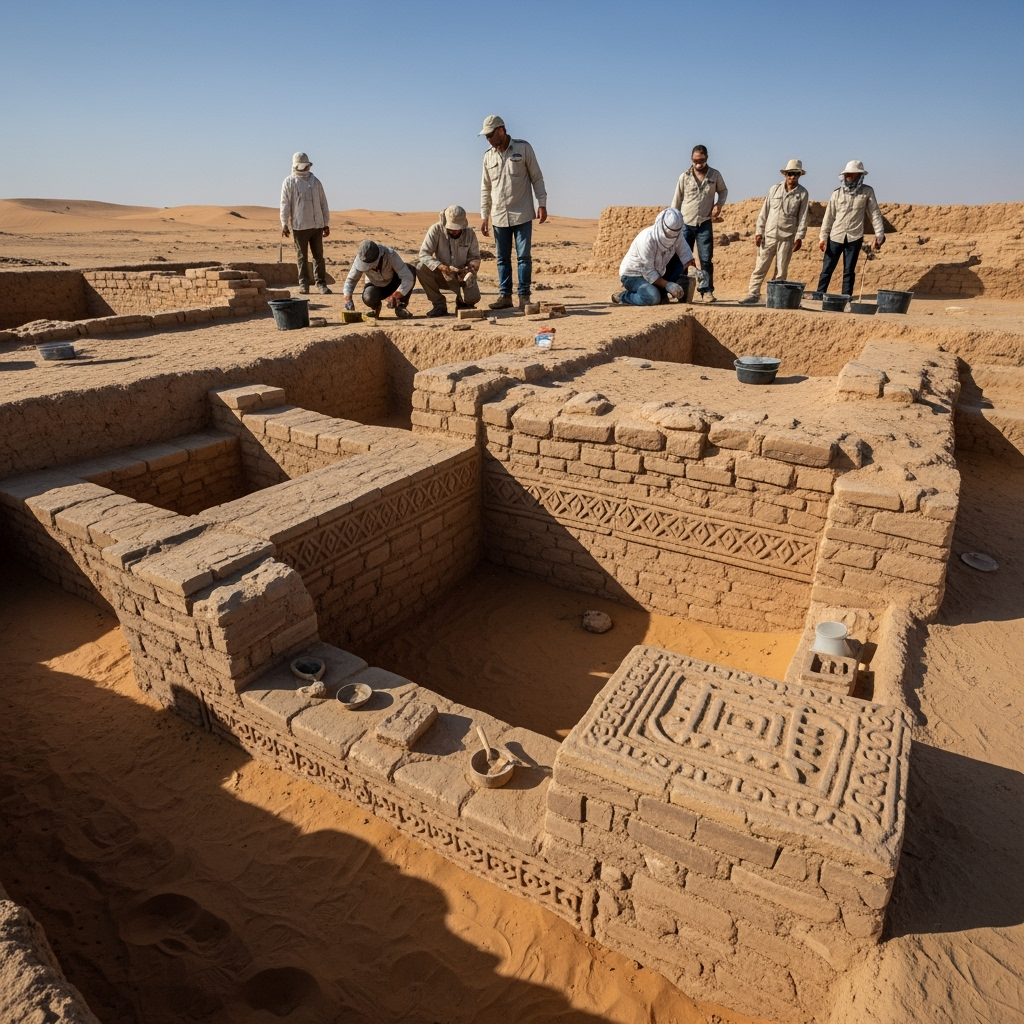
The discovery was made as part of archaeological excavations conducted by the authority in partnership with Japan’s Kanazawa University and in collaboration with NEOM. The settlement dates back to the period between 11,000 and 10,300 years before present, predating the pottery era. Excavations revealed semi-circular architectural units built from local granite stones, including residential buildings, storage facilities, corridors, and fireplaces, reflecting an advanced layout suitable for a lifestyle of hunting and grain farming during that period, according to the Saudi Press Agency (SPA).
Additionally, rare remains of human and animal structures were found, along with stone pieces adorned with geometric lines with symbolic meanings, providing researchers with a deeper insight into the social, economic, and cultural lifestyle of the early Neolithic era.
The Saudi Heritage Authority confirmed that the discovery represents a significant scientific turning point for understanding the beginnings of settled human habitation in the northwest of the Kingdom. It also supports the hypothesis that the region was a natural extension of the “Fertile Crescent” and an early home for the transformation of humans from nomadism to settlement.