
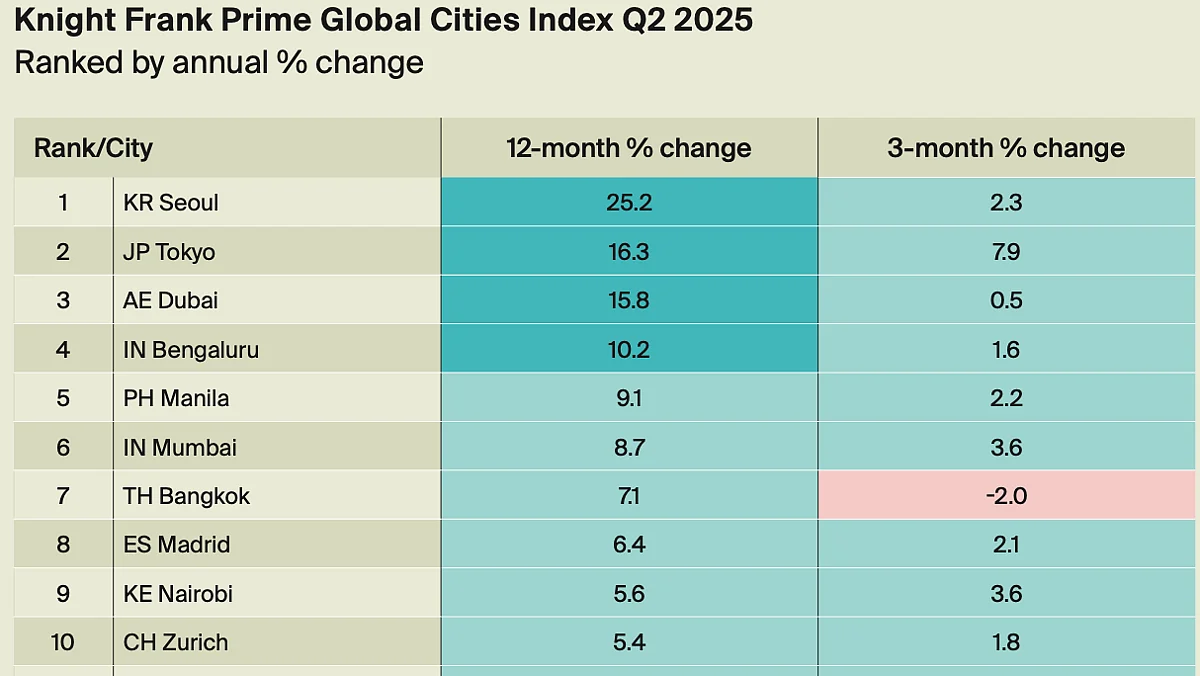
Bengaluru’s elite residential sector is capturing attention with a remarkable 10.2% annual price increase, securing the 4th spot globally in Knight Frank’s Prime Global Cities Index (PGCI) for Q2 2025. This achievement highlights its rise as a significant player in the global luxury real estate market, outpacing traditional Indian giants like Mumbai (8.7%) and Delhi (3.9%).
In contrast, Dubai, ranked 3rd, recorded a 15.8% annual growth, continuing its impressive streak fueled by international investors and high-net-worth individuals. Although Dubai leads, Bengaluru’s steady rise marks a maturing market with growing global significance.
What’s fueling Bengaluru’s growth?
Tech-driven wealth: The city’s thriving IT and startup scene boosts the demand for luxury homes.
Limited supply: Scarce inventory in prime areas drives prices higher.
Investor trust: Bengaluru is increasingly viewed as a stable, long-term investment location.
Quarterly, Bengaluru saw a 1.6% increase, maintaining momentum despite global challenges like postponed interest rate cuts and tighter financing.
“Bengaluru’s property market is on a strong upswing. Homebuyers and investors are showing renewed confidence, with demand fuelled by better connectivity through the expanding metro and large-scale projects like the upcoming Aerospace Park in North Bengaluru. The city also set a new benchmark in H1 2025, clocking 18.2 million sq ft of office absorption—over half led by GCCs [global capability centres] — reflecting its growing global stature. Together, infrastructure, jobs, and lifestyle are shaping Bengaluru into a thriving hub for both living and working,” Sankey Prasad, CMD, Colliers India & Middle East, told Khaleej Times.
The recent price surge is notably driven by the Bengaluru Aerospace Park, significantly boosting property values in nearby areas, particularly in North Bengaluru neighborhoods such as Devanahalli, Bagalur, and Shettigere. The park’s development, along with the KIADB Aerospace SEZ and new infrastructure like Namma Metro and Satellite Town Ring Road, attracts global investors and high-income professionals. This demand surge is driving land and apartment prices higher, with plots appreciating over 20% CAGR recently. The influx of aerospace and IT companies is also creating jobs, further propelling residential and commercial real estate growth. As connectivity enhances and the region evolves into a business and tech hub, property values are anticipated to continue rising steadily, analysts suggest.
Recent pre-launch prices near Kempegowda International Airport in North Bengaluru reflect this trend, with one-bedroom apartments priced at nearly Rs10 million (Dh416,000), up from Rs6 million three years ago. Another local developer, Sattva, announced its new project, Shettigere, near Sadahalli – BK Halli Road, where studios start at Rs6.3 million, reaching Rs86 million for four-bedroom penthouses.
Dr. Prashant Thakur, Executive Director & Head – Research & Advisory, ANAROCK Group, observed that Bengaluru’s residential real estate market is steadily growing, driven mainly by infrastructure development. “The Namma Metro Phase 2 and 3 expansions and the Peripheral Ring Road will undoubtedly boost property values and create new growth corridors, notably around Sarjapur Road and Kanakapura Road extensions. These improvements will steer housing demand towards peripheral micro markets that offer affordability and connectivity to job centers,” he told Khaleej Times.
Key micro markets like Sarjapur-Attibele, Electronic City-Chandapura, and extended Whitefield areas toward Kannamangala and Hoskote are seeing strong sales. North Bengaluru locations like Devanahalli, Bagaluru, and Doddaballapur benefit from airport proximity, and corridors along the suburban rail network are becoming more affordable alternatives with significant growth potential. Lower land costs and well-planned infrastructure upgrades give these areas strong long-term growth potential.
“Thanks to strong IT growth, startups, and infrastructure investments, Bengaluru will witness modest price appreciation over the next 2–3 years. It will remain end-user driven and speculative demand is not a major factor,” Thakur added. ANAROCK Research data shows Bengaluru added 36,200 units in H1 2025 (up 11% from H1 2024), while sales fell 12% to 30,120 units, and average prices rose 12% year-on-year to Rs8,720 per sq. ft.
Dubai: A magnet for global capital
Dubai’s real estate market remains buoyed by tax-friendly policies, Golden visa programmes, along with strong international demand, especially from Europe and Asia.
Dubai’s five-year growth stands at a staggering 107 per cent, second only to Tokyo (120 per cent), reflecting its transformation into a global luxury hub.
However, in quarterly growth Bangalore even pipped Dubai clinching the third position, Knight Frank data showed.
Outlook: Diverging paths, shared strengths
While both cities are thriving, their trajectories differ, analysts say.
Bengaluru’s growth is largely domestic and tech-sector driven, with increasing interest from NRIs and institutional investors.
Dubai’s surge is more globally influenced, tied to geopolitical shifts and wealth migration.
Knight Frank’s global head of research, Liam Bailey, notes: “Prime markets are taking a collective breath. The recovery we’ve seen was aided by expectations of lower borrowing costs. With that timeline now pushed out, a cooling in price growth is inevitable.”
Yet, cities like Bengaluru and Dubai are defying the trend, thanks to strong fundamentals and unique market dynamics.