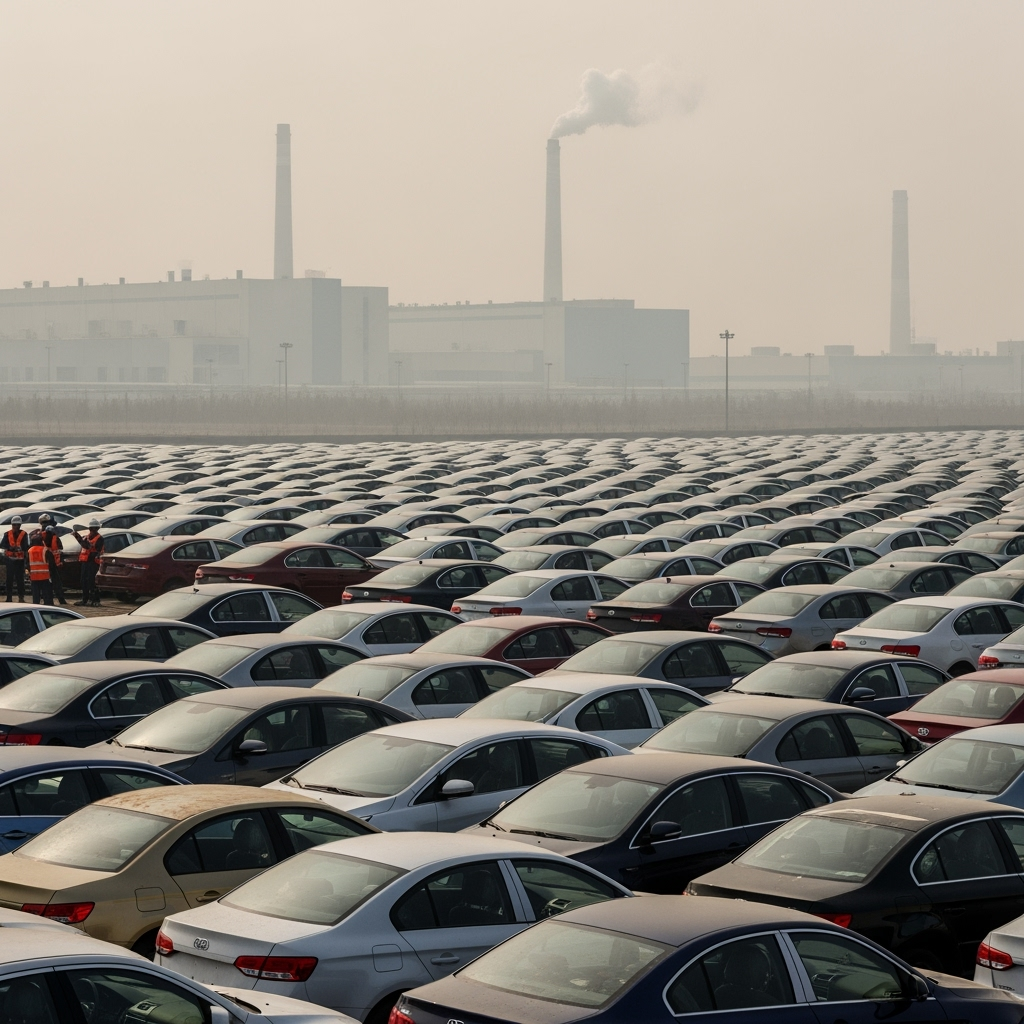
In the bustling city of 21 million, a shopping mall showroom offers exceptional deals on new cars. Here, buyers can select from around 5,000 vehicles. Locally-produced Audis are discounted by 50%, and a seven-seater SUV from China’s FAW is priced at about $22,300, over 60% off its original price.
These offers, provided by Zcar, a company that purchases in bulk from manufacturers and dealers, are possible due to China’s car surplus.
Government subsidies and policies aimed at making China a global automotive leader have led to an overproduction problem. Domestic automakers have surpassed these goals, leading to an oversupplied market with more brands than the largest car market can handle. This has made profitability nearly impossible for most automakers, as Chinese electric cars start under $10,000 compared to the few available under $35,000 in the U.S.
Most Chinese dealers struggle financially due to excessive inventory. To cope, prices are heavily discounted, and unsold cars are often registered and insured in bulk, allowing them to be recorded as sold and dealers to receive factory rebates. These cars flood the gray market, with companies like Zcar stepping in. Some are sold at fire-sale prices on social media, others labeled as ‘used’ despite no mileage, and shipped overseas or abandoned in car graveyards.
This oversupply indicates a potential shakeout similar to China’s property and solar sectors. It stems from policies prioritizing sales and market share over sustainable competition. Local governments offer cheap land and incentives to automakers for production commitments, further exacerbating overcapacity.
Rupert Mitchell, an Australia-based macroeconomics commentator, explains that when Beijing labels an industry strategic, every governor wants a car factory to gain favor with the party, leading to increased investment in the auto sector.
A Reuters investigation into China’s auto market reveals how oversupply weakens it even as it gains global power. Chinese brands outpace foreign ones in new model deliveries. However, government policies that spurred growth and innovation are now causing losses across the sales chain.
China’s industrial and commerce ministries, as well as its top economic planning agency, have not responded to questions on these challenges or the impact of government policies on oversupply. The auto industry, vital to China’s economy, faces significant challenges as automakers have the capacity to produce double the 27.5 million cars made last year. The issue is more severe with gasoline vehicles as demand has plummeted due to the EV push, while EV factories have multiplied.
China’s price war, now in its third year, could be resolved by allowing many automakers to fail. However, this approach is resisted due to potential mass layoffs and reduced consumer spending.
Yuhan Zhang, principal economist at The Conference Board’s China Center, notes that automakers and local governments are stuck in a downward spiral, reinforcing each other, potentially trapping the market in a vicious cycle. Foreign brands are also affected, struggling to maintain market share, while European governments worry about cheap Chinese imports damaging local industries.
China’s drive to lead in electric vehicles dates back to the 1990s, with policies in place to boost production. By 2017, a blueprint aimed to produce 35 million vehicles annually by 2025. This led to local governments incentivizing automakers for production and tax revenues, sometimes at the expense of profitability.
Changfeng county’s bet on BYD paid off, with economic growth outpacing national rates. Similar deals continue as local governments seek to attract automakers with incentives.
Despite alarm bells about unsustainable competition, local governments still push automakers to increase output. Analysts describe the industry as facing ‘involution,’ where competition becomes self-destructive.
Vehicle manufacturers continue selling at losses to maintain cash flow, crucial for survival. Some brands have ceased operations or undergone restructuring due to fierce competition.
The excess capacity problem is systemic, with local governments likely to support struggling automakers, delaying consolidation. Industry leaders set ambitious targets to survive, but most automakers are producing far below these volumes.
State-owned automakers are urged to grow market share and production over profitability. This has led to dealers struggling to turn a profit, selling new cars at losses or offloading them as ‘used’ to meet sales targets and qualify for rebates.
Dealers have publicly urged automakers to align sales policies with market realities to avoid market collapse. Larger dealerships overpurchase inventory to meet sales targets and receive bonuses.
Some automakers have inflated sales figures through creative practices, exacerbating market issues. Zero-mileage ‘used’ cars are sold domestically or exported, often with local government support.
Gray-market traders like Zcar sell these cars at deep discounts, using livestreaming on platforms like Douyin to reach buyers.
Some brand-new unsold cars end up in graveyards, creating environmental hazards. Auctions for these vehicles often see no bidders.
In some cases, courts auction off new unsold cars after disputes, with many sold at a fraction of their original price.