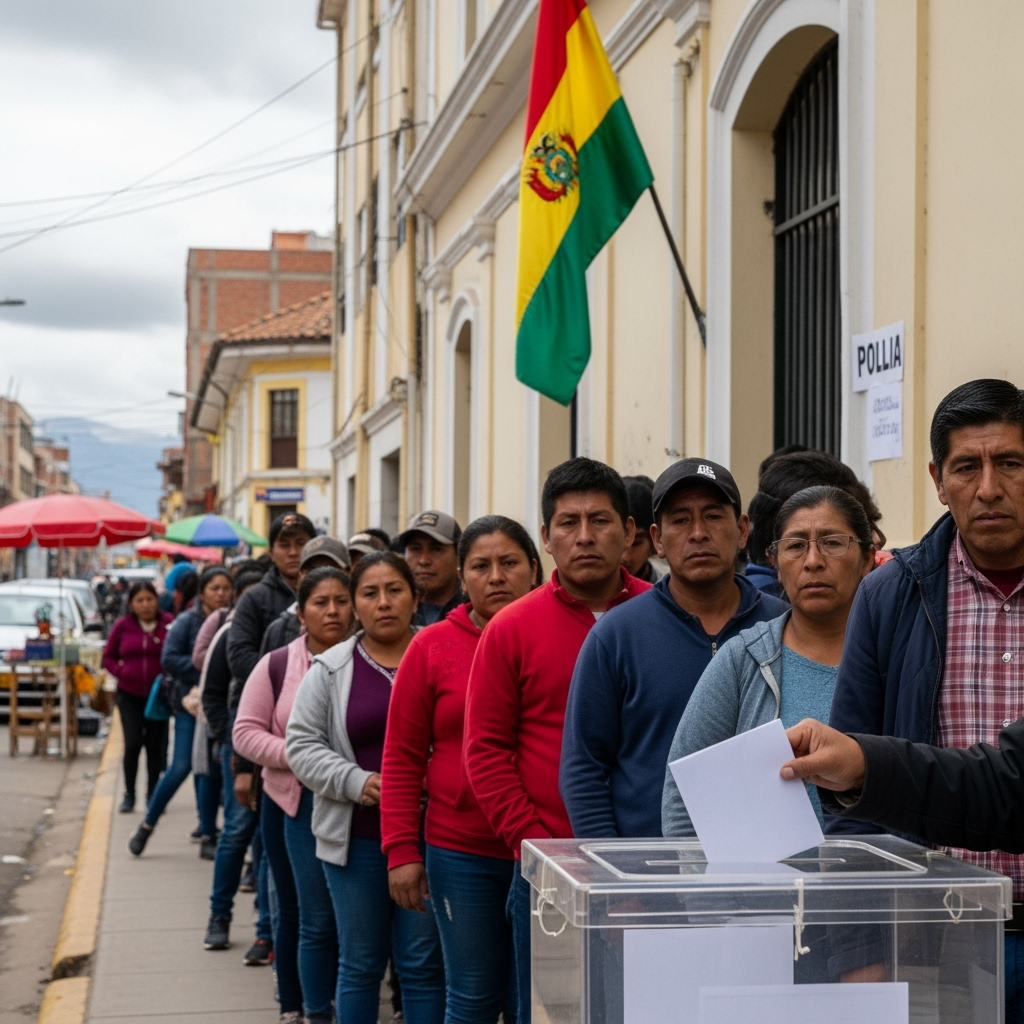
On Sunday, Bolivians turned out to vote with hopes of change amid an economic crisis, giving the right-wing its first chance at governance in two decades.
The country faces its worst financial turmoil in a generation, with annual inflation nearing 25% and severe shortages of fuel and foreign currency.
Polls indicate voters are ready to penalize the ruling Movement Towards Socialism (MAS), in power since Evo Morales became Bolivia’s first Indigenous president in 2005.
“We’re in a severe crisis, and we need change,” said Alicia Vacaflor, a 62-year-old industrial machine importer, after casting her vote in chilly La Paz.
Karla Coronel, a 46-year-old market analyst, also emphasized the need for a new direction.
“Socialism has not benefited us,” she asserted.
Over 7.9 million Bolivians are eligible to vote, electing among eight presidential candidates and 166 legislative members.
Leading the race are center-right entrepreneur Samuel Doria Medina and right-wing ex-president Jorge “Tuto” Quiroga, aiming to replace the unpopular Luis Arce, who is not seeking re-election.
Polls show Doria Medina and Quiroga, both in their sixties, are tied at around 20%, with six other contenders, including leftist Senate leader Andronico Rodriguez, trailing.
An October 19 run-off is scheduled if no candidate secures a majority.
The frontrunners promise drastic reforms to the economic model, aiming to cut public spending, attract foreign investment, and improve U.S. relations, weakened under Morales, who opposed capitalism and imperialism.
“Today is crucial for Bolivians as through voting, we can resolve this economic crisis peacefully and democratically,” Doria Medina stated post-voting in La Paz.
Agustin Quispe, a 51-year-old miner, criticized both political sides for lacking “new ideas.”
He labeled Doria Medina and Quiroga “dinosaurs” and supported center-right candidate Rodrigo Paz.
– Echoes of Argentina –
Analysts compare the election to Argentina’s 2023 vote, when voters rejected the long-standing leftist Peronists for libertarian Javier Milei to combat an economic crisis.
“People seek stability beyond a left-right shift,” said Daniela Osorio Michel, a political scientist at the German Institute for Global and Area Studies.
Unlike newcomer Milei, Doria Medina and Quiroga are seasoned politicians.
Doria Medina, a millionaire and former planning minister, amassed wealth in cement, built Bolivia’s tallest building, and acquired Burger King’s local franchise.
As a moderate, he pledges to curb inflation and restore fuel and dollar availability within 100 days without cutting anti-poverty programs.
Quiroga, a U.S.-trained engineer, was vice-president under ex-dictator Hugo Banzer and briefly president when Banzer resigned for health reasons in 2001.
“We’ll overhaul everything after 20 wasted years,” he declared at his final rally in La Paz.
– Morales’s Legacy –
Under Morales, Bolivia experienced over a decade of robust growth and Indigenous empowerment, nationalizing the gas sector to fund social programs that cut extreme poverty by half.
However, underinvestment has caused gas revenue to plummet from $6.1 billion in 2013 to $1.6 billion last year.
With lithium still untapped, the government is nearly out of foreign exchange to import essentials like fuel and wheat.
Protests have erupted over soaring prices and long waits for basic goods.
Morales, ineligible for a fourth term, has influenced the campaign, urging his Indigenous supporters to spoil their ballots in protest of his exclusion by electoral authorities.