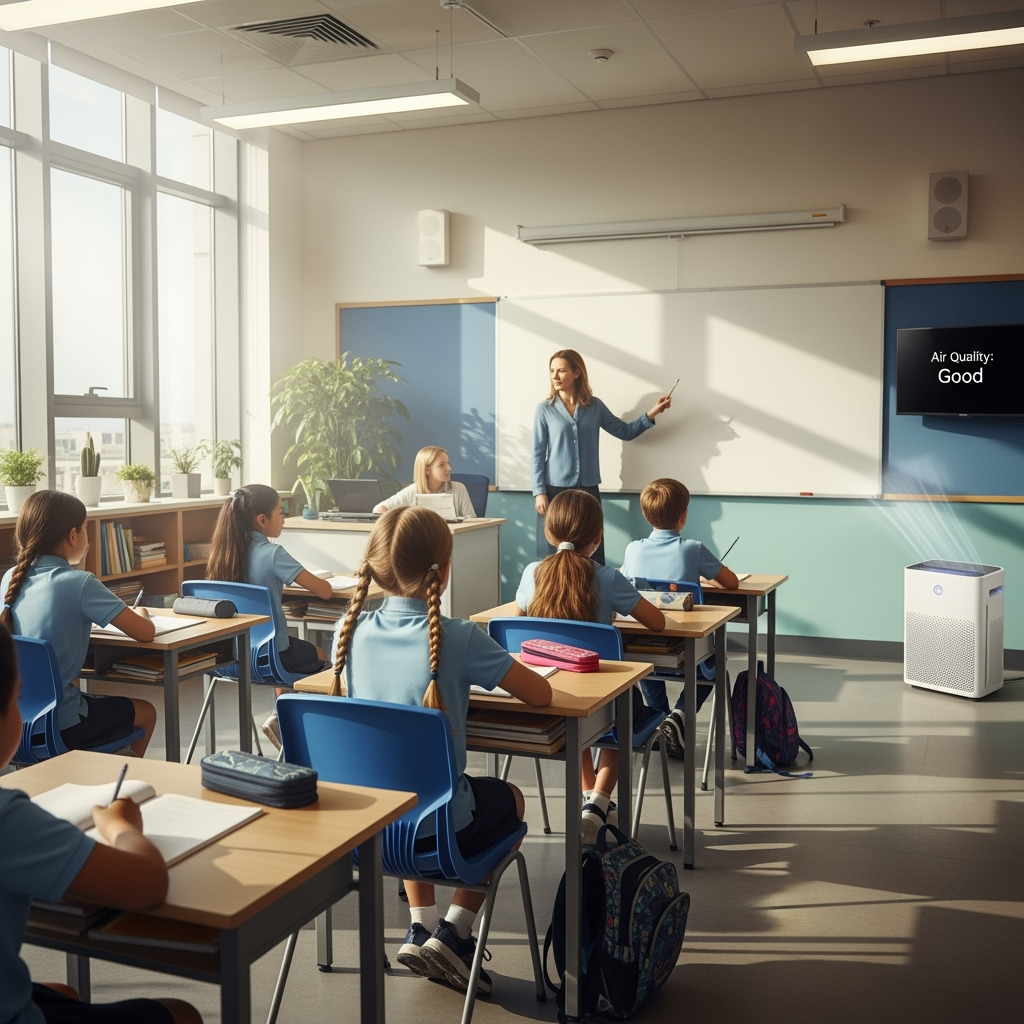
Is the air in UAE classrooms safe and clean for children to breathe? Despite existing measures to maintain indoor air quality, a recent study suggests further improvements are necessary. The study emphasizes the importance of enhancing air quality, particularly for younger students.
The report, titled ‘Take a Breath: Improving Indoor Air Quality’ by Goumbook, examined ten classrooms in Dubai and Sharjah to assess how environmental and structural factors impact children’s learning environments.
This research focused on primary school classrooms, testing interventions, and offering recommendations tailored to the UAE’s specific climate and urban conditions. A major challenge identified is the harsh climate, especially during summer, and the dependency on air conditioning systems.
Stay informed with the latest updates. Follow KT on WhatsApp Channels.
Study Findings
The report notes that extended AC use, if not properly maintained, can circulate pollutants, dust, mold, and allergens in classrooms. Fluctuating humidity levels can foster mold growth, and inadequately cleaned systems may accumulate volatile organic compounds (VOCs).
Schools near construction sites and busy roads face additional risks, with children experiencing higher rates of allergies, asthma, and respiratory issues.
The study, conducted over 265 days, included classrooms from schools built between 1970 and 2021, including those near coastal areas, to assess the impact of humidity and salt conditions.
Institutions close to busy roads and construction sites face added dangers, leading to higher rates of asthma, allergies, and respiratory problems.
Researchers measured pollutant levels and tested five solutions, ultimately aiming to enhance ventilation, maintenance, and air purification systems in UAE schools.
Plans to Maintain Clean Air in Schools
To find out current efforts, Khaleej Times contacted UAE schools.
Deepika Thapar Singh, CEO-Principal of Credence High School, stated, “We have a state-of-the-art VRF (Variable Refrigerant Flow) HVAC system, an efficient solution for maintaining indoor air quality (IAQ) in educational settings. Our AC vents and ducts are regularly inspected, cleaned, and maintained per Dubai Municipality standards. We strictly adhere to DM standards for ventilation, filtration, and routine servicing to ensure a healthy and safe environment in every classroom.”
Other schools are also taking stronger measures. Shiny Davison, Principal of Woodlem Park School, Hamidiya, Ajman, outlined future plans.
“Our plans include equipping classrooms with air purifiers to reduce dust, allergens, and pollutants. AC vents are regularly inspected, cleaned, and maintained to prevent stale or contaminated air circulation. Additionally, we will introduce measures like periodic indoor air quality testing, CO₂ monitors to track ventilation effectiveness, and low-VOC cleaning products to minimize harmful emissions.”
Poor IAQ: A Serious Health Concern
Doctors stress the critical nature of these interventions, as poor classroom air quality is more than a comfort issue—it’s a significant health concern.
Dr. Farah Osamah AlSheikh Bakrou, Specialist in Pediatrics at Burjeel Medical City, Abu Dhabi, stated,
“Poor classroom air quality can lead to numerous health and learning problems for children. It can exacerbate asthma and allergies, increase the risk of cough, wheezing, sinus irritation, bronchitis, and make students more susceptible to respiratory infections like colds, flu, and Covid-19.
“High carbon dioxide levels further impair concentration, memory, and decision-making, often causing headaches, fatigue, and difficulty focusing. Discomfort, drowsiness, and irritability reduce classroom engagement.”
Younger Children are More Vulnerable
Experts highlight that younger children, particularly those in early and lower primary grades, are most affected.
Dr. Maria Thomas, Specialist in Pulmonology at Medcare Royal Speciality Hospital, noted, “Their developing respiratory systems are more sensitive to pollutants, and they typically spend more time indoors. Children with pre-existing respiratory conditions, such as asthma or allergic rhinitis, are especially vulnerable. Staff with similar conditions may also experience worsened symptoms due to poor air conditions.”
She added, “Maintaining good air quality in schools is not only about physical health but also academic performance and overall comfort. Children learn best in environments where they can breathe easily and feel well.”