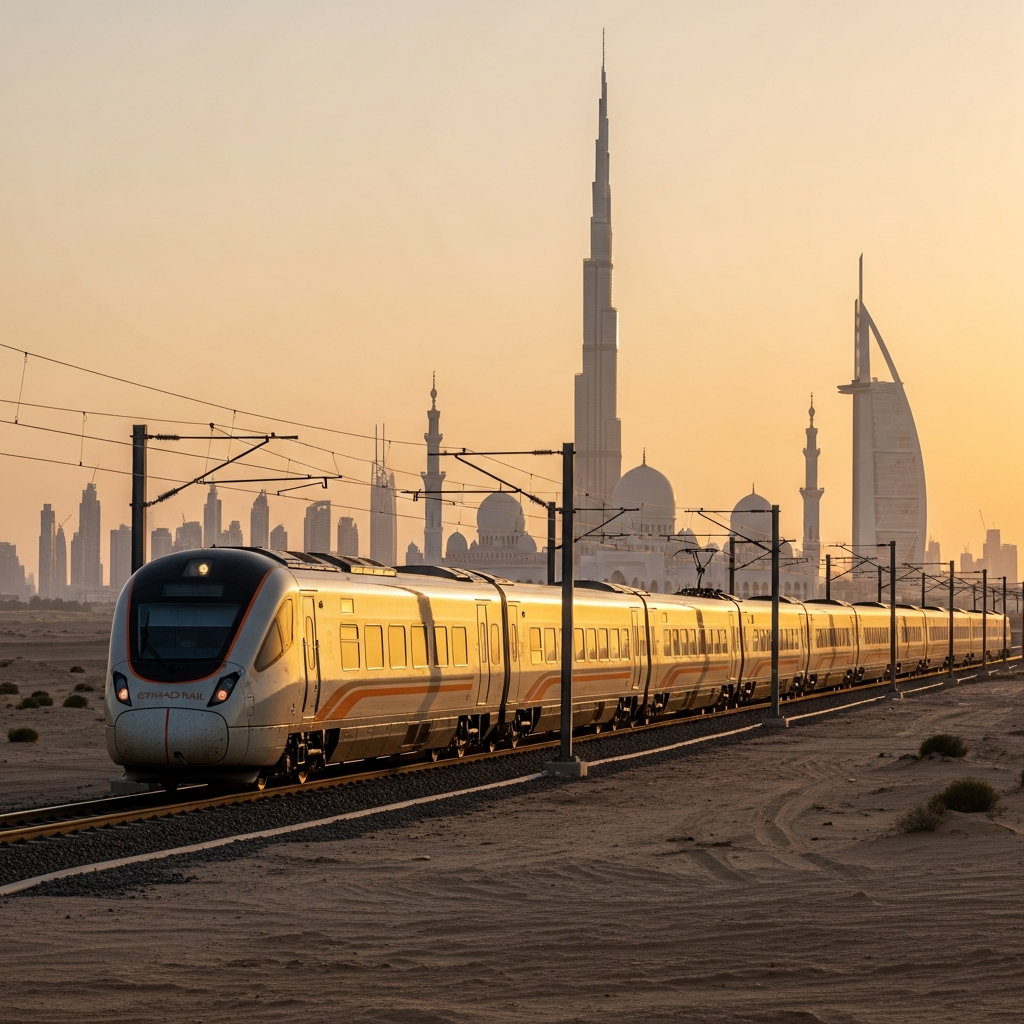
The eagerly anticipated Etihad Rail project is advancing rapidly, with passenger services set to start in 2026. This network will connect 11 key cities and regions, making travel between emirates convenient for residents.
Etihad Rail is envisioned as more than just a transportation network; it’s poised to become the nation’s backbone, reshaping the economy and urban landscapes. Urban planners suggest it might encourage suburban living with easy train commutes to cities. It also aligns with the UAE’s sustainability goals, playing a crucial role in the country’s Net Zero 2050 initiative.
In 2025, road closures and diversions across the UAE have facilitated the network’s construction. This project also aims to link the UAE with neighboring countries through the GCC Rail Network.
Recent Developments
At the Global Rail Conference, Etihad Rail CEO Shadi Malak noted that the GCC rail network will enable sub-five-hour train travel from Abu Dhabi to Riyadh.
During the event, Etihad Rail partnered with Keolis to form a joint venture, Etihad Rail Mobility, which will operate the passenger service, including connections like buses and taxis. Alistair Gordon, CEO of Keolis UK, Middle East, and India, shared that the company will also handle driver training and staffing.
Traveling from Abu Dhabi to Fujairah is projected to take 100 minutes by train, compared to over 2.5 hours by road. The journey from Abu Dhabi to Ruwais will take 70 minutes, and Dubai to Abu Dhabi will be just 57 minutes. Stations have been announced in Sakamkam, Fujairah, and Sharjah, University City.
Dubai Airports CEO Paul Griffiths mentioned that the rail could include a stop at Al Maktoum International Airport, offering potential train station check-ins.
The Network
Spanning 900 kilometers, the network will reduce commute times and decrease road traffic. A conference mockup detailed three station types: operations and maintenance depots, freight terminals, and passenger stations.
The network begins in Abu Dhabi at the Ghuweifat freight terminal, near the Sila passenger station, extending north to the Al Dhanna station, Ruwais Island, and Ruwais Port terminal.
After the Al Faya depot, it passes through Dubai, with terminals at Dubai Industrial City and Jebel Ali Port, and a passenger station near Al Maktoum Airport. Further north, it connects to Sharjah and Al Dhaid stations, Al Ghayl dry port, Siji terminals, and Fujairah stations, extending to the Sohar facility in Oman and Al Buraimi aggregate facility.
The network aims to serve 36 million passengers annually by 2030.
The Trains
Trains will carry up to 400 passengers at speeds of 200 km/h. Prototypes feature economy, family, and business class cabins. Economy has back-to-back seating, while business offers more space. There’s also space for large luggage.
Automated barriers will manage station access, akin to the Dubai metro, with ticket machines for selecting travel class, destinations, and special requests.