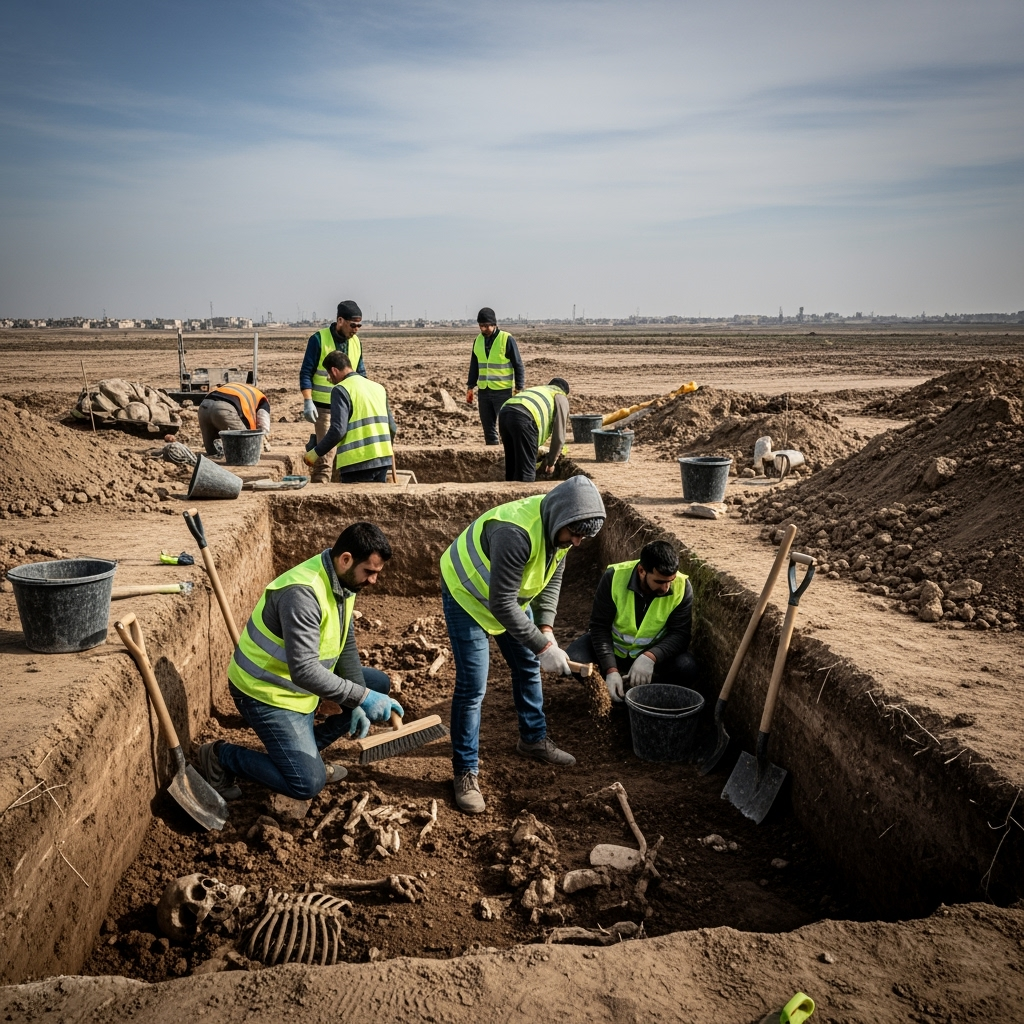
Iraqi authorities have commenced excavating a mass grave site near Mosul city, believed to hold thousands of Daesh victims, the project’s director informed AFP on Sunday.
Starting from August 10, the first phase involves surface excavation at the Khasfa site, according to director Ahmed Al Assadi.
On Sunday, an AFP correspondent at the northern Iraq site reported the team uncovered human skulls buried in the sand.
Khasfa is situated near Mosul, where Daesh established the capital of their self-proclaimed “caliphate” until their defeat in Iraq in late 2017.
Assadi mentioned there’s no exact count of victims at this mass grave—one of many Daesh left in Iraq—but a 2018 UN report suggests Khasfa may be the largest.
Official estimates suggest the site contains at least 4,000 bodies, with potentially thousands more.
The buried victims include “soldiers executed by IS,” Yazidi minority members, and Mosul residents, according to the project director.
Exhuming bodies from Khasfa is challenging, as underground sulphur water makes the ground porous, Assadi noted.
This water may have also eroded the remains, complicating DNA identification, he added.
Assadi said further studies are needed before deeper excavation at the site—a sinkhole about 150 meters deep and 110 meters wide—can proceed.
Iraqi authorities described it as the site of “one of the worst massacres” by Daesh militants, executing 280 people in a single day in 2016, many of whom were interior ministry employees.
In a rapid 2014 advance, Daesh seized large parts of Iraq and Syria, imposing strict Islamic law and committing widespread abuses.
The UN estimates Daesh left over 200 mass graves, potentially containing up to 12,000 bodies.
Besides Daesh-era graves, Iraqi authorities continue to find sites from Saddam Hussein’s rule, toppled by a US-led invasion in 2003.