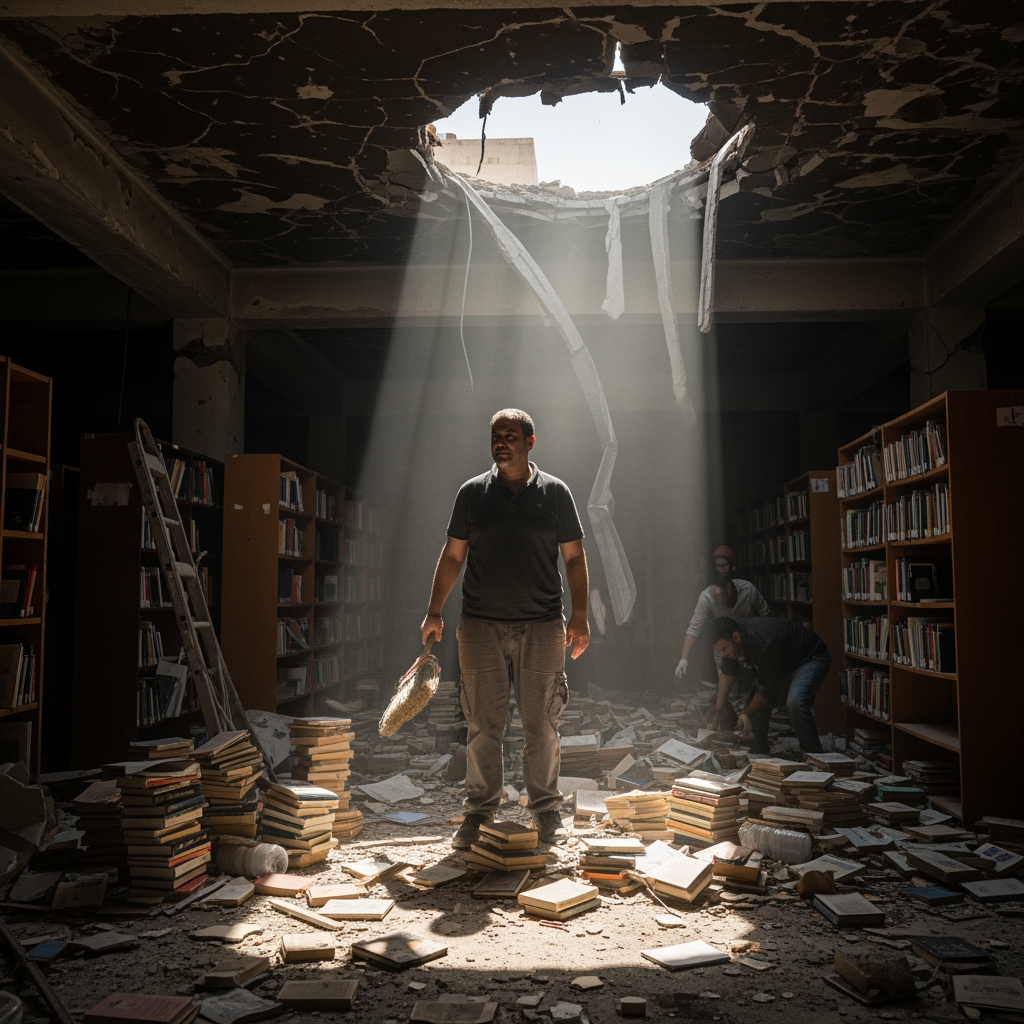
As the residents of Gaza returned to their homes after the war ceased, they inspected their houses and tried to salvage what they could from their belongings. Meanwhile, researcher Falah Al-Dalou was engrossed in rescuing what remained of his library, which housed nearly 20,000 books collected over more than four decades. With the help of his wife and grandchildren, Falah Al-Dalou visits his five-story house daily. This house, which once contained a large library, now lies in ruins. He searches for books that survived the destruction, having collected them from various countries and now trying to retrieve them from beneath the rubble.
Falah Al-Dalou told Sputnik: “For a long time, I have been interested in collecting literary and scientific books, even old research magazines, especially religious books. I studied at the Islamic University in Gaza and graduated in Sharia and Law. Forty-five years ago, I established a library to aid me in my studies and benefit others needing its books. Whenever I found a valuable book, I added it to the library, not just from Gaza but from many countries like Egypt, Saudi Arabia, Sudan, and Jordan. I even communicated with renowned libraries to obtain important books. Over the past four decades, I have collected nearly 20,000 books, serving many students and researchers with a wide range of subjects.”
The library was well-known in Gaza City for its rich collection of books before it was destroyed by Israeli shelling. To Falah Al-Dalou, it was his private world where he could delve into numerous journals on religion, medicine, literature, thought, philosophy, and more. He added, “When the bombing intensified in Gaza, my house, with the library, was targeted. Everything became as you see—destruction and rubble everywhere. Among the debris, books emerge that I cannot leave under the ruins. Every day, with the help of my wife and grandchildren, we gather what books we can that were not destroyed by the shells. With my grandchildren’s small, gentle hands, we save a lifetime of knowledge.”
Only a few books remain buried under the rubble of Al-Dalou’s library, as the Israeli bombing heavily destroyed the place. Most books are found charred and their covers torn. His grandchildren squeeze their small bodies into the crevices formed by the explosion to search for the treasures of knowledge they have yet to learn from. Whenever they find a surviving book, they rejoice as they hand it to their grandfather, who smiles and wipes the dust off his memories.
Murad Al-Dalou, one of the grandchildren, told Sputnik: “Every day, I do this work because I want to help my grandfather restore his library or what remains of it. Since my body and my brother’s are still small, we can reach the narrow areas between the rubble. We have succeeded in retrieving several books, and we will continue this work tomorrow and every day.”
Dohal Dalou, who met her husband through the library while seeking books and research, also has a close relationship with the library. She helps her husband collect books and remove the dust from their pages. She told Sputnik: “Every day, we come to this place filled with our memories. Here is our home, and here is the library. We collect books, albeit a small number, but we will not let despair stop our efforts to gather as many books as possible. Among them are books of great importance and rarity. What happened to the library is a great loss, as generations have learned from and benefited from its books over decades. Many university students from the sector used to come daily to the library to prepare research or study, or even to prepare a dissertation. There are books in the library for over 45 years that we try to reach, but the rubble is dense. I am worried about my grandchildren who enter the narrow areas to search for books inside the ruins.”
Despite the pain and the destruction of his home and library, Al-Dalou insists on rebuilding the edifice of knowledge and seeks to restore his valuable library by collecting the surviving books and research from the bombing to continue providing free education and knowledge. He told Sputnik: “Even if most books are burned, there is still hope to retrieve an important number of them, preserve them, and with the help of some entities, I aspire to rebuild my library and offer it to students for free.”
At the end of a tiring day of searching and excavating between the rubble and ruins of the library, Falah Al-Dalou, his wife, and grandchildren managed to gather dozens of books, which they placed on a wheelchair, helping each other push and move them to their temporary residence in Gaza.
According to the government office in Gaza, the education sector suffered significant destruction, with 95% of the sector’s schools damaged partially or completely due to the shelling. A total of 170 buildings related to education were completely destroyed, and 118 buildings were partially destroyed. Regarding schools affiliated with the United Nations Relief and Works Agency for Palestine Refugees (UNRWA), over 100 educational buildings were destroyed during the war.
The Israeli war on the Gaza Strip left widespread destruction affecting everything. Estimates from the Gaza government’s media office indicate that about 90% of the infrastructure was damaged entirely or partially. Israeli bombing operations resulted in approximately 70 million tons of rubble scattered throughout the sector, with about 20,000 unexploded shells and rockets posing a constant danger to civilians.
In the Gaza Strip, less than 20% of the houses are suitable for habitation. The United Nations estimates the cost of rebuilding Gaza at about 70 billion dollars due to the consequences of the Israeli war. The Gaza government announced last month that the sector is an environmentally and structurally devastated area.