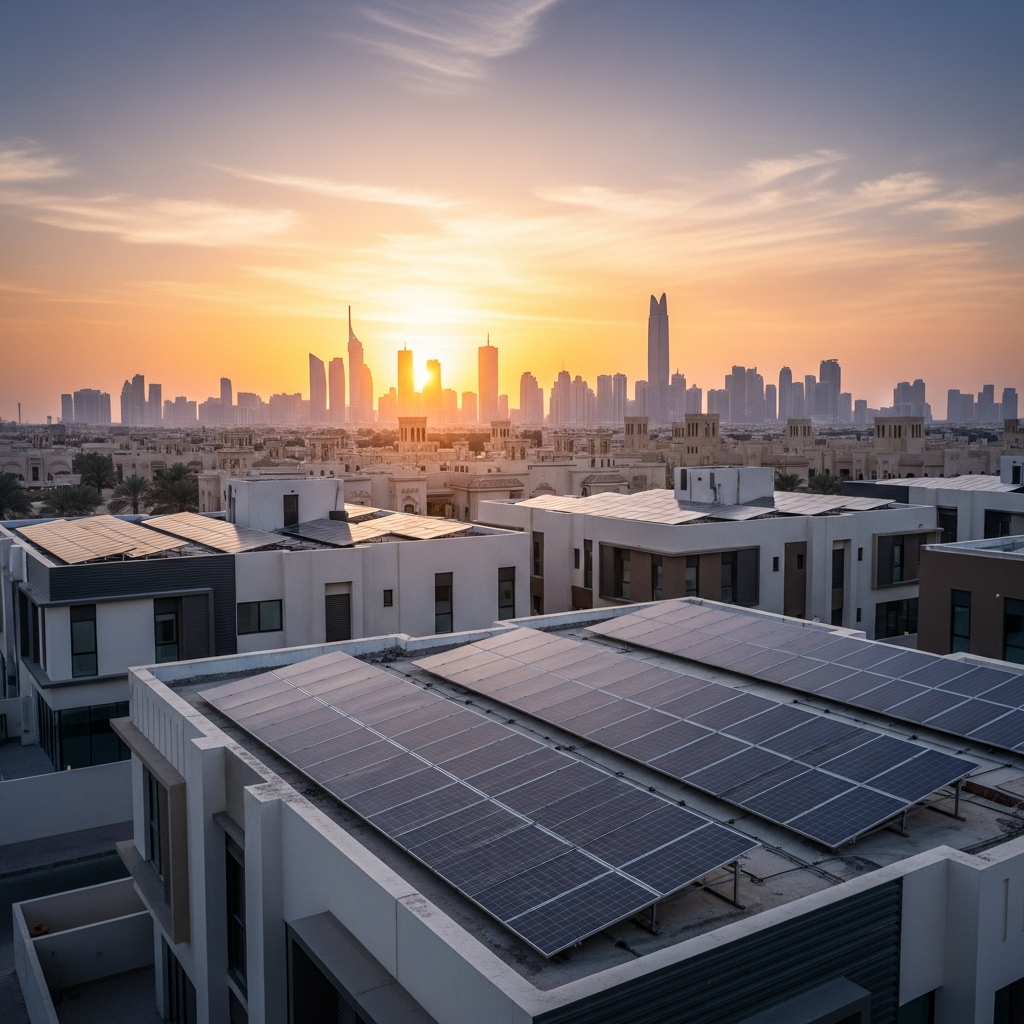
Extensive use of rooftop solar panels in GCC cities could be pivotal for countries to reach their carbon neutrality goals and offer a lucrative opportunity for landlords and investors, a report revealed on Monday.
Research by global real estate consultancy Knight Frank, in partnership with the University of Leeds and University of Bristol, suggests the region is nearing a new renewable energy era, shifting from large desert solar parks to urban installations.
The study, Going Green: Rooftop Solar Potential in the GCC, utilized advanced geospatial modeling to create the first detailed inventory of rooftop solar potential in Abu Dhabi and Riyadh.
Knight Frank’s assessment in Abu Dhabi identified 42.8 square kilometers of usable rooftop space—an area over 6,000 football fields. This space could become a distributed solar power plant equating to 55.5% of the land occupied by the Mohammed Bin Rashid Solar Park, yet would be located directly where power is used.
The research also shows that large rooftop installations are nearing cost parity with desert solar farms, known for low energy tariffs. In Abu Dhabi, systems over 10,000 sqm can achieve an LCOE as low as 8 fils/kWh, slightly higher than the 6 fils/kWh of desert parks, but without land costs.
The UAE aims to be a clean energy leader, targeting 50% electricity from clean sources by 2050 and a 70% carbon emission reduction under the UAE Energy Strategy 2050. So far, utility-scale solar projects like the Mohammed Bin Rashid Al Maktoum Solar Park in Dubai have led the way, with rooftop solar making up less than 1% of installed capacity.
Faisal Durrani, Head of Research, MENA, remarked: “The built environment accounts for 39% of global carbon emissions, and with rapid real estate growth expected across the Gulf until 2040, our whitepaper highlights an opportunity for developers, investors, and governments to capitalize on unused urban roof space. The findings show distributed rooftop solar is now essential in regional energy planning, offering long-term cost stability, grid resilience, and substantial carbon reduction.”
Saudi Arabia aims for net-zero carbon by 2060 and a 50% renewable energy mix by 2030, with significant solar infrastructure growth supported by government tenders and increased private sector involvement.
Utility-scale projects like Sakaka (300 MW), Sudair (1,500 MW), and Al Shuaibah (2,600 MW) set cost-competitive solar power standards in the kingdom, with LCOE at 6-9 halalas/kWh.
The research surveyed approximately 870,000 buildings in Riyadh, identifying 158.2 square kilometers of technically usable rooftop area. While half of Riyadh’s buildings have small roofs with limited capacity, buildings with over 1,000 sqm of usable space make up 26% of the city’s total roof area.
If all large rooftops (>1,000 sqm) in Riyadh were fully utilized with single-axis solar tracking systems, the city could generate 17,500 GWh of electricity annually, equivalent to 40.7% of Riyadh’s total annual electricity use, based on 2023 data.
Wesley Thomson, Head of ESG, MENA, said: “Although distributed solar is still new, commercial and industrial installations are emerging in industrial zones, logistics parks, and new developments in Riyadh, Dammam, and Jeddah, showing a growing interest in energy diversification, cost efficiency, and demand for “green” assets.”
The Importance of Scale
In both Riyadh and Abu Dhabi, scale is crucial.
In Abu Dhabi, small residential systems (less than 100 sqm) produce energy at around 30 fils/kWh. However, for rooftops over 1,100 sqm, this cost drops nearly 60% to about 13 fils/kWh. Large industrial roofs push it further down to 8 fils/kWh.
Similarly, in Riyadh, transitioning from small residential setups to large commercial installations significantly reduces the payback period. This size-to-value correlation highlights to owners of warehouses, malls, industrial parks, and government buildings that their roofs can become revenue-generating assets.
While gigawatt solar parks in the region lead in efficiency and output, urban solar generation offers unique benefits that help achieve net-zero goals. Producing power where it’s consumed eases transmission network strain, reduces peak load pressures, and enhances grid resilience. It also requires no new land, a major cost in traditional solar farms, and directly reduces the carbon intensity of property portfolios.
Dr. Christopher Payne, Strategy, Economics and Geospatial Partner, MENA, said: “Our analysis indicates the GCC is moving from utility-scale success to distributed opportunities. Projects like Noor Abu Dhabi, Sakaka and Sudair have proven solar’s viability in the desert, but cities offer vast potential for the next decarbonization phase.
“As the UAE and Saudi Arabia continue urban expansion to accommodate growing populations, their cities’ energy demands will increase. Part of the solution is overhead. By scaling rooftop solar, GCC nations can create sustainable infrastructure assets, attract international investments, support environmental goals, and secure a low-carbon future.”
Thomson added: “We’re seeing a clear path for distributed solar becoming central to the Kingdom’s energy strategy. This isn’t just theoretical; the economics are compelling now. Using Shamsi Solar Calculator data, we estimate rooftop photovoltaic systems in Riyadh offer a payback period of just 7-11 years. Industrial and logistics assets are particularly suited for this shift, with larger installations achieving payback in as little as seven years due to scale economies.”