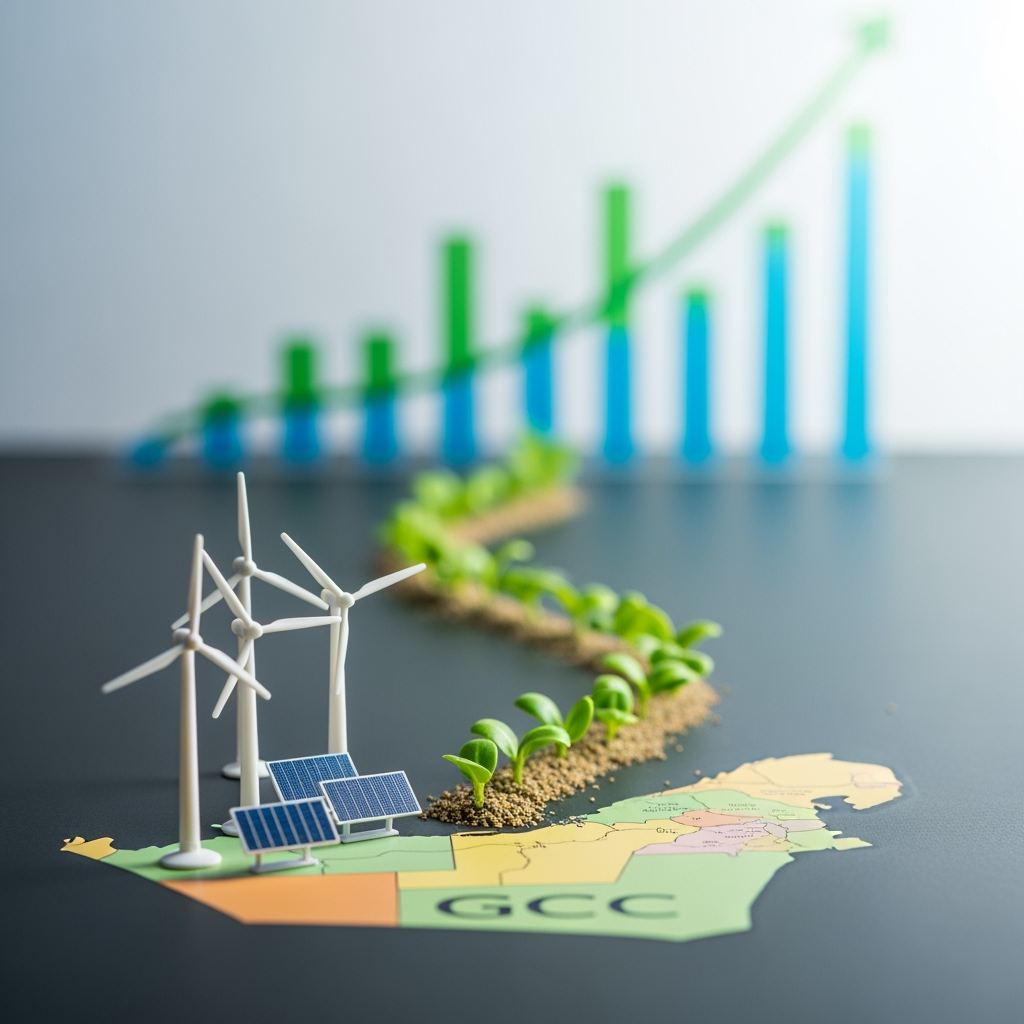
The GCC is at a pivotal point in its journey towards economic diversification, with a new report highlighting the region’s substantial untapped potential to attract climate-aligned foreign direct investment (FDI).
Between 2020 and 2024, over $1 trillion in global green FDI was invested in projects, yet the UAE, Saudi Arabia, and Oman collectively attracted only $24 billion, representing just 2% of the total. This modest inflow sharply contrasts with the $132 billion these countries invested abroad in green projects during the same period, revealing a gap the region is eager to address.
According to Strategy& Middle East’s analysis of over 100 large-scale FDI deals each exceeding $1 billion, green investment is categorized into hydrogen and ammonia, renewable power, green industrials and chemicals, batteries, electric and hydrogen vehicles, sustainable construction, and carbon capture. The findings show that 53% of all major cross-border investments during the period were in green sectors, with hydrogen, renewable power, and batteries alone accounting for 80% of these flows. The momentum peaked in 2022–2023 as post-pandemic recovery fueled climate-aligned spending, with strong inflows continuing in 2024 at $158 billion, nearly triple the 2020 level.
Despite capturing a small slice of this trillion-dollar wave, the GCC holds significant advantages. The region boasts some of the world’s lowest renewable energy costs—six out of the ten lowest-cost solar projects globally are in the Gulf. Coupled with ambitious net-zero commitments by Saudi Arabia and the UAE, and Oman’s rise as a green hydrogen hub, the region is well-positioned to become a leading destination for climate capital.
Saudi Arabia attracted the largest regional share with $12.6 billion, while Oman secured $8.9 billion, including two major Indian-backed projects in green ammonia and green steel. The UAE also secured deals in hydrogen and electric vehicles, backed by its Sustainable Finance Framework. On the outbound front, GCC capital has primarily targeted hydrogen and ammonia projects in North Africa, notably in Egypt and Mauritania.
“Climate concerns and government incentives have sparked an investment surge reshaping the global economy,” said Dr. Yahya Anouti, partner at Strategy& and leader of its Energy, Resources and Sustainability practice in the Middle East. “The GCC is uniquely poised to benefit, with bold net-zero ambitions and some of the world’s cheapest clean energy sources. However, more can be done to fully harness the momentum of global green investment.”
The report also draws comparisons with global peers. In the United States, the Inflation Reduction Act (IRA) has spurred a surge in climate-aligned investments across renewables, batteries, and clean vehicles, while Europe’s Green Deal drives large-scale investments into sustainable industries. Relative to GDP, the GCC’s inflows lag behind such regions, with Oman being the only country close to matching international benchmarks.
To unlock its green FDI potential, Strategy& recommends four strategic priorities: landmark policy reforms, investment de-risking tools, green industrial development, and smarter outbound investments. Policy reforms should include climate-forward manufacturing laws, emissions reporting, and enforceable product standards. De-risking tools such as long-term offtake agreements, expanded green bonds, and dedicated clean-tech funds could attract investors wary of project risks. Meanwhile, green industrial development could position the GCC as a leader in hydrogen, low-carbon materials, and circular economy ventures by leveraging its abundant low-cost renewable energy. Finally, targeted outbound investments in global clean-tech hubs could allow the GCC to bring capabilities and co-investment opportunities back home.
Several countries are already progressing in this direction. Saudi Arabia has launched a Green Financing Framework and issued $1.7 billion in sovereign green bonds, Oman has signed a pioneering green hydrogen offtake agreement, and the UAE is embedding climate finance priorities through its Sustainable Finance Framework. Experts argue these steps are just the beginning of a long-term shift that will determine how effectively the GCC integrates into global climate capital flows.
“The green transition is redefining how and where industries grow,” said Devesh Katiyar, partner at Strategy& Middle East. “As climate capital remains a fixture in global markets, the region must play a greater role in not only deploying capital but attracting it. This means embracing regulatory clarity, incentives, and de-risking mechanisms to channel more funds into the Gulf.”