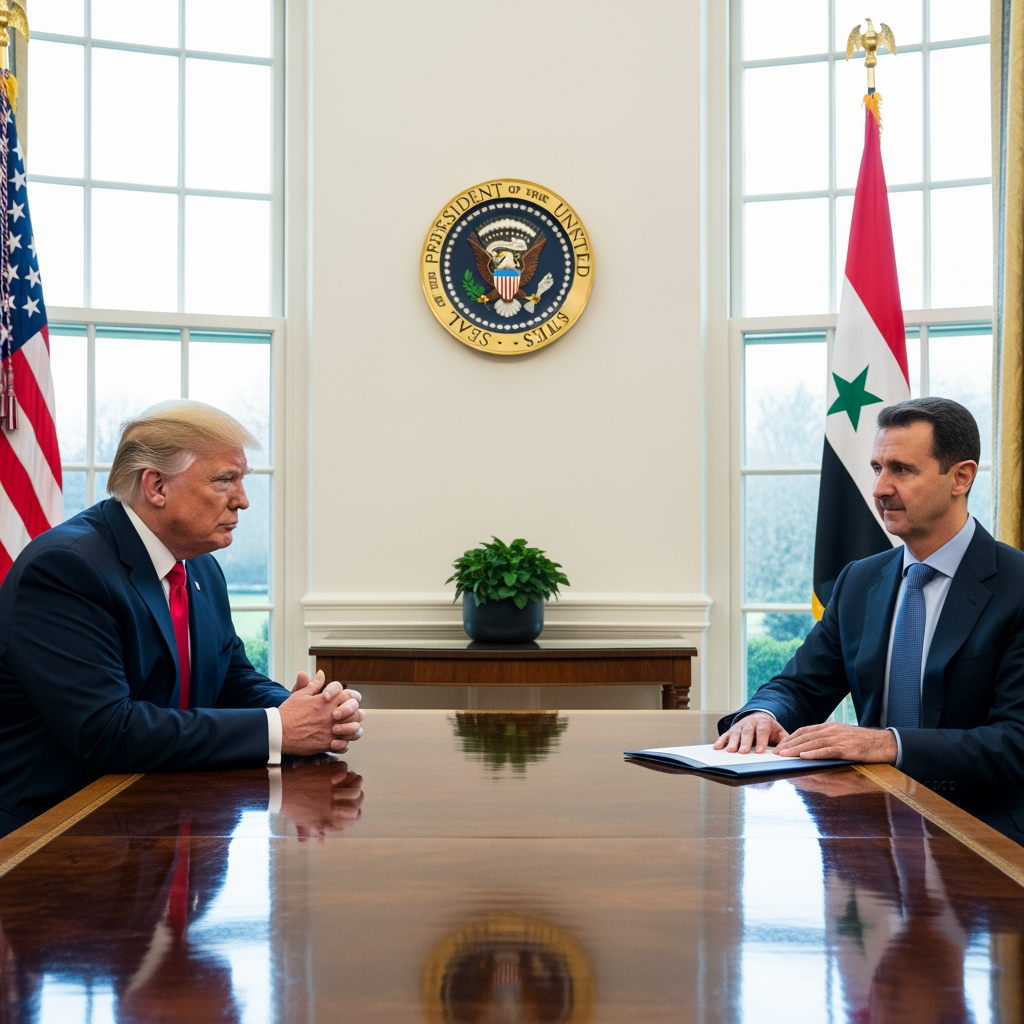
Shar’ met with President Donald Trump at the White House, marking the first meeting of its kind in decades. President Trump praised his Syrian counterpart, Ahmad Shar’, following unprecedented talks at the White House on Monday. Trump stated that Shar’s military background will aid in rebuilding his war-torn country. He emphasized that Syria is a “significant part” of his broader peace plan in the Middle East, which the American president relies on to reinforce the ceasefire between Israel and Hamas in Gaza. Trump expressed his desire for Syria to “succeed” after the decade-long war, believing that Shar’ is “capable of achieving this.” Unlike the usual protocol followed when Trump meets world leaders, the meeting with Shar’ was closed and away from the media. However, the Syrian presidency released photos of Trump shaking hands with Shar’ in the Oval Office. In other photos, Shar’ is seen sitting opposite Trump in the presence of senior American officials, including Vice President J.D. Vance, Secretary of Defense Pete Hegseth, and Chief of Staff Dan Keen. The Syrian presidency celebrated the occasion, stating, “President Ahmad Shar’ arrived at the White House on an official visit to the United States, where he was received by President Donald Trump.” The presidency revealed that the two presidents held talks attended by Syrian Foreign Minister Asaad Al-Shaibani and U.S. Secretary of State Marco Rubio, discussing bilateral relations between the two countries and ways to enhance and develop them, as well as several regional and international issues. Syrian Foreign Minister Asaad Al-Shaibani announced on Tuesday that he received a signed decision from Washington lifting restrictions on the Syrian diplomatic mission and embassy in Washington, allowing it to fully resume its activities. Al-Shaibani wrote on the “X” platform: “Today, Syria resumes its full diplomatic role on American soil as part of the Syrian Foreign Ministry’s strategic plan.” This visit follows increased pressure on Shar’ from both inside and outside, as the security situation remains unstable, with individual killings of a sectarian nature. Additionally, the governorate of Suwayda and the region east of the Euphrates remain outside Syrian sovereignty, with local factions controlling the former and the Syrian Democratic Forces the latter, alongside Israeli incursions in southern Syria, in Quneitra, Daraa, and the countryside of Damascus.