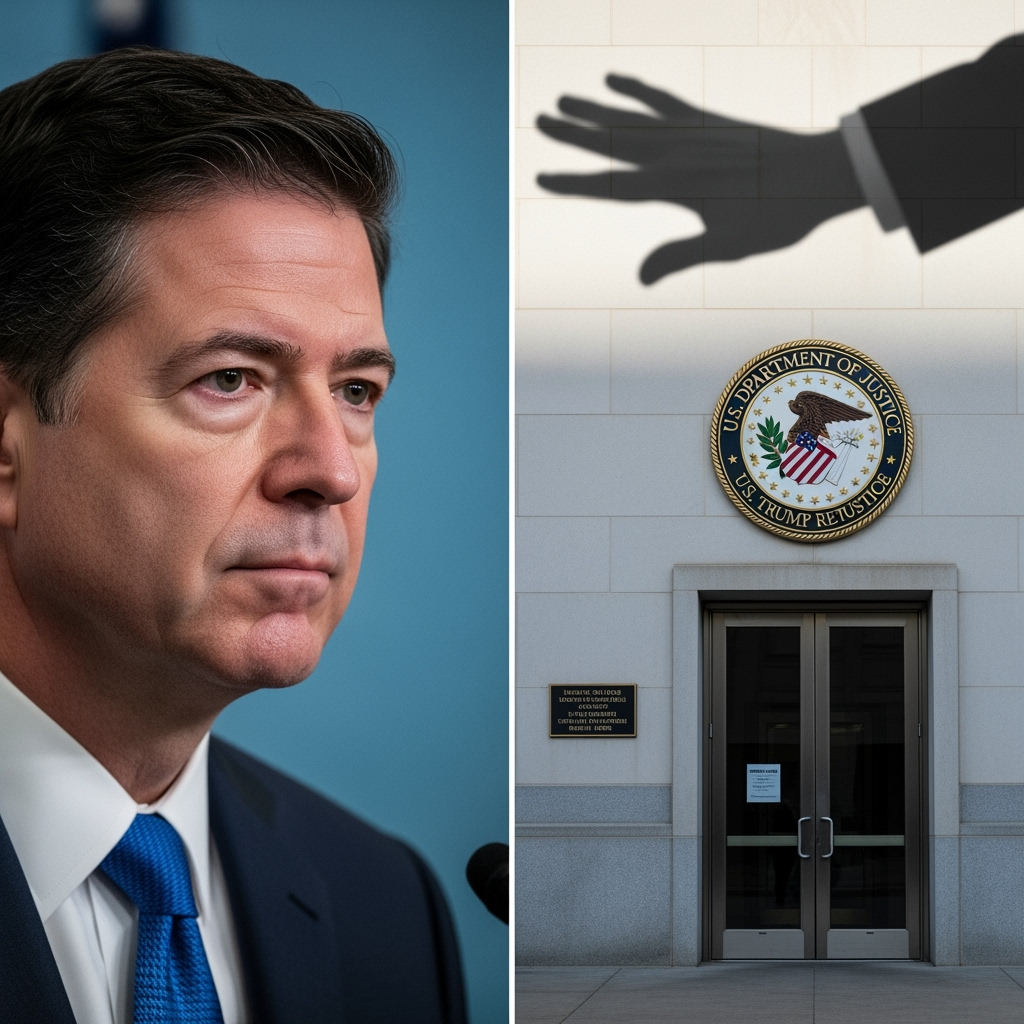
On Thursday, the US Justice Department charged former FBI Director James Comey with criminal offenses, marking a significant move in President Donald Trump’s campaign against his political adversaries.
If found guilty, Comey could face a prison sentence of up to five years. He is accused of making false statements and obstructing a congressional probe.
In an Instagram video, Comey expressed, “I am heartbroken for the Department of Justice, but I trust the federal judicial system and know I am innocent. Let’s have a trial and maintain faith.”
Stay informed with the latest updates. Join KT on WhatsApp Channels.
Comey’s lawyer, Patrick J. Fitzgerald, stated: “Jim Comey fully denies today’s charges. We anticipate clearing his name in court.”
Since his 2015 presidential campaign, Trump has talked about jailing his political opponents, but Thursday’s indictment is the first successful grand jury indictment during his administration.
Trump’s Justice Department is also probing other critics, including New York Attorney General Letitia James and John Bolton, a former national security official under Trump.
The charges challenge long-standing norms meant to keep US law enforcement free from political influence. The federal prosecutor in Virginia, initially handling the case, resigned last week after facing Trump’s displeasure for expressing skepticism about the case, with others in the office privately agreeing that the evidence does not justify criminal charges, according to sources.
Trump, who has urged Attorney General Pam Bondi to prosecute Comey and other critics, celebrated the indictment on social media, writing: “Justice in America! He has been detrimental to our country for too long.”
Trump dismissed Comey in 2017, early in his presidency, and has frequently criticized Comey’s management of the FBI investigation into Russian contacts with Trump’s 2016 campaign. Since Trump resumed office last January, his Justice Department has been reviewing Comey’s 2020 testimony regarding Republican criticisms of the Russia investigation and his denial of authorizing leaks of sensitive information to the media.
The indictment accuses Comey of misleading Congress by saying he did not authorize anyone to be an anonymous source in news reports about an FBI investigation.
The Trump administration has been overhauling the Justice Department, which Trump claims was politically weaponized when he left office in 2021. Trump himself faced federal charges for mishandling classified documents and attempting to overturn his 2020 election loss, both of which have been dismissed.
Norm Eisen, a former government ethics official under Barack Obama and a Brookings Institution fellow, stated, “Donald Trump has ordered political prosecutions, and the Justice Department is unjustly complying. This indictment is a clear case of a vengeful and baseless prosecution.”
Justice Department Tensions
The push to indict Comey was met with doubt in the Eastern District of Virginia, where US attorneys are handling the case. After Erik Siebert, the top federal prosecutor, resigned last week, others advised his successor, Lindsey Halligan, against filing charges due to insufficient evidence, according to a source. Career prosecutors had previously drafted a memo advising Halligan not to seek an indictment, citing a lack of probable cause, Reuters reported.
Highlighting the case’s weaknesses, the grand jury on Thursday refused to indict Comey on a third proposed charge of making a false statement to Congress concerning his Senate testimony on the 2016 election, court documents reveal.
Halligan, who recently served as a White House advisor and formerly as Trump’s private attorney, personally presented evidence to the grand jury, an unusual act typically undertaken by a line prosecutor, according to four informed individuals. Comey’s son-in-law, Troy Edwards, resigned as a senior national security prosecutor, citing his commitment to the “Constitution and country,” following the indictment, Reuters reported. Comey’s eldest daughter, Maureen Comey, was fired from her federal prosecutor role in Manhattan in July. She has filed a lawsuit, claiming her dismissal was “based solely or significantly on her father’s identity.”
Trump and Comey have had a contentious relationship since Trump’s first term began. Trump dismissed Comey shortly after Comey confirmed the president’s investigation over Russian election interference. Comey then emerged as a vocal Trump critic, labeling him “morally unfit” for office.
Comey’s firing led to Robert Mueller’s appointment as special counsel to oversee the Russia investigation, which found multiple campaign-Russian contacts but concluded there wasn’t enough evidence for a criminal conspiracy.
Trump frequently denounced the investigation as a “witch hunt.” His second term has aimed to discredit US intelligence and law enforcement findings on Russia’s 2016 election interference, where Trump defeated Hillary Clinton.