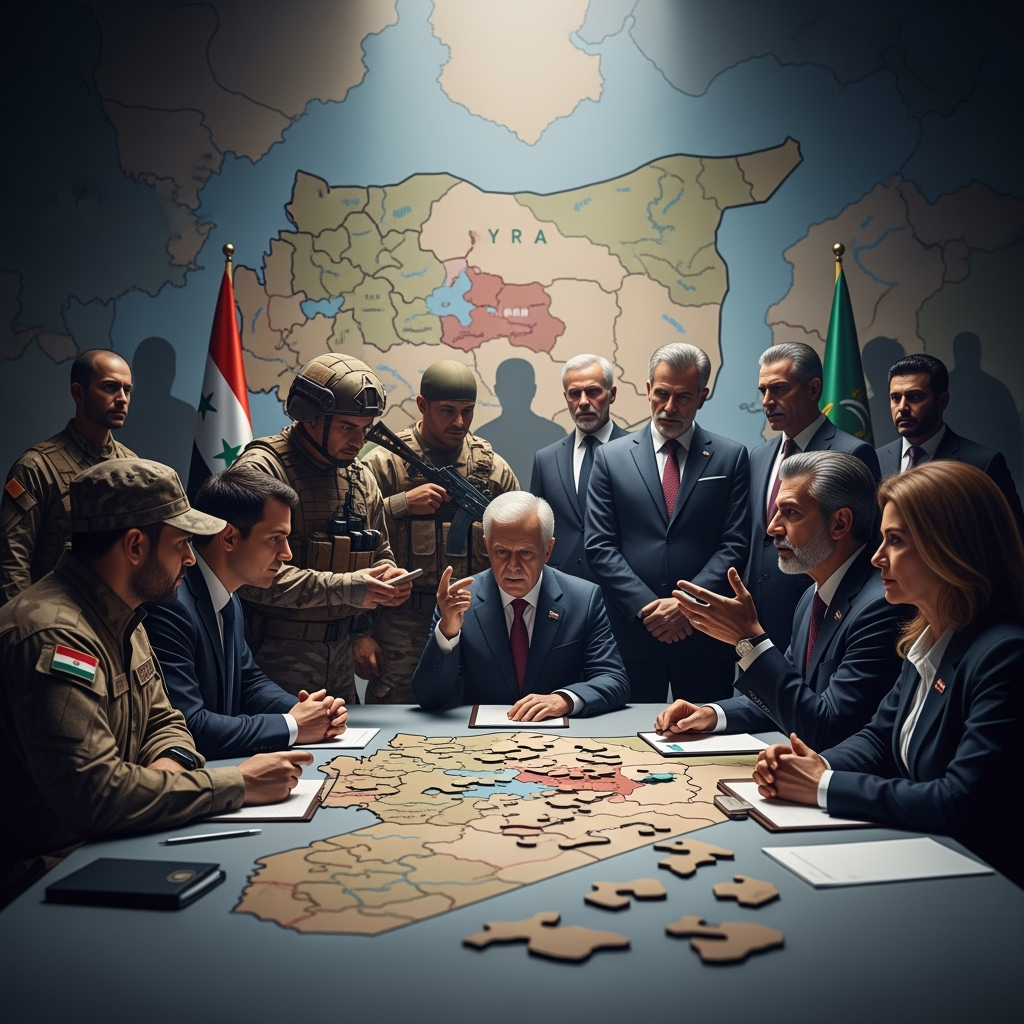
Hussein said in statements today, Saturday, that “since the signing of the political framework between the Syrian transitional president Ahmad Al-Shara and the leader of the Syrian Democratic Forces (SDF), Mazloum Abdi, on March 10th, a negotiation phase began. This phase was seen as an attempt to reestablish institutional ties between the Syrian government and the self-administration institutions in Northeast Syria after long periods of almost complete separatism.
He added that “the negotiation process witnessed a slowdown and a series of setbacks began, with the rounds of negotiations becoming intermittent, making the negotiation process complicated and on the verge of reaching a dead end.
The Kurdish expert continued: “It appeared from previous rounds that there is a desire to dissolve all civil, security, and military institutions within the self-administration, which believes that integration should mean connection and integration without abolishing institutions, and here lies the primary dilemma.
Mohammad Hussein considered that “the steps to implement the agreement collided with the security and military integration and resource sharing, which eventually led to a dead end and the situation returned to tension and mistrust between the two parties as it was before the meeting.
He pointed out that a series of follow-up rounds took place between delegations from both parties, but practical implementation stalled due to tactical and political differences and regional and international interventions.
The Kurdish expert noted that “there are regional interventions, especially from Turkey, and international ones primarily from the United States and to a lesser extent from France, affecting the negotiation process. A new chapter began in which these parties exerted varying pressures on both sides, attempting to weaken the position of the self-administration and prevent any form that could give even symbolic gains to the SDF, which Ankara considers linked to organizations like the Kurdistan Workers’ Party. Meanwhile, Western pressures were exerted towards a solution that reduces the security vacuum, allowing continued fighting against the [terrorist organization banned in Russia] ISIS, and enhancing the return of services to those areas to ensure a good degree of stability there.
He explained that “there is a disparity between the objectives of the two parties. The Syrian government only seeks to achieve tactical goals such as reclaiming and appearing as the successful controlling state, winning economic revenues from oil and crossings, and closing the division file without taking any steps to make the possibilities of division out of the question among several essential components in Syria, not just among the Kurds.
The Kurdish expert emphasized that “the self-administration seeks to ensure constitutional and political rights for the Kurdish component, which has the simplest rights to preserve its identity, protect its employees, and secure security guarantees from Damascus while preserving the administrative and service achievements it has made thanks to the great sacrifices it has made over many years.”
It is noted that the Syrian transitional president Ahmad Al-Shara and the leader of the Syrian Democratic Forces (SDF), Mazloum Abdi, signed an agreement on March 10th to integrate the SDF within Syrian institutions, affirming the unity of Syrian territories and rejecting division.
A conference on Kurdish unity was held in Qamishli on April 26th, which in its final statement called for a decentralized parliamentary governance system with two chambers, relying on political pluralism, peaceful power transition, and separation of powers, as well as establishing councils for the regions within the decentralized system.
However, the Syrian presidency expressed its categorical rejection of any attempts to impose a divisive reality or establish separate entities under any name, whether federal or self-administration, in response to the demand by the leadership of the Syrian Democratic Forces (SDF) for a decentralized governance system in Syria.
In early August, a conference was held in Hasaka, Northeastern Syria, which included Kurdish, Arab, Syriac Assyrian, Turkmen, Armenian, and Circassian figures, with the spiritual leader of the Druze community, Sheikh Hikmat Al-Hijri, and the head of the Alawite council, Sheikh Ghazal Ghazal, participating via video.
The conference, in its concluding statement, called for “drafting a new constitution and establishing a decentralized system in the country, adhering to the inclusive national democratic path based on diversity, partnership, and equal citizenship.”
However, the Syrian government considered this conference “an attempt to internationalize the Syrian issue, bring about international sanctions again, and impose them once more, which the SDF bears the legal, political, and historical consequences of.”
The Syrian government called on the “SDF” forces to seriously engage in implementing the March 10th agreement, as well as urging international mediators to transfer all negotiations to Damascus as the legitimate and national address for dialogue between Syrians.
It is worth noting that the Syrian Democratic Forces, supported by American forces in Northeast Syria, announced after the outbreak of the Syrian crisis in 2011, the establishment of a self-administration in the areas under its control in the provinces of Aleppo, Hasaka, Raqqa, and Deir ez-Zor.